China's non-communist parties introduce their missions, contributions







BEIJING - To name China's eight non-communist parties is quite challenging for many foreigners, let alone understand the differences between them.
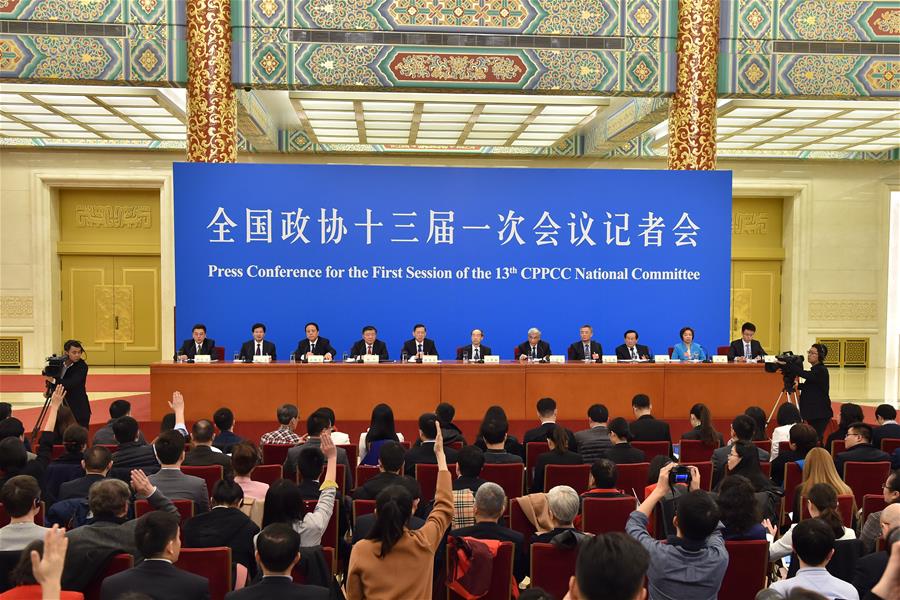
A chance was offered Tuesday as the parties' leaders came to a press conference to introduce how their organizations have effectively participated in China's system of multiparty cooperation and political consultation, and made contributions to the modernization drive of the country.
The press conference was held on the sidelines of the ongoing first session of the 13th National Committee of the Chinese People's Political Consultative Conference (CPPCC), the top political advisory body, many of whose members are from the parties.
WHO THEY ARE
-- The Revolutionary Committee of the Chinese Kuomintang (RCCK) was founded in 1948 in Hong Kong.
-- The China Democratic League (CDL), founded in 1941, mainly consists of intellectuals working in the fields of culture, education, science, and technology.
-- The China National Democratic Construction Association (CNDCA), founded in 1945, mainly consists of patriotic industrialists, business people, and intellectuals.
-- The China Association for Promoting Democracy (CAPD), founded in 1945, mainly consists of intellectuals working in the fields of culture, education, publishing, and science.
-- The Chinese Peasants and Workers Democratic Party (CPWDP), founded in 1930, mainly consists of leading intellectuals in the fields of health care, population resources, and ecological protection.
-- The China Zhi Gong Party, founded in 1925, mainly consists of overseas Chinese who have returned to the mainland, relatives of nationals living abroad as well as those with close connections with overseas Chinese.
-- The Jiusan Society, founded in 1945, mainly consists of senior and mid-level intellectuals engaged in science, technology, culture, education, medical and health work.
-- The Taiwan Democratic Self-Government League, founded in 1947, mainly consists of Taiwanese living in the mainland.
HOW IT WORKS
The leaders shared the highlights of their participation in political consultation, deliberation of state affairs, and democratic supervision.
A considerable number of members of the non-communist parties are deputies to the National People's Congress or members of the National Committee of the CPPCC, able to participate in the country's top-level legislative affairs or political consultations.
The non-communist parties have also launched a series of supervisory investigations on issues such as health care, education, regional economic integration, and poverty reduction.
The investigation reports often go directly to the Communist Party of China (CPC) Central Committee or the State Council and many helped in formulating policies and laws, according to Wan Exiang, chairperson of the RCCK Central Committee.
NEW TYPE OF PARTY SYSTEM
President Xi Jinping shared his understanding of China's party system while attending a joint panel discussion with political advisors on Sunday.
The system of multiparty cooperation and political consultation led by the CPC is "a new type of party system growing from China's soil," said Xi, also general secretary of the CPC Central Committee and chairman of the Central Military Commission.
The Chinese system is new, because it unites all political parties and people without party affiliation toward a common goal, effectively preventing the flaws of the absence of oversight in one-party rule, or power rotation and nasty competition among multiple political parties, according to Xi.
When asked to comment on Xi's words, Hao Mingjin, head of the CNDCA Central Committee, said China's party system has unique creative elements with Chinese characteristics.
The new system had offered a Chinese approach and Chinese wisdom to the development of party politics around the world, said Hao.
Ding Zhongli, chairperson of the CDL Central Committee and vice president of the Chinese Academy of Sciences (CAS), also summarized the differences between China's multiparty cooperation system, and the one-party system or competitive multiparty politics in other countries.






- Guangdong urged to drive high-quality development
- Shanghai hosts 6th intl 3E talent fair
- Xi's special envoy attends inauguration of Bolivian president
- Countdown to 15th National Games: On-site warm-up entertains audience
- Eight missing after cargo ship collides with fishing vessel near Shandong
- Investing in people: a worthwhile investment