Abe's visit helps renormalize Sino-Japanese relation







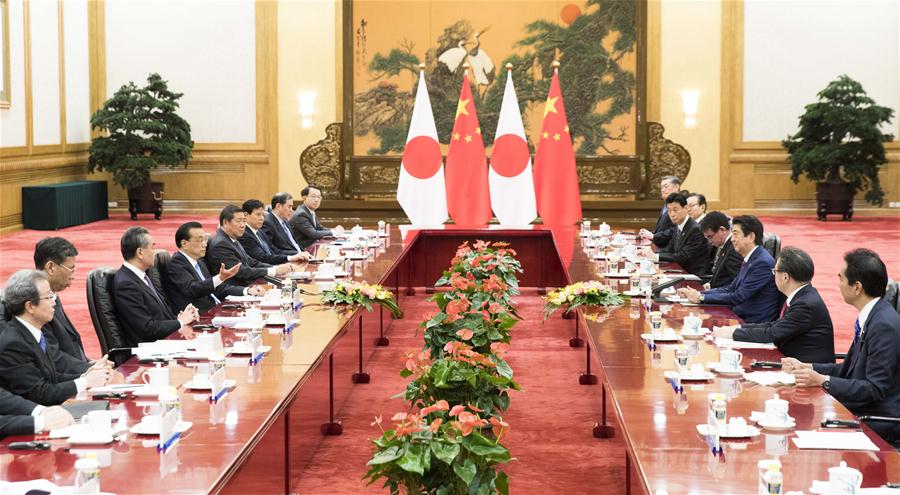
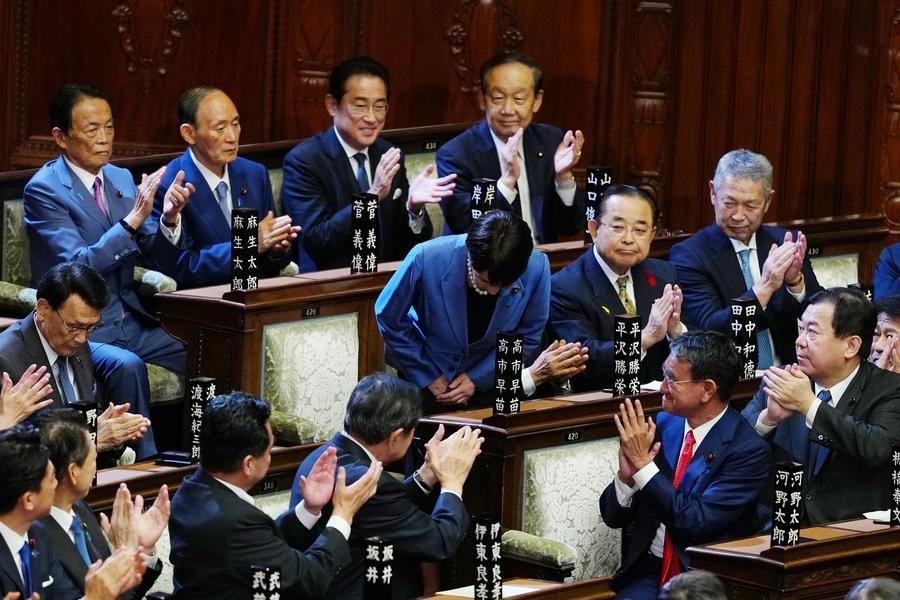
Accompanied by a 500 strong delegation of business leaders, the Japanese Prime Minister Shinzo Abe visited Beijing from October 24-27, 2018, aiming to renormalize the relationship between China and Japan. It was his formal visit to China after starting the new term as prime minister. The timing of his visit coincided with the 40th anniversary of China's reform and opening-up policy and the signing of the China-Japan Treaty of Peace and Friendship. During his visit, he met President Xi Jinping and Premier Li Keqiang, attended the celebration of the peace and friendship treaty as well as the first investment forum of collaboration in third countries.
Abe was elected as Japan's 90th prime minister in 2006 but was forced to resign in the following year. He was re-elected in 2012, becoming Japan's second politician to have done so. In the same year, a Sino-Japanese foreign relation crisis erupted due to Japan's claim on the territorial right of the Diaoyu Islands, and in the next years, the two countries confronted each other with hostility and distrust arising from the sensitive territorial issue as well as the painful memory of the Sino-Japanese war.
During the meeting, Abe was warmly welcomed by Xi and their discussion led to some positive results for both countries. Xi said that Abe's visit was helpful for renormalization, charting an appropriate course for bilateral cooperation, including China's Belt and Road Initiative (BRI). Abe indicated that the BRI had a great potential of development, including third-party collaboration.
The bilateral relation between China and Japan is strategically important for both countries. China is the largest trading partner of Japan, and the latter is the second-largest trading partner of the former. In 2017, the volume of bilateral trade was about $300 billion, recovering strongly from the downward trend. Japan is also one of China's largest investors. Japanese total investment stock in China was more than $100 billion by the end of 2017. More than 30,000 Japanese companies operate in China. In 2017, Japanese investment into China amounted to more than $3 billion, up by 5.1 percent from the previous year. In the first three quarters of 2018, bilateral trade and investment between the two countries continued to grow strongly, reflecting the "re-normalization" of the Sino-Japan relation.
In the new century, China has emerged as the world's second-largest economy, replacing Japan. Close geographical distance and natural complementary between China and Japan imply that the former is inevitably a top choice for the latter to expand its export and investment opportunities. More importantly, a better Sino-Japanese relation can bring about peace as well as common prosperity not only for the world's second and third largest economies but also for the entire Asia-Pacific.
China and Japan not only have common interests, but also have strong trade and technological complementarities which could be further exploited to generate huge mutual benefits. Their common interests are reflected by the need for trade expansion and more investment opportunities to maintain steady economic growth and improve the livelihood of people through wealth and job creation. The trade and technological complementarities between China and Japan suggest that the two countries could change their relationship from that of confrontation and competition to that of cooperation, allowing more bilateral flows of commodities and capital so that additional wealth and jobs could be created for the good of both parties.
However, before mutual benefits can be fully exploited, China and Japan need to regain mutual trust for long-term peace and friendship, to remove or reduce the differences in the painful past-history and ideology, and to build a constructive bilateral relationship. This is no easy task, but Abe's visit in Beijing turned out to have achieved some remarkable results. China and Japan signed a new agreement of currency swap amounting to 200 billion RMB which is 10 times as large as that in the first agreement made in 2002. They also agreed to cooperate in many major investment projects to support the BRI, including an urban development project in Thailand and a wind-power project in Germany. Some other agreements were also signed relating to bilateral cooperation in the areas of finance, stock market development, etc.
Yao Shujie is a professor of Economics at the Chongqing University and the University of Nottingham Ningbo China.