There's no turning back for Chinese women







Real estate developer Yang Huiyan is the richest woman in China, with a 150 billion yuan ($21.50 billion) net worth. Liu Yang went where no Chinese woman had ever been — space. Tu Youyou wrote history by becoming the first woman in China to win the Nobel Prize.
To understand and appreciate the achievements of these and millions of other Chinese women, we need to step back a little. Just seven decades ago, when Tu was well into her teens, 90 percent of women in the country could not read or write. At that time, women only did household chores and took care of babies. They had no access to education, no career opportunities and the concept of gender equality did not exist. Marriages were arranged by parents and women were stuck with their husbands for life, as divorce was next to impossible. A widow was supposed to spend the rest of her life with her in-laws, as remarriage was unthinkable.
But these practices underwent a drastic change after the Communist Party of China established the People's Republic of China in 1949. Less than a year later, the Marriage Law of 1950 was promulgated to promote marriage freedom and gender equality and protect women's interests. This was a landmark move, as it did away with bigamy, child betrothal and interference with remarriage of widows. This law was the first step in moving toward gender equality.
Slowly women started stepping out of the shadows. They began to see more job opportunities, enrollment in schools and colleges went up, they began to have a bigger say in choosing their life partner, divorces and remarriages were no longer taboo and for the first time in centuries their status in society started to improve.
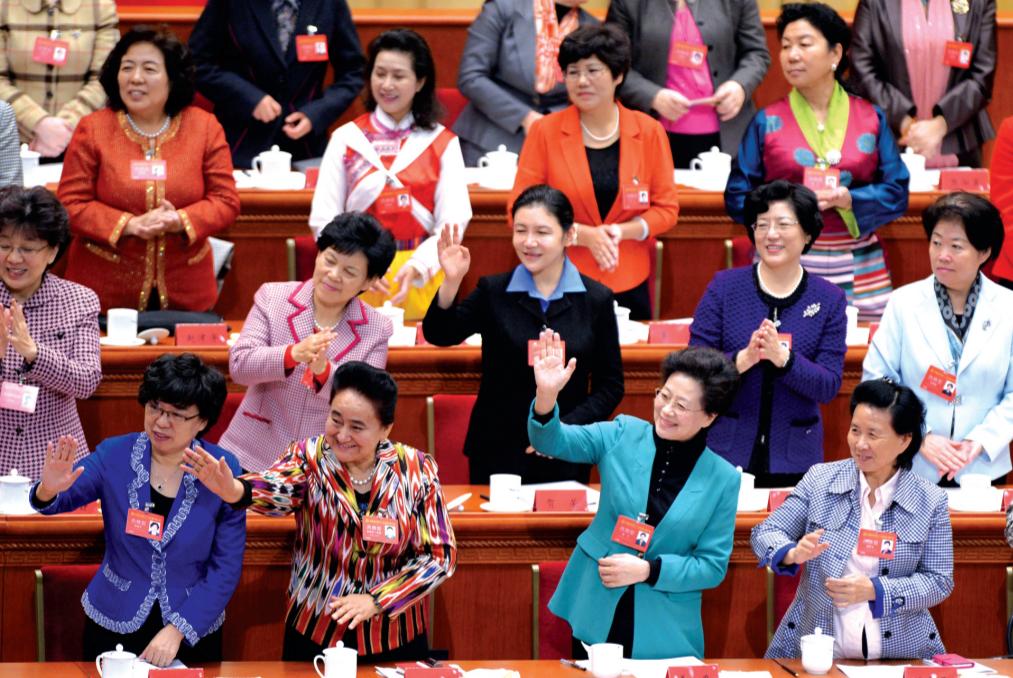
As the All-China Women's Federation wraps up its 12th National Women's Congress, the organization's top governing body, there's a lot to celebrate.
Today, there are more female than male students in colleges and schools. In 2016, there were more female postgraduates — over 100 million — than male postgraduates. The adult female illiteracy rate has dropped below 7 percent, and almost 100 percent of girls attend primary school. The average life expectancy of women has risen to 79.43 years, and the maternal mortality rate has fallen from 30 per 100,000 in 2010 to 19.6 in 2017. More than 43 percent of the nation's workforce is female. Over half of all online businesses are founded by women and women constitute over one quarter of total entrepreneurs in the country. There is no single field where women are not making a mark, be it flying fighter jets, winning Olympic medals or directing movies.
Six or seven decades is a miniscule time in the history of a country, especially for a civilization as old as China. So the progress Chinese women have achieved in such a short period is remarkable. But there's still a long way to go. Although attitudes have changed, families still prefer boys and spend more on their education than on girls'. Women, even those working in highly specialized fields in big cities, continue to face constant pressure to get married. And while they outnumber male university students, their number is nowhere near their male counterparts in subjects such as science, technology, engineering and math. There still exists a huge gap when it comes to salary or promotion of women to top positions.
However this does not mean there's nothing to celebrate. In the past seven decades, women have covered a lot of ground in China and now there's no turning back. There are and will remain obstacles, but don't be surprised if Chinese women set new benchmarks in gender equality in the next 70 years. They might go from "holding up half the sky," as Mao Zedong said, to holding up most of it.
The author is a journalist with more than 18 years experience in media.