Experts note progress in fighting graft







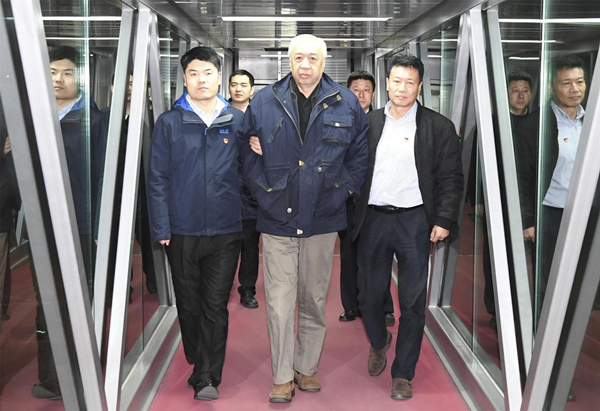
Attitude of 'long-term deterrence' has taken hold to nip corruption in the bud
China has made great progress in curbing graft among high-ranking officials, and it will attach more attention to uncovering crimes in the fields of poverty relief, pollution control and fighting mafia-like gangs to avoid corruption at the grassroots, according to experts.
Since the 19th National Congress of the Communist Party of China was held in Beijing in October 2017, those three sectors have emerged as the country's three biggest battles, said Zhuang Deshui, deputy director at the integrity-building research center of Peking University.
Data released by the Central Commission for Discipline Inspection show that the CCDI and National Supervisory Commission jointly handled 44 cases involving corruption in the poverty relief sector last year.
In addition, they publicized six graft examples involving ecological protection that involved 55 county or bureau-level Party officers, including polluting Dongting Lake in Central China's Hunan province. People involved in five of the corruption cases were found to be serving as "protective umbrellas" for organized gangs.
"Corruption in those areas has seriously violated the people's vital interests and happy life, and is posing a serious threat to public security," Zhuang said. "Disciplinary officers should be cautious and take effective measures to handle them."
Since last year, China's fight against corruption has won an "overwhelming victory and multiple reforms are helping to reduce and prevent graft at its source", said Song Wei, a law professor at University of Science and Technology Beijing.
Last year, 23 ministerial-or provincial-level officials were investigated for alleged graft by both the CCDI and the National Supervisory Commission, a year-on-year increase of 22 percent, the CCDI said.
Of the 23 who were investigated, 15 corrupt officials were referred to prosecuting departments for criminal charges, including Ai Wenli, a former senior political adviser in Hebei province; Zhang Shaochun, former vice-minister of the Ministry of Finance; and Pu Bo, former vice-governor of Guizhou province.
Moreover, 354 senior officials in the provinces were probed for serious violations of Party discipline and laws last year, an increase of 10 percent over 2017, it said.
"From the figure, we can see that central authorities have not loosened their efforts and are maintaining high pressure against corruption," Song said. "They will concentrate resources to target corruption, especially when supervisory commissions are established across the country."
Zhuang added: "We have really adopted long-term deterrence and a zero-tolerance attitude toward corruption, and there is no sign of any relaxation. This not only shows the country's resolute determination to combat corruption but has boosted people's confidence to achieve financial success."
According to the CCDI, more than 80 percent of the investigated high-ranking officials violated Party political and organizational discipline, and they resisted their supervisors and didn't truthfully report their personal matters, such as marriage and property. Some of them were involved with election scandals or resorted to bribery to get promotions, Zhuang said.
They also violated the Party's eight frugality standards in accepting banquets in luxury clubs, games of golf or tourism arrangements. For example, Feng Xinzhu, former vice-governor of Shaanxi province, accepted a private manager's entertainment for a lengthy period.
More than 76 percent of the senior corrupt officials probed were suspected of abusing power and engaging in corrupt activities such as bribery. They used the convenience of their job to gain benefits for their families or other enterprises and individuals, then accepted huge bribes, paid in cash or property, in return. For example, Li Yihuang, former vice-governor of Jiangxi province, abused power to benefit others in business management, then accepted bribes from them.
"Apart from combating corruption, we should place more emphasis on educating Party members to be loyal to the Party and its people, have correct political beliefs and establish a correct outlook on life and values," said Jiang Laiyong, a senior researcher at the Chinese Academy of Social Sciences.
With the acceleration of legislation, such as the International Criminal Justice Assistance Act-which opens new channels for nabbing corrupt fugitives and confiscating their assets-and the Party's revised Discipline Punishment Regulation, disciplinary officers will use more standardized methods to cope with corruption, Jiang added.



- Guangdong urged to drive high-quality development
- Shanghai hosts 6th intl 3E talent fair
- Xi's special envoy attends inauguration of Bolivian president
- Countdown to 15th National Games: On-site warm-up entertains audience
- Eight missing after cargo ship collides with fishing vessel near Shandong
- Investing in people: a worthwhile investment