Party-led progress behind China's impressive achievements







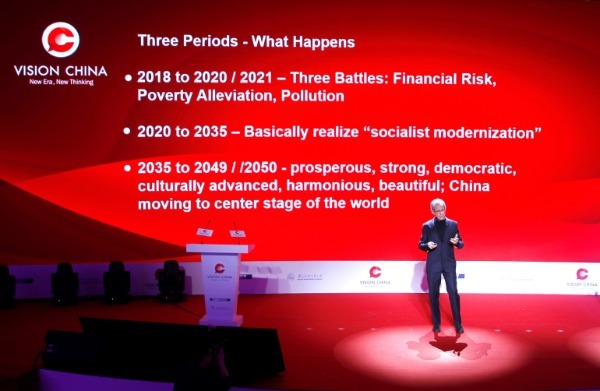
Innovation and change
The Party-led system involving effective feedback mechanisms in turn can help fuel innovation and improvement, Kuhn says.
"There is this constant desire to make changes by getting real-time monitoring of results. For example, the Chinese government uses scientific polling to get a sense of what people think. So, even though there are no elections in the Western sense, there's a good deal of feedback from different constituencies. For example, when officials are nominated to new positions, there's often a period of time for feedback from his or her colleagues, subordinates and bosses in an organized way.
"And when new policies are considered, scientific polling assesses opinions and attitudes of those who would be affected.
"Moreover, the work reports of Party leadership at Party congresses every five years, and the work reports of the government at the National People's Congress each year, reflect a great deal of input and suggestions from all relevant officials, experts and constituencies.
"These work reports are not just something top leadership and their teams put together. No, they are drafted by many teams, and feedback and opinions are solicited from numerous officials and experts; the documents circulate many times during the six to eight months or more of the drafting period," he says.
"These work reports are exceedingly important in the Chinese system; for the government, they assess the achievements of the past year and set the plan for the next year; for the Party, it's the past five years and next five years, respectively.
"So there is this intricate and extensive feedback between experts and officials over many months, plus various in-field research and polling.
"Understanding the process of drafting the work reports of the Party and the government is a good way to understand how China's system works. If one simply states that China is a 'perpetual Party-led government', it sounds rigid and aloof. In fact, the drafting of the work reports tells a different story," Kuhn says.
"When one sees how the Party operates, including this monitoring, this polling, this feedback, one begins to see how the Party implements change based upon the real world."
While China's success is based on Party-led principles rooted in China's conditions and culture, this same approach may not be directly applicable to other countries, he says.
"There's always a danger in transporting social strategies, social programs, that work in one place into another place. That's true even within the same country, within the same culture, and such 'copy-and-paste' application gets much more complex, and riskier, when transporting systems from one country to another country and from one culture to another culture.
"Each country is, as we say, sui generis, one of a kind. China has its own particular kinds of uniqueness. Its huge population is the obvious one," Kuhn says.
"Here are the driving principles that China has used, as the largest population on Earth has sustained the greatest economic development in history: consistent political leadership; strong top-down government with hierarchical governance from central to local; willingness to reform and open up; recognition that change is inevitable and change is catalyzed by facts from feedback; mobilization of national resolve and resources; and a large population prepared to work hard and long. All these are key characteristics of the Chinese system."


- Guangdong urged to drive high-quality development
- Shanghai hosts 6th intl 3E talent fair
- Xi's special envoy attends inauguration of Bolivian president
- Countdown to 15th National Games: On-site warm-up entertains audience
- Eight missing after cargo ship collides with fishing vessel near Shandong
- Investing in people: a worthwhile investment