Dutiful rethink







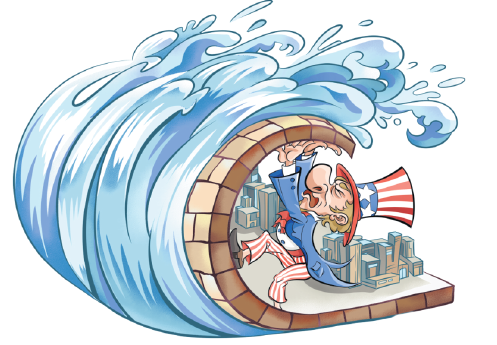
Substantial reduction of bilateral tariffs between China and the US would help stabilize the global supply chains
Federal Reserve Chairman Jerome Powell made it clear that it was probably time to retire the word "transitory" when describing inflation at a Senate Banking Committee hearing in Washington on Nov 30, saying that inflation has been more persistent and higher than expected. On Dec 2, US Treasury Secretary Janet Yellen said at the Reuters Next conference that the tariffs of up to 25 percent on hundreds of billions of dollars worth of annual imports from China are contributing to the higher prices in the United States.
Of course, Yellen's criticism does not necessarily mean that the US is going to remove all the tariffs on imported goods from China. In fact, it is still difficult to do so. Yellen's criticism from the perspective of US consumer interests may simply be intended to use the tariffs as an excuse and explanation for the US government's current inflationary pressures, as the current level of inflation has, to some extent, affected the approval rating of US President Joe Biden.
In fact, in the current political environment, where there is a bipartisan consensus that China is a strategic competitor of the US, any weakness in policy toward China is politically harmful.
Political opponents, including Republican lawmakers, have begun scrutinizing statements from Biden's team, ready to pounce on any effort to roll back the Donald Trump-era punitive tariffs and technology export controls. Earlier this year, new US trade representative Katherine Tai made it clear that the US is not ready to abolish tariffs on China.
At the same time, the administration probably wants to maintain the tariffs so that they can be used as leverage for any forthcoming economic and trade negotiations with China. Even advocates of free trade within the US, such as former US treasury secretary Hank Paulson, while calling on the Biden administration to cut tariffs on China, also believe that tariff cuts should be in exchange for Chinese concessions on subsidies, State-owned enterprises and other structural reforms. In an exclusive interview with the Wall Street Journal, Tai implied support for the above strategy with China and said that "good negotiators hold onto their leverage and use it".
The priorities for the Biden administration are to maintain US leadership in key technologies and to ensure the country's supply chain security. During his election campaign, Biden himself explicitly opposed the use of tariffs to solve the economic imbalance between China and the US, but he retracted his statement under political pressure. Various policy orientations since Biden took office suggest that tariff measures are not the policy thrust of the current US administration.
But the feasibility of lowering some tariffs on China and forming a positive interaction does exist, as high inflation in the US persists and its monetary policy is in a dilemma. The rebound in the US economy is not yet solid. At the same time, with the strong support of personal assistance policies, the US labor force participation rate is significantly low. In this context, reducing some of the tariffs on China has become an option available to the US government. Broadly speaking, it could reduce the US inflation rate by about 0.5 percentage point.
There is plenty of room for US policy to lower some tariffs on China. Up to now, the US still retains additional tariffs on $370 billion of imported Chinese goods, including 25 percent on List 1($34 billion), List 2($16 billion) and List 3($200 billion), and 7.5 percent tariffs on List 4A($120 billion).Although the Office of the US Trade Representative revived the tariff exclusion process on Nov 5, the policy extent is very limited, and unlikely to substantially lower the tariffs on China.
Our research finds that List 3 and List 4A have substantially lower exclusion rates compared to List 1 and List 2. The approval rates for List 1, 2, 3, and 4A exclusion requests were 33.8 percent, 37.4 percent, 4.9 percent, and 6.5 percent respectively. The reason for this is that the goods in Lists 1 and List 2, such as electronic components, automobile parts and instruments, have relatively complex production technologies and supply chains, and it is hard to find substitutes in a short period of time; while the goods in Lists 3 and List 4A, such as leather products, apparel, and shoes, have relatively simple supply chains, and it is easier to find substitutes.
The US is most likely to remove tariffs on Lists 3 and 4A first, as these involve a wide range of daily necessities such as clothing and shoes, which are more harmful to the welfare of US consumers. The possibility of the US fully eliminating tariffs on List 1 and List 2 is relatively low, as these are designed more for strategic competition with China.
In general, China and the US can consider reciprocal tariff reductions to promote positive interaction in bilateral economic and trade relations. Against the backdrop of the pandemic, global supply chains are currently facing unprecedented uncertainty. Any shocks will put more pressure on the tight supply chains. Given the uncertainties, stagflation may further squeeze the US monetary policy space. China and the US should form a consensus to strengthen cooperation to maintain global supply chains and collaborate to stabilize expectations and reinforce the shock-resistance of the global supply chains. A substantial reduction of bilateral tariffs between China and the US would help reduce the costs in the global supply chains, thus accelerating the relief of inflation.
The author is an assistant research fellow of the Institute of World Economics and Politics at the Chinese Academy of Social Sciences. The author contributed this article to China Watch, a think tank powered by China Daily. The views do not necessarily reflect those of China Daily.