How the Central Revolutionary Base developed over the years







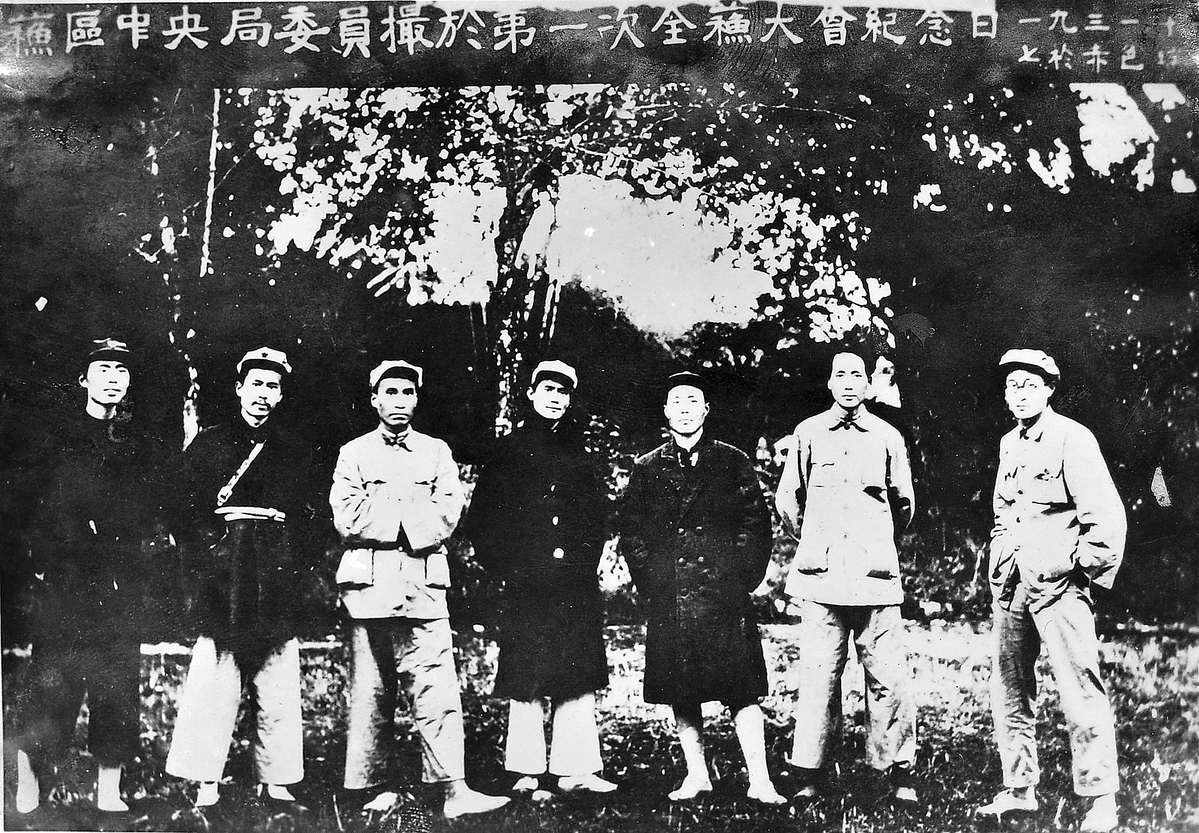
The Central Revolutionary Base, which is centered around Ruijin county in Jiangxi province, mostly covers areas in present-day southern Jiangxi, western Fujian and northeastern Guangdong provinces.
Dubbed the "Cradle of the People's Republic", the base was created by Communist Party of China figures who would become the founding fathers of the People's Republic of China, among them Mao Zedong (1893-1976), Zhou Enlai (1898-1976) and Zhu De (1886-1976).
On Aug 1, 1927, the CPC led the Nanchang Uprising, its first military resistance against the reactionaries of the Kuomintang Party, who purged CPC members during their alliance. The troops, led by Zhu, eventually joined forces with troops led by Mao in Jinggangshan, western Jiangxi, in April 1928, forming the Fourth Red Army, the core force of the CPC-led military power.
Mao and Zhu led the army through southern Jiangxi and western Fujian in early 1929, recruiting soldiers from various CPC-led uprisings along the way. After two years of battle in Jiangxi, Fujian and Hunan provinces, the West Fujian and South Jiangxi revolutionary bases were established as the Central Revolutionary Base began to take shape.
After smashing encircling and suppressing military operations by the KMT three times in 1930 and 1931 and linking revolutionary bases in southern, southwestern Jiangxi and western Fujian, the CPC convened the First Soviet Congress in Ruijin from Nov 7 to 20 in 1931.
It led to the declaration of the Provisional Central Government of the Chinese Soviet Republic, a milestone that signified the official establishment of the Central Revolutionary Base.
The outline for a constitution was drafted, and laws and policies on land, labor and economics were promulgated. Mao was elected chairman of the central executive committee, and Zhu was named chairman of the central revolutionary military commission.
The base experienced its heyday after military victories in 1932 and early 1933, when the KMT's fourth attempt to encircle and suppress was thwarted.
Including about a dozen smaller revolutionary bases controlled by the CPC, at its peak, the CSR covered some 400,000 square kilometers and was home to about 30 million people, with the Central Revolutionary Base accounting for about one-fifth of the territory and one-seventh of the population, according to the Ruijin Central Revolutionary Base Memorial.
The CPC carried out explorations in governance, including land redistribution, government and military structure, agricultural production and finance, and achieved initial success.
However, as dogmatic "Leftist" leaders pursued an offensive policy and handed over command of the Red Army to Communist International military adviser Otto Braun (1900-74), known as Li De in Chinese, who had little practical understanding of China, the CPC failed to stop the KMT's fifth encirclement campaign, which began in September 1933.
As the situation worsened in 1934, the leaders of the Red Army decided to make a strategic shift. In October 1934, the central government of the CSR, along with core forces from the Red Army, began what was later known as the Long March, which ended successfully in Northwest China in 1936.
A small fraction of CPC-led forces stayed at the Central Revolutionary Base and began a three-year guerrilla war. Supported by local people, they survived extreme conditions and kept the resistance against KMT troops going.
In December 1936, as KMT leader Chiang Kai-shek (1887-1975) repeatedly refused to stop attempts to eliminate CPC forces despite an increasingly aggressive Japanese invasion, KMT generals Yang Hucheng (1893-1949) and Zhang Xueliang (1901-2001) took Chiang hostage to force him to work with the CPC and fight the invaders. The CPC played an important role in settling the incident peacefully, and the formation of a second KMT-CPC alliance became irresistible.
After agreements were signed by the CPC and the KMT, the CSR was formally reorganized as a special administrative area of the Republic of China in September 1937. In October, CPC-led guerrilla forces in southern China, including those in the former Central Revolutionary Base, emerged from their hill hideouts and were reorganized as the New Fourth Army. China eventually won the War of Resistance Against Japanese Aggression in 1945.
With the help of the people, the CPC-led People's Liberation Army successfully beat the KMT in the War of Liberation (1946-49). Ruijin, once capital of the CSR, was liberated on Aug 23, 1949.


- Guangdong urged to drive high-quality development
- Shanghai hosts 6th intl 3E talent fair
- Xi's special envoy attends inauguration of Bolivian president
- Countdown to 15th National Games: On-site warm-up entertains audience
- Eight missing after cargo ship collides with fishing vessel near Shandong
- Investing in people: a worthwhile investment