Better regulation key to healthy development of pet industry







Editor's note: More than four decades of reform and opening-up have not only turned China into the world's second-biggest economy but also changed Chinese people's lifestyle. A veteran journalist with China Daily tries to analyze the changes in people's attitude toward pets.
There are more than 100 million pets in China, with about 60 percent of them being dogs and the rest mostly cats, according to a report issued last year. But I believe the reported figures are lower because I know that some dog-owners do not register their pets as required by law and it is not mandatory to register cats as pets.
Counting the dozen-odd deserted pets in my community that are unlikely to be included in the official data, we can assume that the numbers of dogs and cats must be a lot more than the registered figures. But thanks to the animal lovers who provide food and water for abandoned pets, most of the homeless animals seem to be in good condition.
Dogs and cats used to be raised as house guards and to catch mice. When I was young, few Chinese families had pets because people themselves could not get enough food to eat. As a child, I rarely heard dogs barking while cats had to depend on their mouse-catching skills to be part of a household.
The Chinese people started keeping dogs and cats as pets on a large scale more than two decades ago when they had more money to spare. Different breeds of dogs and cats were introduced to China, with some costing as much as 500,000 yuan ($74,930) each.
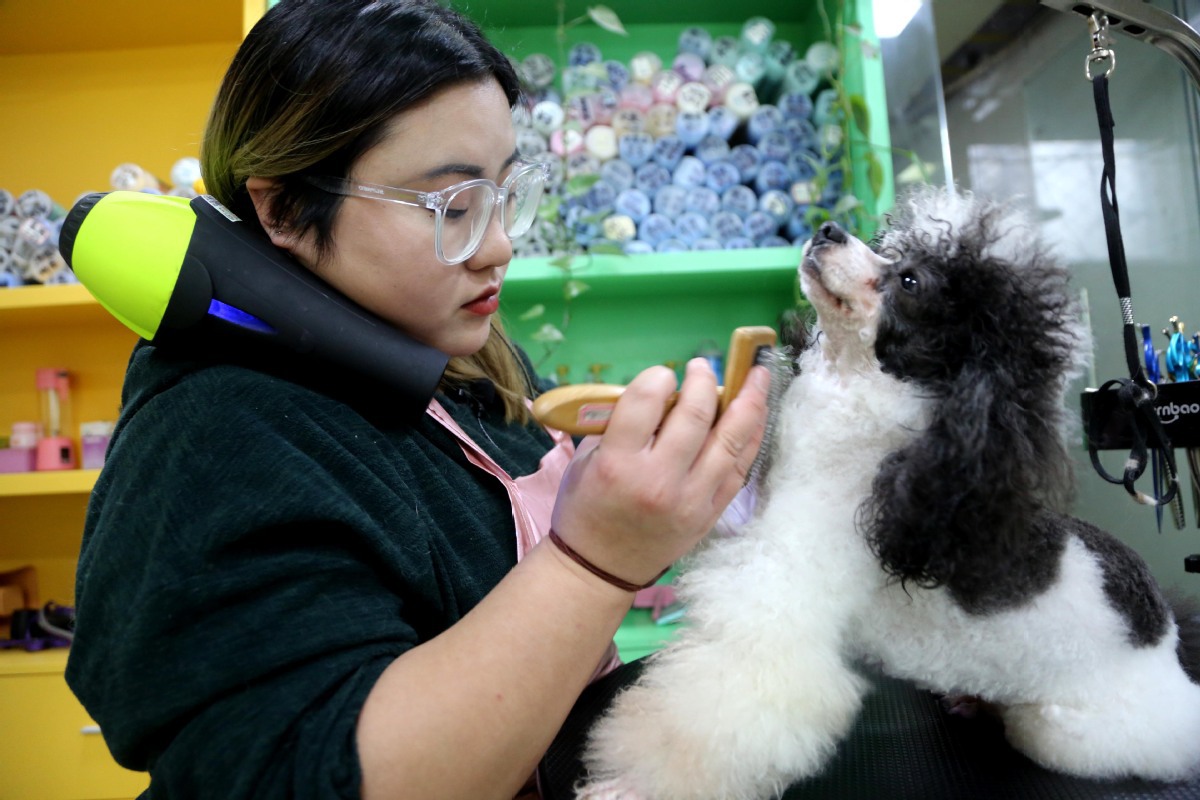
Foreign-invested factories have been set up to produce special food and toys for pets. And the pet clinics (and saloons) that have mushroomed enjoy booming business even though their medical bills could be much higher than hospitals providing medical services to humans.
Retired people keep pets for company to overcome their loneliness, while the dogs and cats young couples keep act as companions to their single child. So don't be surprised to overhear old women talking about "my little baby" in community squares, for what they mean are not their middle-aged sons or daughters but their pet dogs and cats.
The rising number of pets have created a prosperous industry-the industry grew on average 20 percent a year between 2010 and 2020, faster than most other sectors. According to industry insiders, the scale of the pet industry will be worth 445 billion yuan by the end of next year, with some observers saying the sector still has much room for growth, because only about 17 percent of Chinese families have pets while the ratio is 67 percent in the United States and 62 percent in Australia.
But the two- to three-fold increase in the number of pets could create serious problems if the existing challenges are not addressed and regulations not strictly implemented.
Dog droppings on pavements are already a big problem in many localities. Although dog-owners are required to clean the droppings of their pets, many ignore it. While dogs larger than a certain size are not allowed to be kept as pets in urban areas, people can be seen walking large, unregistered dogs on the streets, perhaps because the high cost of enforcing the regulations prevents officials from taking strict action against such "minor cases".
Also, dog attacks are frequently reported and dog barking has become a prime reason for disputes among neighbors. And many people abandon their pets for various reasons, with no authentic data on how many pets have been deserted by their owners.
The above problems call for better control of the pet industry. Regulations related to pets should be reviewed with the aim of better protecting the rights and interests of non-pet owners. And stricter rules should be implemented to ensure that not only all dogs but also cats are registered, and prevent people from abandoning their pets at will, while the registration fees should be raised to increase the government revenue, so more people can be recruited to enforce the pet-related regulations.
The higher revenue could also be used to build pet relief centers for the abandoned animals. Pets that give people comfort deserve better treatment.
The author is former deputy editor-in-chief of China Daily.
If you have a specific expertise, or would like to share your thought about our stories, then send us your writings at opinion@chinadaily.com.cn, and comment@chinadaily.com.cn.