US biofuel quest behind food shortage







The COVID-19 pandemic and the Russia-Ukraine conflict have raised fears over global food security, despite global grain production continuously rising over the past two decades. Corn is widely cultivated throughout the world, and a greater weight of corn is produced each year than any other grain, with its production growing on average 3.5 percent a year since 2000 to reach a record 1.2 billion metric tons in 2021.
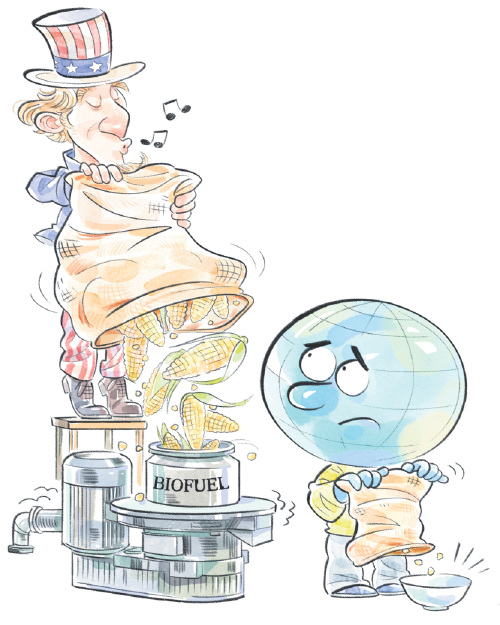
However, the world has faced two food crises since 2000, and is staring at a third, partly because the use of corn to produce biofuel has pushed up grain prices. With the fast expansion of the biofuel industry, the United States has become the world's largest corn-biofuel consumer. Over the past decade, about 40 percent of the US' total corn production has been used to make biofuel. In fact, the US' use of corn to make biofuel exceeds Africa's total corn consumption as food.
The world faced the first food crisis from 2005 to 2008. In March 2008, the global crop price index rose to 163.3-1.7 times higher than in early 2005. While rice prices nearly tripled between 2005 and 2008, wheat, corn and soybean prices rose by more than 40 percent. The dramatic rise in food prices coincided with the first wave of expansion of the biofuel industry in the US. In 2005, the then US president George W. Bush signed the Energy Policy Act, which mandates the mixed use of biofuels including bioethanol and biodiesel with gasoline.
In 2006, the US administration announced additional funding to support research and development in biofuel, and in 2007, it passed the Energy Independence and Security Act to strengthen US energy security.
Thanks to favorable government policies, the US' biofuel industry has been growing rapidly since 2005. According to the US Department of Agriculture, in 2005, domestic biofuel production was 3.9 billion gallons, with 40.72 million tons of corn-14.4 percent of the US' total corn production-used for biofuel production.
In 2007, US biofuel production increased to 10.9 billion gallons, nearly three times that of 2005, and the use of corn to produce biofuel reached 94.21 million tons, accounting for 30.8 percent of the US' total corn production. Even after the record rise in global food prices in 2008, the production of corn-biofuel in the US continued to increase, exceeding 117 million tons in 2009. Overall, from 2000 to 2009, the use of corn to produce biofuel rose by 24.7 percent a year on average.
In fact, a study by Renmin University of China shows that at least 30 percent of the food price increase between 2005 and 2008 was due to the expansion of the global biofuel industry, especially in the US.
The second global food crisis in 2010-12 again was caused by the increasing use of corn to make biofuel in the US. Global food prices shot through the roof again in 2012, with soybean and corn prices rising by over 50 percent, and the amount of corn used to make biofuel in the US reaching 127 million tons in 2010, or 40.4 percent of the US' total corn production. This means the US used more than 15 percent of the total global corn production in 2010 to make biofuel, which was more than twice the amount of corn consumed as food in North Africa and sub-Saharan Africa. In 2012, the percentage of US corn used to produce biofuel reached 43.2 percent.
Many studies show the use of corn to make biofuel in the US is a main cause of rising global food prices, which could lead to a global food crisis. Yet during the second global food crisis, large US food companies such as Cargill, Bunge, Archer Daniels Midland expanded their biofuel business through mergers and acquisitions, and investments while consuming more than 40 percent of corn produced in the US.
In the second half of 2020, global grain prices began rising again, with wheat prices hitting a record high, and soybean and corn prices approaching record highs. An increasing number of people across the globe face hunger due to skyrocketing food prices thanks to the US' increasing use of corn to produce biofuel. According to the USDA, the US produced 45 million tons of biofuel in 2021, up 8 percent year-on-year.
Assuming three tons of corn is needed to produce one ton of biofuel, the US used 135 million tons of corn for biofuel production in 2021, which is more than the amount of corn (112 million tons) consumed by 1.39 billion people in Africa as food. In the first quarter of this year, the US used 34 million tons of corn to produce biofuel, which is equivalent to the amount of corn consumed as food by the whole of Africa in four months.
Despite the world facing a food crisis, the US administration has announced new subsidies for biofuel production. On April 12, US President Joe Biden announced emergency waivers to spur biofuel production, which further raised global food prices.
On June 3, the USDA announced $700 million worth of subsidies to support biofuel producers. And as part of the efforts to strengthen the Renewable Fuel Standard, the US Environmental Protection Agency recently set the corn-biofuel mandate at a record 15.25 billion gallons. These moves may benefit biofuel producers in the US, but will further raise global food prices.
In the face of an imminent global food crisis, the US' move to use more and more corn to make biofuel is not only selfish but also harmful to the rest of the world, especially the developing countries. The US and some other advanced economies have repeatedly used their monopoly in the agriculture sector to manipulate global food prices and make huge profits at the cost of people's lives in developing countries.
As a member of the international community, therefore, the US should stop using corn to boost biofuel production-instead of accusing other countries of hoarding food grains-for it will intensify global food shortages and hunger.
The author is with the School of Agricultural Economics and Rural Development, Renmin University of China.
The views don't necessarily reflect those of China Daily.
If you have a specific expertise, or would like to share your thought about our stories, then send us your writings at opinion@chinadaily.com.cn, and comment@chinadaily.com.cn.