Moves to prevent people slipping back into poverty







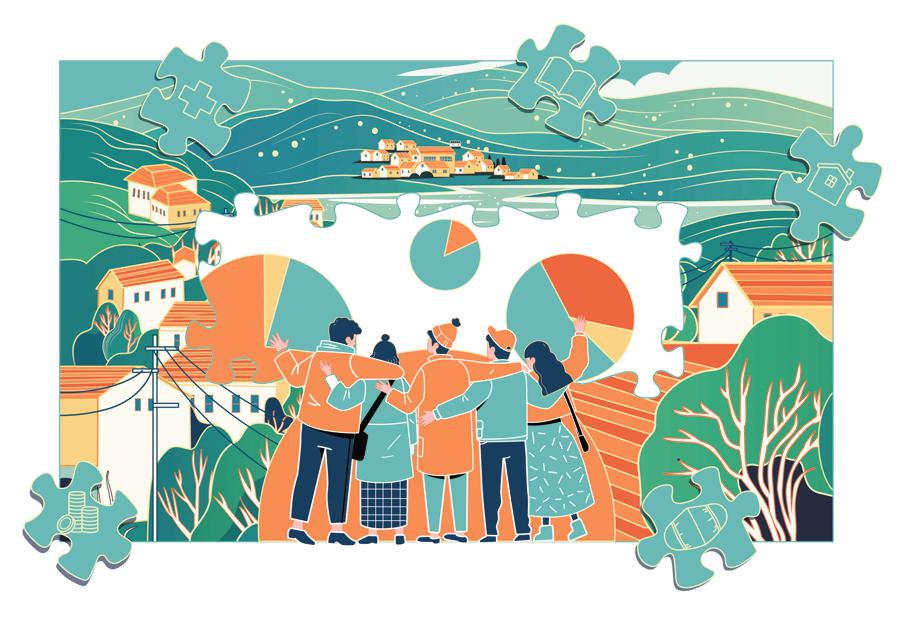
The Communist Party of China has developed a better understanding of the prevailing trend while prioritizing the eradication of poverty as a principal task of governance after the 18th National Congress of the CPC in 2012. The CPC united and led the Chinese people in winning the biggest battle against poverty in human history, and solving the problem of poverty that had plagued the Chinese nation for several thousands of years.
Yet China will need more time to eliminate relative poverty even though it has eradicated absolute poverty in the shortest period of time.
In fact, despite being the world's largest developing country, China is still in the primary stage of socialism, facing unbalanced and inadequate development. Although it is possible for those who have emerged out of poverty to slip back into poverty, China will constantly monitor their socioeconomic condition and take industrial, fiscal and financial measures, and pair assistance policies to make sure that does not happen again.
Also, the model of poverty alleviation has changed from one that mainly relied on external support like a blood transfusion to making more sustained efforts to climb up the socioeconomic ladder. And since most people lifted out of poverty are gainfully employed (including self-employed) and have stable incomes, China is not likely to see a large number of people falling back into extreme poverty again.
More important, China now ranks among the upper-middle-income countries and is on the threshold of becoming a high-income country according to the World Bank's criterion of poverty headcount ratio at $6.85 a day (2017 PPP) (purchasing power parity). As a result, some foreign observers believe there are still 270 million impoverished people in China.
According to the World Bank, a country with a gross national income per capita of $12,696 or more qualifies as a higher-income country, but the per capita income is used to pay for all the expenses of a person including food, clothing, shelter, housing, education and medication. But rural residents in China do not need to spend much on housing, education, and they are covered by basic or rural cooperative medical treatment insurance.
So China needs to set its own poverty line based on its own reality, which is, in 2020 a person making less than 4,000 yuan ($594.6) a year could not be listed as impoverished, rendering the claim that China still has 270 million impoverished people groundless.
Yet the government should realize that China faces the daunting challenge of consolidating and expanding the achievements of poverty alleviation. It is very important to adopt policies to minimize the possibility of people newly lifted out of poverty slipping back into poverty.
First, a long-term mechanism should be established to monitor the income, education level, basic medical treatment, housing security and safe drinking water of the people who have been newly lifted out of poverty, in order to prevent them from slipping back into absolute poverty. The goal of the follow-up monitoring is to intervene through support measures if they show any signs of falling into poverty again. The idea is to regularly analyze, and check the rural areas' monitoring results and take steps to improve people's quality of life.
Second, there should be consistency in policy to prevent people from sliding back into poverty. People in counties have been given a five-year grace period from the day they emerged out of poverty during which they will continue to enjoy the main support policies, which will be adjusted and optimized category-wise. Over time, the resources leveraged to strengthen the poverty elimination drive will be redirected to rural revitalization programs, which will boost the development of agriculture, rural areas and the well-being of farmers.
Third, efforts should also be made to provide more funds and increase other types of assistance for areas that have recently emerged out of poverty. While follow-up support should be given to the resettled communities whose employment should be secured, the authorities need to provide technological, equipment, financial and marketing support for local industries and create more jobs for people who have newly emerged out of poverty, and enhance regular and tiered assistance to low-income rural residents to prevent a large-scale re-emergence of poverty.
Fourth, the biggest strength of a socialist country such as China is pooling resources to solve major problems. China's experience shows that only when a country mobilizes all sectors of society to unite and act can poverty be defeated. The government should also provide more fiscal, financial and industrial support to facilitate the implementation of policies.
Fifth, Party secretaries at the provincial, city, county, township and village levels must be held accountable for the work of rural revitalization and consolidating the achievements of poverty alleviation during the grace period. The status of formerly impoverished people will be evaluated and Party committees and governments at all levels will continue to take measures to ensure that people do not sink back into poverty.
There is no reason to believe that a large number of people recently lifted out of poverty could return to poverty. However, consolidating the achievements of the poverty alleviation program remains a formidable task, for which relevant departments need to take measures to ensure people do not slip back into poverty in large numbers, and establish long-term mechanisms to promote rural revitalization.
Zhou Yuehui is a professor of economics of the Party School of the Communist Party of China Central Committee and Gao Yongzhi is a postgraduate student at the Party School of the Communist Party of China Central Committee. The views don't necessarily represent those of China Daily.
If you have a specific expertise, or would like to share your thought about our stories, then send us your writings at opinion@chinadaily.com.cn, and comment@chinadaily.com.cn.