Populist tantrum over a balloon







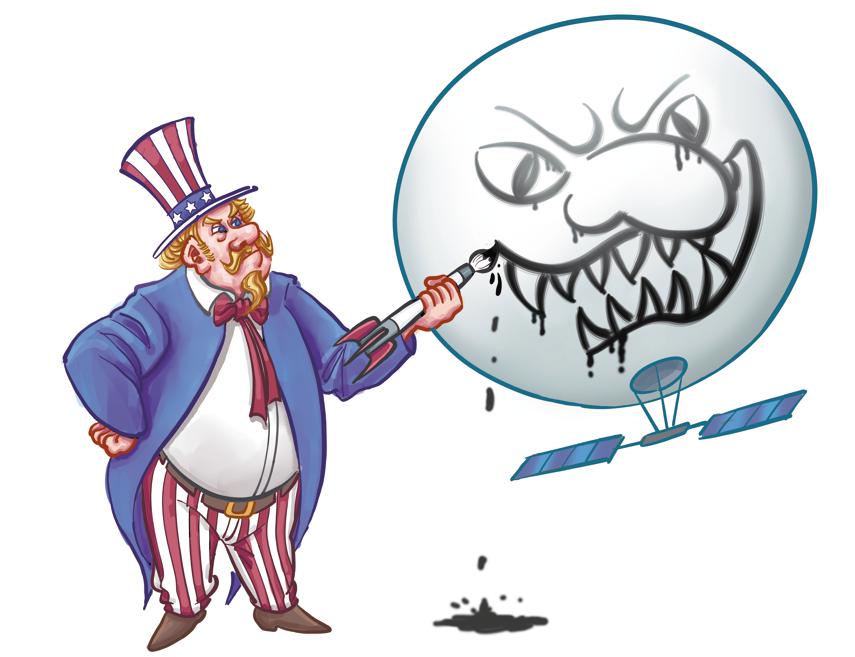
Between Jan 28 and Feb 4, a high-altitude balloon of Chinese origin — dubbed "the Chinese spy balloon" by the United States — drifted into US airspace. As a consequence, the world media has been full of blustering narratives over the past couple of weeks, saying the US has shot down a Chinese "spy balloon", which allegedly flew from China to Alaska and British Columbia. In the same sequence of events, the US has shot down three more "unmanned flying craft".
In a recent statement, US President Joe Biden said: "The intelligence community's current assessment is that these three objects were most likely balloons tied to private companies, recreation or research institutions studying weather or conducting other scientific research."
The official position of China on the unmanned flying craft was released on Feb 3. It clearly said: "The airship is from China. It is a civilian airship used for research, mainly meteorological, purposes. Affected by the Westerlies and with limited self-steering capability, the airship deviated far from its planned course. The Chinese side regrets the unintended entry of the airship into US airspace due to force majeure. The Chinese side will continue communicating with the US side and properly handle this unexpected situation caused by force majeure."
In summary, China has acknowledged the airship's proprietorship, made clear its civilian nature, explained that the drifting of the aircraft was accidental and unintentional, while regretting the inadvertent entry of the balloon into US airspace due to force majeure.
Given these facts, four points stand out:
First, despite international regulations defining the legal nature and altitude of airspace under state sovereignty, and the lower limit of outer space (often designated by the Kármán line), as a global common, aircraft and balloons flying over foreign states is not a new phenomenon. For years, Washington has been flying balloons and other aircraft beyond the US' sovereign airspace, especially during and after the end of the Cold War.
As for the Chinese weather balloon, it was seen flying across the US at an altitude of 60,000 feet (18 kilometers), which is a gray area where it cannot be determined whether US law and civil aviation international convention are superseded by outer space law.
Second, the International Civil Aviation Organization, as a United Nations agency, is entrusted with the responsibility of regulating global civil aviation. Balloons and airships both are considered aircraft under international law. The ICAO describes a balloon as a "non-power-driven, unmanned, lighter-than-air aircraft in free flight", and says that an airship must give way to balloons because an airship is more maneuverable (Rules of the Air, Annex 2 to Chicago Convention). Thus, in its official statement, China acknowledged that the aircraft was indeed an airship with a limited self-steering capability-technically, an unmanned, non-military stray airship.
Third, therefore, the legal nature and operation of high-altitude or "weather balloons" are legislated for sovereign states and under international law. Since non-military high-altitude balloons are categorized as aircraft by the ICAO, they have to follow international aviation law, although the ICAO does not regulate military activities. Also, the US and China are both members of the 1944 Chicago Convention on International Civil Aviation, a treaty that upholds the jurisdiction of the ICAO and its framework on international aviation regulations and laws.
And fourth, the Chicago Convention recognizes the principle of exclusive sovereignty over the airspace above a state's territory (Article 1) and this international instrument is very clear in relation to over-flights: no state aircraft of a contracting State shall fly over the territory of another State or land thereon without authorization by special agreement (…)(Article 3c).
The spirit of the Chicago Convention can be summarized by the combination of its preamble and the Article 37. In a nutshell, international collaboration.
As the preamble to the Chicago Convention says: "Whereas it is desirable to avoid friction and to promote that cooperation between nations and peoples upon which the peace of the world depends." The practice of inter-state diligent technical collaboration is the foundation stone of this instrument of international law.
China and the US are not small states. Both are global leaders, and their actions are regarded by the community of sovereign states as quasi-normative. So it is in their best national interest and in the interest of the international community, that both engage in responsible competition without escalation.
In addition, it is a matter of global sovereign responsibility to defuse any escalation perception through regular diplomatic means, making public only what should be on the public domain and avoiding confrontational narratives.
Indeed, when China acknowledged the balloon's proprietorship, and the balloon's civilian nature, said the flight's pathway drift was accidental and unintentional, and diplomatically regretted the inadvertent entry of the airship into US airspace due to force majeure, it created, as a responsible state, the necessary conditions for diplomatic and technical collaboration, promoting restraint on state-level public criticism.
But the US, by transforming the regrettable incident into an appalling populist tantrum, lost another good opportunity to lead by example.
The author is an associate professor at the City University of Macau (China).
The opinions expressed here are those of the writer and do not necessarily represent the views of China Daily and China Daily website.
If you have a specific expertise, or would like to share your thought about our stories, then send us your writings at opinion@chinadaily.com.cn, and comment@chinadaily.com.cn.