Against the grain








Japan's moves aimed at decoupling from China are flying in the face of reality
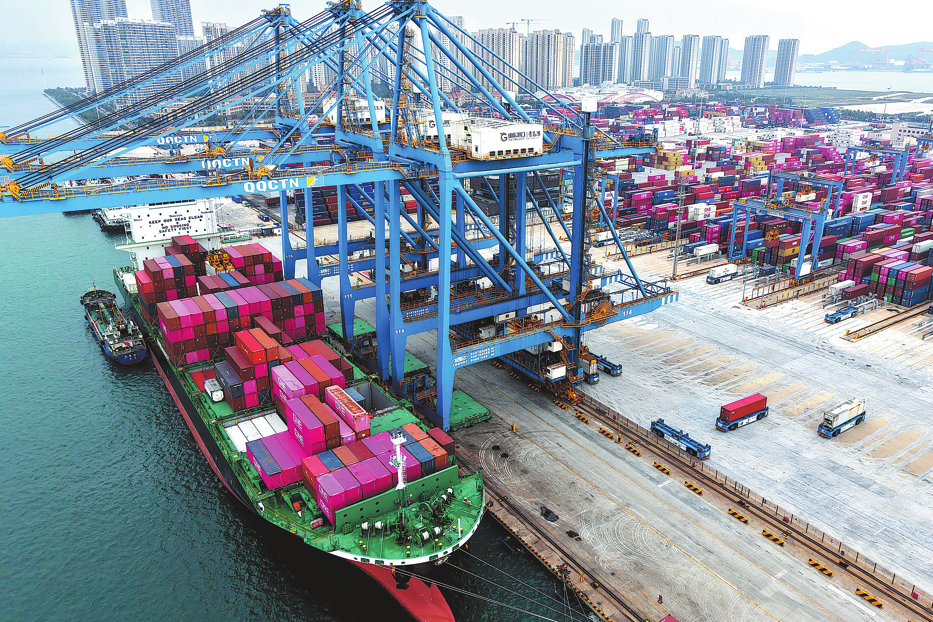
Looking back over the past 50 years, China-Japan relations have experienced ups and downs, but as far as bilateral economic and trade cooperation is concerned they have developed in a healthy manner. From 1972 to 2022, the trade volume had increased more than 300 times, and the cumulative direct investment of Japan in China had amounted to $120 billion. Since 2007, China has been Japan's top trading partner while Japan has been China's second-largest trading partner and also the main source of foreign investment in China.
The great achievements of China-Japan economic and trade cooperation over the past half a century can be attributed to a combination of various factors. But there is no doubt that China's booming economy has been the fundamental driving force; it would be impossible for the two countries to have such huge scale cooperation without China's reform, opening-up and peaceful rise.
At the same time, their cooperation has adapted to the evolving situation of China's economy at different stages, kept pace with the times and made its contributions to China's economy. The two economies promote and complement each other.
Yet the political relations between China and Japan are complex and volatile and they have a major impact on bilateral economic cooperation. In fact, in recent years, against the backdrop of increasingly prominent China-Japan frictions, the economic and trade ties between the two sides are facing multiple challenges.
Bilateral trade fell into negative growth last year, and the total bilateral trade was $357.42 billion, down 3.7 percent year-on-year. Over the same period, China's total foreign trade in US dollars increased by 4.4 percent, China-US trade grew by 0.6 percent, and the trade between China and the Republic of Korea increased by 0.1 percent.
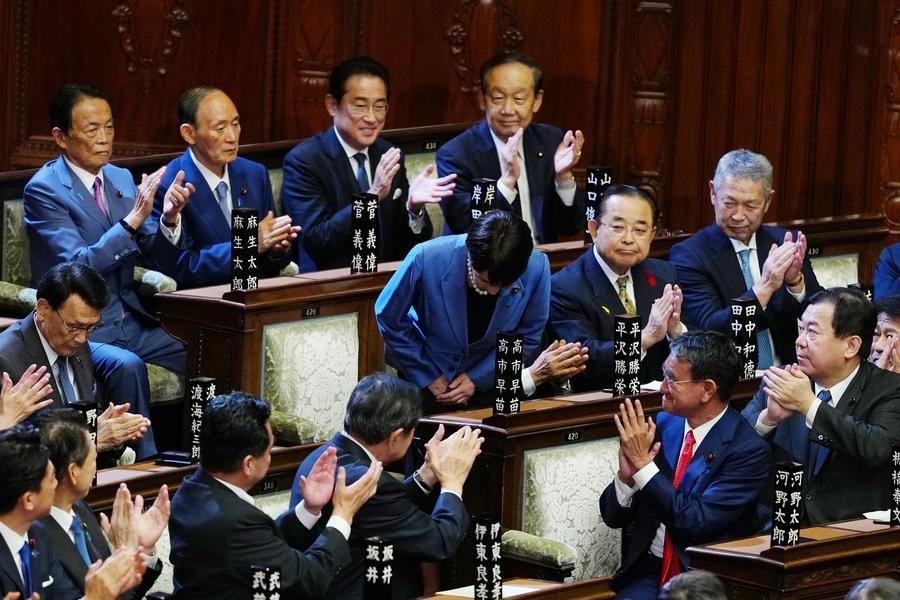
Since April 2020, strategic competition between China and the United States has been intensifying, and Japan has followed the US' lead and intensified its efforts to contain China. In May 2022, the Japanese Parliament formally passed an economic security bill primarily aimed at preventing excessive economic dependency on China. Although the "Indo-Pacific Economic Framework for Prosperity" (IPEF) is led by the US, Japan is an enthusiastic endorser of it.
This framework is not only a measure aimed at depriving China of its economic dominance in the Asia-Pacific region, but also bundles in Japan's huge interests in China, such as its industrial chain and value chain layout.
In fact, it is not easy for Japan to decouple from China's economy. Economic globalization and their long-term cooperation mean the optimal allocation of resources has been achieved in accordance with market rules and the production networks of East Asia and the world have been set up. It is on this basis that the industry, supply and value chains have been formed.
It is difficult to imagine that there will be an economy that can replace China's position in the East Asian industry chains in the short term. Facts have proven that it is almost impossible for Japan — or even the US — to decouple from the Chinese economy.
The trade war between the US and China has lasted for years. Yet the trade volume between the two countries continues to rise, increasing by 8.8 percent in 2020, 28.7 percent in 2021 and 0.6 percent in 2022 — to reach a record high of $759.43 billion, which is 2.1 times that of the China-Japan trade.
With the US and the West trying to prevent China from having cutting-edge technology, there is the possibility that Japan and China will partially "decouple" in some cutting-edge science and technology fields. But if even the US can't decouple from China's economy, it is even more unfeasible for Japan to realize complete decoupling.
Japan's economic security legislation may work in the short term, but it cannot be sustained, since social demand is the most important driving force for technology transfer or the transformation of scientific and technological achievements. In the same way, the IPEF designed to contain China is not a sustainable strategy.
Japan has not recovered completely since its economic bubble burst in the early 1990s. The COVID-19 outbreak has further hurt Japan's economy. Worse, the current imported inflation in Japan has brought risks of stagflation like that in the 1970s.
To promote its economic recovery, Japan should strengthen its economic cooperation with China. The US-led IPEF offers few economic benefits to Japan. Only the Regional Comprehensive Economic Partnership can bring direct benefits to Japan, of which China-Japan trade can provide the most. Thanks to the RCEP, China's zero-tariff coverage rate of imported products from Japan will rocket from the current 8.4 percent to 86 percent, and a broader trade market will be expanded.
With the high-quality growth of China's economy, its market capacity will grow increasingly larger, and it will soon surpass the US to become the world's largest consumer market. However, Japan's domestic market is already saturated. In addition, structural problems such as its aging population, the heavy burden of long-term government debt, and the low potential economic growth rate, are difficult to solve. Expanding foreign demand is particularly important for Japan's economic development.
Although the current China-Japan economic and trade cooperation is at a low ebb because of various adverse factors, the basic fact that the two sides are important economic partners for each other has not changed. The importance of their economic and trade cooperation and its role as the "ballast stone" of bilateral relations have not changed.
The positive factors for China-Japan economic and trade cooperation are also on the rise. The Chinese economy is overcoming the difficulties it has faced and is stabilizing, and it continues to move forward on the track of high-quality growth. With a focus on boosting its national strategic scientific and technological strength and the organizational capacity of its industry and supply chains, China will continue to expand high-level opening-up and its domestic consumer market, bringing more opportunities to countries including Japan.
In the future, China-Japan economic and trade cooperation will encounter various challenges, but its capability to cope with the risks caused by non-economic factors will be improved under the RCEP framework. It can be expected that with the end of the COVID-19 pandemic, personnel exchanges and economic cooperation between the two countries will see explosive growth.
China and Japan have a long history and foundation of economic and trade cooperation. The basic characteristics of the healthy development of bilateral economic and trade relations, such as their economic complementarity, will continue to exist for a long time. The mutual benefit of China-Japan economic cooperation and the spillover effects of their cooperation will be sustained. Driven by the high-quality growth of China's economy, the long-term prospects for China-Japan economic and trade relations are promising.
The author is a researcher at the Institute of Japanese Studies and the National Institute for Global Strategy at the Chinese Academy of Social Sciences. The author contributed this article to China Watch, a think tank powered by China Daily.
The views do not necessarily reflect those of China Daily.