Developing together








Pacific islands and China's bilateral relations have and will withstand the tests of evolving international landscape
In November 2018, Chinese President Xi Jinping visited the South Pacific. Together with the leaders of the countries in the region, President Xi outlined a new vision for China-Pacific relations. Then Chinese state councilor and foreign minister Wang Yi visited the Pacific islands in June 2022, reiterating that China is ready to share its development experience, opportunities and dividends with the Pacific islanders. In this process, China's foreign affairs principle that all countries, big or small, are equal, resonates particularly well in our small land and human communities.
The Chinese presence, filling the West's void, has been warmly welcomed by the Pacific governments and communities. It was heartening to see that with China's sincere input, the governments of the United States, Australia, New Zealand, and France were attaching greater importance to the status and role of the Pacific island countries. Pacific islanders naturally welcome and hope that these developed countries will come up with concrete actions and measures, making their due contribution to peace and prosperity in the region.
While the West intensifies slogans and warnings and speaks more freely about a possible full-blown Western Pacific war before 2025, China proposes global initiatives and visions such as the Belt and Road Initiative, a community with a shared future for mankind, the Global Development Initiative, and the Global Security Initiative, as well as tools such as the Asian Infrastructure Investment Bank.
In this, the southward maritime extension of the Belt and Road Initiative, the Maritime Pearl Road as it is identified in the Pacific, is playing a significant role by providing support and assistance for the development of Pacific island countries in investment, trade opportunities and infrastructure. A World Bank analysis has noted that the Belt and Road Initiative can potentially increase trade by as much as 9.7 percent for the participating economies. To this date, 10 Pacific island countries have joined the initiative.
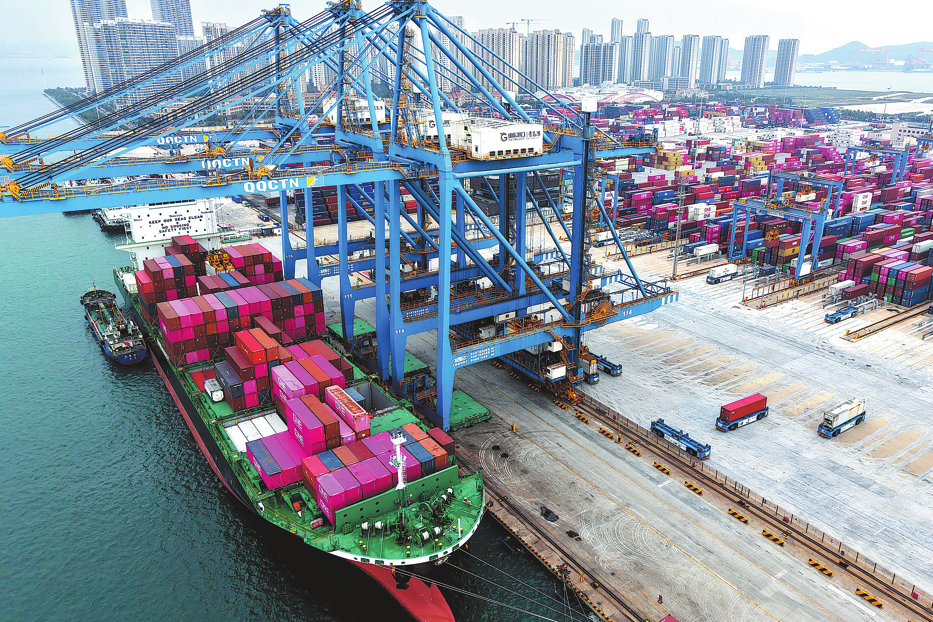
From 1992 to 2021, the total trade volume between the Pacific islands and China grew from $153 million to $5.3 billion, a 30-fold increase in 30 years. By the end of 2021, China's direct investment reached $2.72 billion. China has helped accelerate the connectivity of Pacific island countries by carrying out a series of key infrastructure projects, including the Independence Boulevard in Papua New Guinea, Malakula island highway in Vanuatu, renovation of Tonga national road, Pohnpei highway in Micronesia and a number of sustainable aquaculture projects and solar power plants in different island countries. Projects for reinforcing local regional airlines, maritime freight and internet connectivity are also in the talks.
The probable next natural step would be to establish a Pacific-based bank authorized to clear renminbi transactions, which would be a game changer in the financial industry and a milestone for the Maritime Pearl Road in the Pacific region.
At the end of the day, we need to ask which political and economic system does a good job of meeting the people's needs. While China proposes to improve globalization, expand regional markets, and increase purchasing power, the Western narrative focuses on making us fearful to allow such assistance programs.
From the Pacific perspective, the Chinese development proposals draw on the belief that safe, effective, and sustainable development methods arise when all countries have the ability to develop. Clearly, this vision seems to be the most realistic and practical path toward common development. When the Pacific islanders seek to cooperate with such Chinese initiatives, they do so because they believe that only a diversity of development assistance predicated on all our countries developing together can produce a better world and life for us collectively.
This new design in international relations — with a commitment to be guided by mutual respect, understanding of local customs and habitats, fair and win-win cooperation, just and equitable governance and more balanced economic models — is very attractive at a rhetorical level and also represents an unbiased and inclusive development model advocating the building of a community with a shared future and common prosperity in an open, inclusive and sustainable way.
In recent years, China and the Pacific Island countries have expanded cooperation and drawn up blueprints for the future, effectively elevating their cooperation to a higher level, without forgetting the common roots China and Pacific. Look at what has been achieved in the firm commitments by both Pacific nations and China: the 2019 Nadi Declaration adopted by China-PICs Agricultural Ministerial Meeting; the 2021 Guangzhou Consensus adopted by China-PICs Forum on Fisheries Cooperation and Development; the 2022 China's Position Paper on Mutual Respect and Common Development with Pacific Island Countries; the 2023 Nanjing Consensus adopted by China-PICs Ministerial Meeting on Agriculture and Fisheries; to the 2024 opening by the International Research Center for Austronesian Archaeology in Pingtan, Fujian province, of a dedicated museum focused on the Polynesian ancestors and the Austronesian canoe migrations.
The next step, as clearly outlined in the 2023 Nanjing Consensus, will be to establish a mechanism for China-Pacific islands industrial cooperation that would involve policymakers and private sector operators, think tanks, media outlets and NGOs to share information, seek points of complementarity, pool strength and mobilize resources. This super-charged Pacific-China mechanism, with regular ministerial meetings, friendship forums, organizations such as the China Oceanic Development Foundation or the Pacific China Friendship Association, as well as the establishment of Friendship Cities, etc, will contribute to the ongoing development of a new type of China-Pacific islands strategic partnership featuring economic win-win cooperation and cultural exchanges.
Through this vision, development models and tools are secured within fair global initiatives. Pacific islanders will feel comfortable in transcending our differences, while focusing on the common expectations of our developing economies.
Clearly, China has been accompanying Pacific island countries in developing their economies and enhancing self-driven sustainable development. With strong economic complementarity, together, we have enormous cooperation potential.
The author is the president of the Council of Pacific Affairs. The author contributed this article to China Watch, a think tank powered by China Daily.
The views do not necessarily reflect those of China Daily.