The chips are down
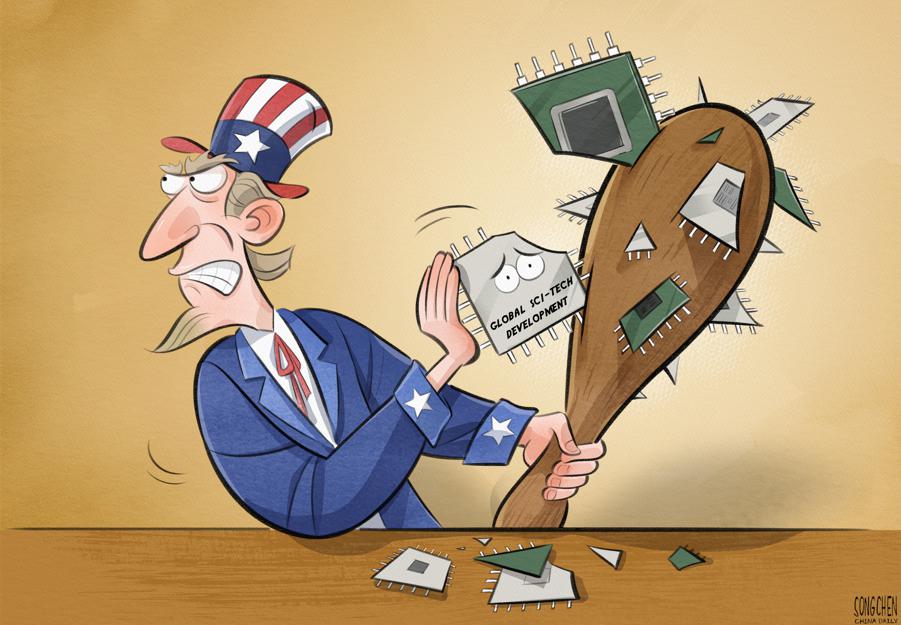
The United States has put technology at the forefront of its overall strategic competition with China, which disrupts global industry chains and hinders global sci-tech development







The United States has put technology at the forefront of its overall strategic competition with China, which disrupts global industry chains and hinders global sci-tech development
The Joe Biden administration believes that sci-tech competition is the lynch-pin for the United States to maintain its economic and military dominance, and to win the strategic competition with China. Its strategy of technology competition against China has three aspects.
First, to upgrade the US' sci-tech competitiveness. Since the end of World War II, the US has been the dominant economic, military and technological power. However, over recent years, its leadership positions in emerging and critical technologies such as artificial intelligence, quantum technology, supercomputers and 5G have been weakened, or risk being overtaken by China. Viewing sci-tech competitiveness as the key to maintain the US' hegemony, the Biden administration has scaled up investment in science and technology.
Second, to preserve the US' military advantage. Military supremacy is the keystone of the US hegemony. Having a technology advantage is indispensable to ensure the US retains its military edge. Biden believes that high-end chips, AI, quantum technology and supercomputers play irreplaceable roles in modern information warfare and the high-tech warfare of the future, and seizing the commanding heights of emerging and critical technologies will give the US military advantages on battlefields. Therefore, the Biden administration aims to enlarge the US' lead in science and technology and thus preserve the US' military dominance through its sci-tech competition with China.
Third, to slow China's technology progress. In September 2022, US National Security Advisor Jake Sullivan said in a policy address that "the strategic environment "of global sci-tech competition has changed, and the US must "maintain as large of a lead as possible".This speech proved to be a watershed. Since then, the US has tightened its squeeze on China's high-tech sector, and stepped up export controls and suppression targeting China to preserve its lead in key sci-tech areas.
The Biden administration has adopted a three-pronged strategy to thwart China's technology development.
First, to ramp up investment in and support for high-tech areas. In the face of China's rapid development in the high-tech sector, the Biden administration is convinced that government support is essential to maintain the US leadership in science and technology. Given the foundational nature of certain technologies, such as memory chips, the Biden administration has prioritized research and development efforts in these areas.
In August 2022, Biden signed the CHIPS and Science Act, showing its strong resolve to maintain the US' sci-tech edge through huge investments and policy support. He also signed the Inflation Reduction Act, which aims to bolster the clean energy sector and bring advanced manufacturing industries back to the US through government subsidies.
Second, to intensify high-tech export controls and investment restrictions vis-a-vis China. Since taking office, Biden has escalated the previous government's control of high-tech exports to China. In October 2022, the US Commerce Department announced a sweeping set of more aggressive export controls aimed at limiting China's access to the most advanced chips and the tools needed to develop its own. Moreover, the Biden administration mulled imposing investment bans targeting China's high-tech industries, and put many Chinese high-tech companies on a list of entities subject to export controls citing national security reasons.
Third, to form small anti-China cliques. The US has enlisted its allies in a bid to contain China's technology development using coercive measures. On the one hand, the US has formed the so-called Chip 4 alliance with Japan, the Republic of Korea and the Chinese island of Taiwan to block the development of the Chinese mainland's semiconductor industry and shut the Chinese mainland out of the high-end chip supply chain. On the other hand, the US has roped in the Chinese island of Taiwan, Japan, the Netherlands and the ROK to join its export controls on advanced chips and chipmaking equipment targeting the Chinese mainland in an attempt to cut its access to high-end chips and chipmaking tools.
Driven by its zero-sum view of China-US relations and China's technology development, the Biden administration has adopted a series of strategies and policies that will hinder the technology development of both countries and the world at large.
First, it has worsened the already strained China-US ties. Two and a half years into the Biden administration, bilateral ties, rather than being improved, have continued their downward spiral. Biden's attempt to turn the US' comparative advantages in technology into absolute advantages by suppressing China's high-tech sector has further soured bilateral relations and increased the risk of confrontation.
Second, it has disrupted the global semiconductor industry chain, and hindered the global development of technology. The Biden administration is endeavoring to ensure the control of the whole supply chain for high-end chips is in the hands of the US and a few of its allies. This will disrupt the division of labor in the supply chain, impede the growth of the high-end chip industry and the progress of global technology development, and waste resources. In fact, these measures will not stop China's technology development, rather it will deal a heavy blow to the development of the chip technology of the US and its allies and the global chip industry.
Third, it has fueled a technology Cold War. Science and technology are meant to benefit humanity. But the United States, putting its narrow interests first, has gone to great lengths to suppress China's technology progress, severely disturbing normal technology exchanges and cooperation among countries. By weaponizing the US' leading position in the supply chain for high-end chips, the Biden administration is pushing for technology decoupling from China and waging a technology Cold War against China.
The author is a professor of the Center for American Studies at Fudan University. The author contributed this article to China Watch, a think tank powered by China Daily. The views do not necessarily reflect those of China Daily.
Contact the editor at editor@chinawatch.cn.