BRICS' steady advent and unfolding scenarios
Despite reservations, the group has achieved significant milestones, such as a bank of its own, moves to trade in local currencies, and sharing a development agenda despite distances








Despite reservations, the group has achieved significant milestones, such as a bank of its own, moves to trade in local currencies, and sharing a development agenda despite distances
It has been almost two decades since the acronym BRIC was coined, and it has since evolved through the worst political, financial and social-health crises. Today, BRICS represents a fundamental transformation undertaking in the international system. Its member countries contribute 32 percent of the global GDP, which is more than the share of G7 countries. BRICS, comprising 42 percent of the world population, has been forthcoming in meeting Human Development Index requirements and has helped the world achieve poverty alleviation targets and set examples to overcome spatial differences.
The world has changed on many fronts, and challenges have multiplied. The significant risks in the financial markets, waves of pandemic in the past few decades, including SARS, Ebola and now COVID-19, besides climate change, are the new challenges that underline the importance of the BRICS grouping. BRICS includes countries from various regions and each has their priorities to deal with. At the same time, the larger consensus of the Global South over the global crises has rekindled the hope in BRICS, as these countries have faced adverse global conditions such as post-war polarization of growth and the wealth divide.
The West-led globalization generated disproportionate benefits. The rich countries' interest in the abundant factors of production in developing countries lets them control the financial strings and affect the growth of developing countries. The fundamental hurdle for developing countries to overcome the challenges has been answering the "deprivation". The socioeconomic and technological advent of the BRICS countries is possible only with its financial platform. The New Development Bank was a revolutionary idea by the developing bloc, as it includes a clause to make it accessible to every developing country seeking assistance. The low-income and middle-income countries require finance for their development projects. There is a need for colossal funds in developing economies to make a transformative impact.
As per a statistical study by Oxford Economics, the global infrastructure investment is required to be $94 trillion between 2016 and 2040. This means $3.7 trillion per year on average.
The study also forecasts that Africa's investment gap will widen further to 43 percent if the investment needs include Sustainable Development Goals. Developing countries need to address this massive gap in development finance, underlining the need and scope of the NDB. The bank has become an operational arm of BRICS extending help and accessibility to developing and emerging economies.
Be it developmental goals, sustainability and development indexes, BRICS provides a realistic alternative. BRICS is expanding the group through a process of evolution. BRICS and the Global South are overcoming the financial uncertainties not by adopting the over-leveraging approach of the liberal economies, but by reducing risks.
The data from the Organization for Economic Cooperation and Development and the World Bank suggest that the North-North flow of foreign direct investment shrunk in the first quarter of this century, and the outbound investments within the Global South increased by approximately 20 percent.
Moreover, the South-South FDI scenarios multiplied, accounting for 18 percent of the world FDI, up from a mere 3 percent in 2001. The prospects of South-South cooperation have increased manifold according to the United Nations Conference on Trade and Development and the Asian Development Bank.
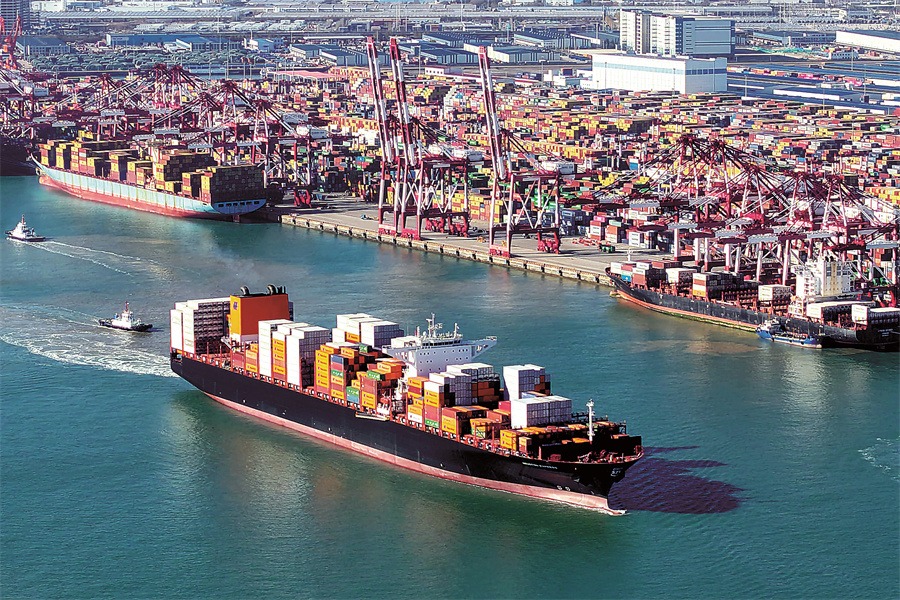
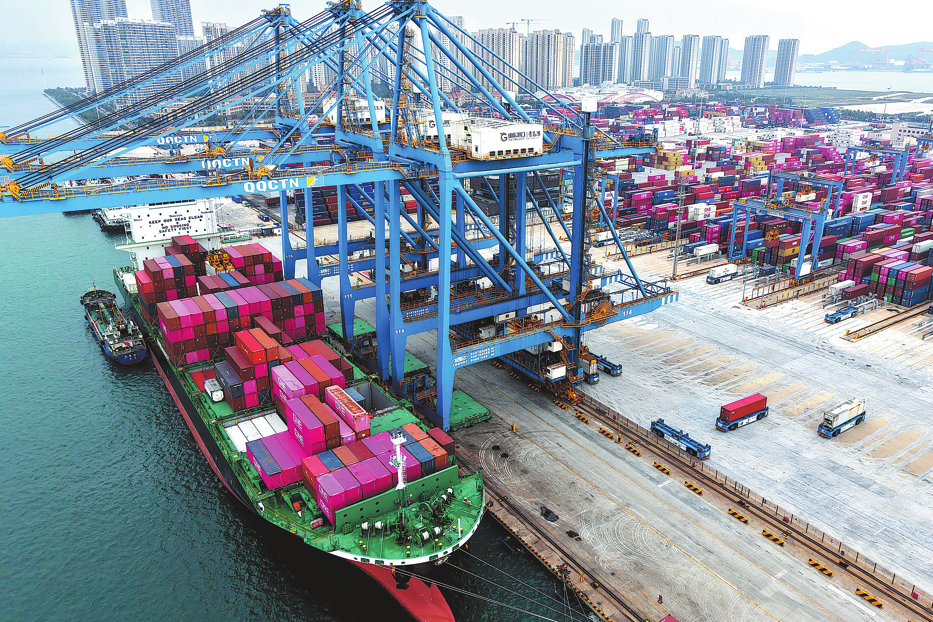
The next step is forging a common agenda and streamlining cooperation. The BRICS countries need to find ways to gather consensus over a currency independent of the West-dominated world economy. About 84.3 percent of global trade takes place in the US dollar. Given that the BRICS countries account for 18 percent of the global trade and 19 percent of the global export volume, over-reliance on a single currency could be disastrous.
A free and independent international monetary system, free trade and promotion of global public interest lie in the need to de-risk developing economies from their excessive dependence on the dollar as the dominant currency to trade. BRICS is already looking beyond the dollar, paving the way for a multi-currency system. Boosting local currencies and, at the same time, eliminating risks of foreign exchange fluctuations, are indispensable measures.
The evolving BRICS signals how the West is slowly losing the remarkable capacity it has enjoyed to set the agenda on a global scale. In the opinion of Kishore Mahbubani, former Singaporean ambassador to the United Nations, the responses from the West to the current challenges have been inconsistent, and this has led to the emergence of a non-Western approach to balance and reform the governance system. The pandemic has offered a glimpse of such a phenomenon which is already underway.
Global Health Governance is the benchmark that the BRICS continues to pursue. During the third BRICS summit in 2011, about 10 years before COVID-19, health issues were raised for discussion. A year later, in 2012, India, Brazil and China jointly protested against developed nations' efforts to make the intellectual property regime more stringent through the World Trade Organization. At a meeting in the WTO, the three countries of the BRICS grouping refused to give in to the pressure from the developed countries under the legitimate reasoning that such moves could seriously hinder poor people's access to cheap drugs. This collective stand helped BRICS phenomenally. During and after the pandemic, the potency of BRICS in global health is slowly being recognized.
Despite the contention that BRICS is incapable of finding a common denominator and challenging the members to streamline the agenda, BRICS has achieved significant milestones. BRICS stands out as a special institutional arrangement because of its ability to integrate countries from different parts of the world with diverse challenges and yet homogenize the approaches to form a collective development vision. Distance is not an obstruction for BRICS, as the transnational commonalities among them have brought them close together.
The author is an associate professor at Jawaharlal Nehru University. The author contributed this article to China Watch, a think tank powered by China Daily. The views do not necessarily reflect those of China Daily.
Contact the editor at editor@chinawatch.cn.