Not an easy task
US will face challenges in building the India-Middle East-Europe Economic Corridor if it keeps bringing great power competition into economic cooperation







US will face challenges in building the India-Middle East-Europe Economic Corridor if it keeps bringing great power competition into economic cooperation
Editor's note: The world has undergone many changes and shocks in recent years. Enhanced dialogue between scholars from China and overseas is needed to build mutual understanding on many problems the world faces. For this purpose, the China Watch Institute of China Daily and the National Institute for Global Strategy, Chinese Academy of Social Sciences, jointly present this special column: The Global Strategy Dialogue, in which experts from China and abroad will offer insightful views, analysis and fresh perspectives on long-term strategic issues of global importance.

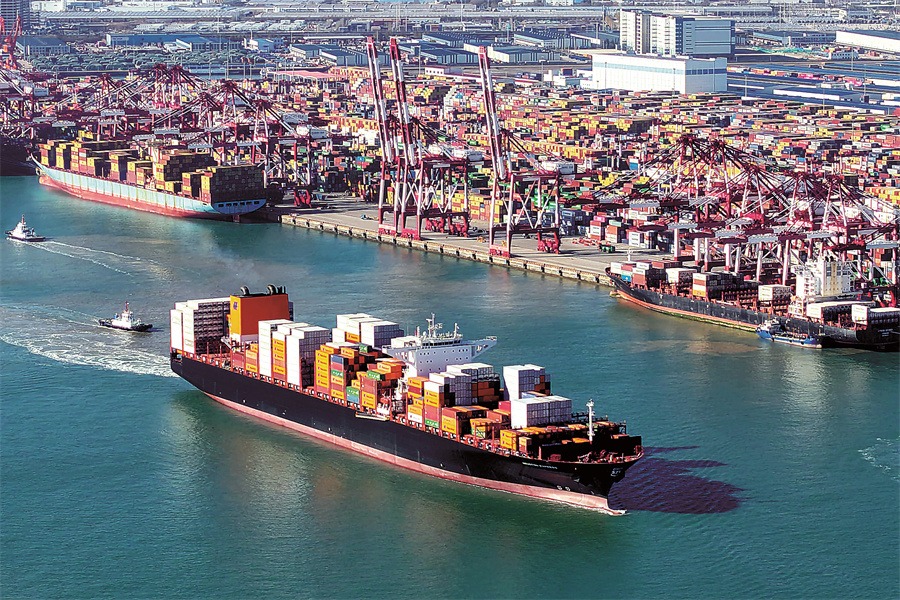
On Sept 9 at the G20 summit, the United States, India, Saudi Arabia, the European Union and other countries announced a memorandum of understanding on working together to develop a new India-Middle East-Europe Economic Corridor (IMEC).
Some Western media outlets have characterized this move as a strategic initiative to compete with China's Belt and Road Initiative. However, based on the currently available information, the IMEC still faces significant uncertainties in terms of resources and intergovernmental coordination. These uncertainties stem from the development cooperation model centered on the US.
The US has never hidden the anti-China motivations for its economic development initiatives. In August, President Joe Biden referred to the Belt and Road Initiative as a "debt and noose agreement" in a speech. But from China's perspective, if the IMEC translates into action rather than mere rhetoric, it could hold some positive implications for building a community with a shared future for mankind, as in a world marked by frequent global crises, weak infrastructure in multiple regions and fragile economic structures, real US engagement in the international arena could help address environmental challenges and mobilize countries such as India to participate in global governance.
The current efforts by the US, India and other countries to promote the IMEC come with several advantages. First, traditional powers such as the US and the developed European countries have established a certain level of political cooperation and institutional presence in regions such as the Middle East. Second, the US holds a technological advantage and attractiveness in the high-tech sector. Third, the IMEC has attracted participation from strategically important regional powers such as India and Saudi Arabia, which are interested in expanding their international influence. The US and its allies may leverage these advantages to promote so-called high standards and intensify competition with China in the realm of development and technology.
However, the IMEC also faces uncertainty in several areas.
First, the continuity of the IMEC faces challenges due to the dynamics of US election politics. The upcoming presidential election in 2024 carries significant uncertainty, and President Biden does not hold a clear advantage over potential competitors such as Donald Trump, who, championing trade protectionism, announced the US' withdrawal from the Trans-Pacific Partnership in the early days of his presidency and subsequently had a relatively negative stance toward international development multilateral mechanisms, such as frequently absenting himself from ASEAN summits. Even if Trump is not able to run for office, the rise of a president with a similar right-wing populist position could introduce significant changes to cooperative frameworks such as the IMEC.
Second, the high cost associated with the IMEC could affect its implementation. Currently, the memorandum and US public discourse do not mention the actual costs of the IMEC. US government debt has already surpassed $32 trillion, with over $7 trillion in debt maturing within one year, and there is a risk of a government shutdown on Oct 1. Debt pressure constrains spending by the US government in development areas.
Additionally, fiscal expenditures by the US on other issues, such as the Ukraine crisis, could also limit funding for IMEC-related infrastructure projects. Furthermore, President Biden's IMEC plan includes many projects with a Democratic Party flavor, such as clean energy initiatives, while the Republicans currently control budgetary decision-making. The ongoing partisan battles between the two parties are creating limitations on US overseas development plans.
In theory, the US could rely on partners such as India to share the costs, but the corridor's facilitation of India's overseas trade is not evident, and the economic benefits for countries such as Saudi Arabia rely on connectivity between Arab nations and Israel, which poses significant challenges. Therefore, once countries begin to implement infrastructure projects, the US may need to bear a substantial portion of the IMEC's costs, which could be a challenging task for the Biden administration.
Third, the US faces challenges in mobilizing other IMEC members. The Biden administration is skilled in "mini-multilateral" governance cooperation but often struggles to make substantive progress when leading large-scale international frameworks. Take the "Indo-Pacific Economic Framework for Prosperity" as an example. While IPEF negotiations have progressed relatively quickly, they do not cover key areas of cooperation such as US market access, resulting in limited substantive impact, and significant uncertainty remains. Future IMEC negotiations may also encounter similar challenges, and the US must strike a balance between the negotiating progress and substantive outcomes.
The IMEC heavily relies on the coordinated efforts of key hub countries, especially nations with diverse political, cultural and interest-based demands such as Israel, India and Saudi Arabia. This poses a daunting task for the US as the framework leader. Besides, the IMEC presents policy differences with some non-member countries along its route, such as Iran, which could hinder the implementation of infrastructure projects and the spillover effects of the IMEC into neighboring regions.
In essence, frameworks such as the IMEC primarily serve the US in promoting its high standards and consolidating its global leadership. Through these frameworks, the US aims to, on the one hand, constrain non-member countries such as China, and on the other hand, standardize and influence other members. However, there are significant differences in interests and even potential sovereignty concerns among other members, especially developing countries. Moreover, frameworks centered on the US are susceptible to US political influence, making economically cooperative efforts led by the US often difficult to sustain.
In summary, the success or failure of the IMEC hinges on the US.To realize the IMEC, the US has to not only make substantial investments but also garner broad international participation and support. This requires the US to move away from a mindset of centrism and great-power competition and instead advocate open, inclusive and diverse international development cooperation.
If the US remains trapped in a confrontational mindset against the Belt and Road Initiative, the IMEC framework is likely to struggle and may not genuinely benefit the countries along its route. However, if the US can genuinely respect the interests and demands of IMEC member countries along the route, as well as those of countries worldwide, then the IMEC and the Belt and Road Initiative can coexist and mutually promote development in a spirit of healthy competition.


The author is an assistant research fellow at the Institute of World Economics and Politics at the Chinese Academy of Social Sciences and the National Institute for Global Strategy. The author contributed this article to China Watch, a think tank powered by China Daily.
Contact the editor at editor@chinawatch.cn.