'Money rules' in American elections







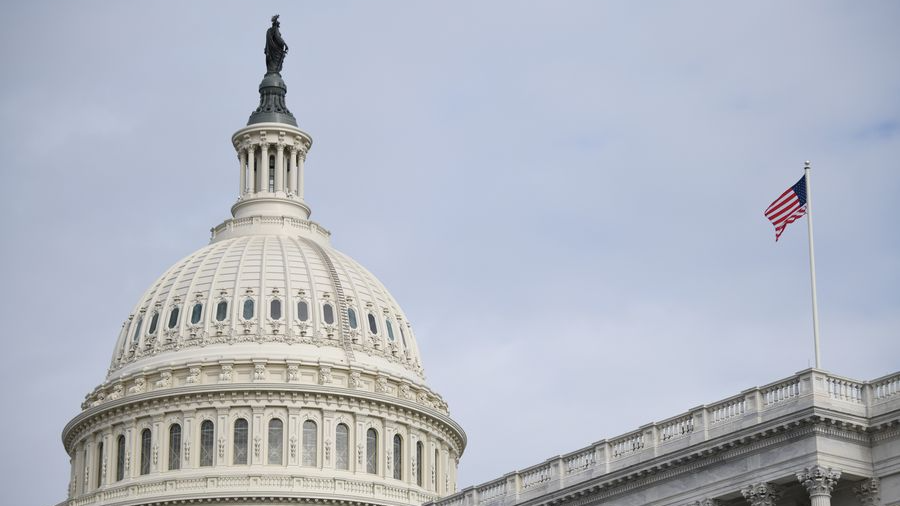
Former US President Donald Trump, who has clinched the 2024 Republican presidential nomination, announced that his campaign had raised 50.5 million US dollars at a major fundraiser in Florida last week.
This figure broke the record of 25 million dollars in fundraising in a single political event set by incumbent President Joe Biden, a Democrat.
For a long time, money has been the dominant factor in American elections, and whoever raises more money has a greater chance to win. The power of capital permeates and affects all aspects of American society through political power, forming an "American democracy" that is very much dependent on money.
In recent years, the cost of elections in the United States has skyrocketed, and money and politics have become more closely intertwined.
The total spending of the 2020 US election was as high as 14 billion dollars, twice that of 2016, with 6.6 billion dollars spent on the presidential election and more than 7 billion dollars on the Congressional elections, according to statistics from the Center for Responsive Politics.
Some American research institutions predict that 2024 will be the most expensive election cycle in American history, with candidates spending more than 10 billion dollars on political advertising alone.
The financial threshold for participating in elections is getting increasingly higher.
Although people have the right to vote, they cannot exert a real influence over politics, which makes the "free election" that American democracy claims an empty slogan.
"The Irony of Democracy: An Uncommon Introduction to American Politics," co-authored by Louis Schubert, Thomas R. Dye and Harmon Zeigler, argues that the American people no longer believe that the government serves the common good, and most people think that a few large interest groups control the American political system, and often neglect the public interest to serve their own interests.
The intensification of partisan rivalry is an important factor driving rising election costs.
In recent years, American society has become increasingly polarized and so has public opinion. The two major political parties and their supporters compete for votes in an extremely fierce manner.
To "buy" the political power that will dominate resource allocation in the future, additional bets have been continuously added, thus pushing up campaign costs.
Politicians are particularly good at turning social tensions, which involve issues of climate change, abortion, trade, immigration and other aspects of the economy and people's livelihood, into tools to win over public opinion.
With more and more issues involved in party rivalry, the two parties are under increased pressure to invest more money in policy-making and advertising to win public opinion.
In addition, in the context of intensified party rivalry, the cost of candidates attacking and slandering each other and the two parties fighting each other is also high.
Japan's business newspaper Nihon Keizai Shimbun said in an article that the advertising industry predicts the cost of political advertising in this year's US presidential election has surged, of which 70 percent are "negative advertisements" used to attack political opponents, and that expensive "slander campaigns" will intensify.
Money runs deep on all levels of the American political system.
The rampant gun violence is inseparable from the fact that gun interest groups invest heavily in supporting politicians who are in favor of protecting the right to own guns and blocking the passage of gun control bills.
Behind the epidemic of drugs, there are also a lot of lobbying and political donations from large pharmaceutical companies.
While campaign spending is seeing an incredible rise, investment in the country's dilapidated infrastructure is quite small. The recent bridge collapse tragedy in Baltimore, Maryland revealed the true state of dilapidated infrastructure across the United States.
The many social and economic problems in the United States today are the result of power serving money, and politicians turning a deaf ear to public opinion and being indifferent to people's livelihood.
For a long time, military-industrial enterprises have funded members of Congress to achieve personal political goals, and lawmakers have approved huge military expenditures to reciprocate and take advantage of the opportunity to make profits.
Senior US defense officials have provided a steady stream of military contracts, arbitraged through the "revolving door" between politics and business.
To maintain the operation of this huge interest chain, this interest group formed by the military, military industrial enterprises and politicians has constantly provoked conflicts and created wars around the world, plunging many countries and regions into wars and turmoil.
As Boaventura de Sousa Santosone, a Portuguese expert on international issues, once pointed out, US foreign policy and democracy are dominated by three oligarchies: the military-industrial complex; the gas, oil and mining complex; and the banking and real estate complex. One of their ways to gain exorbitant profits is to keep the world at war, and they are increasingly dependent on US arms sales.
In today's American political reality, the US dollar controls the power and money truly dominates election campaigns.
Under the influence of money, American politics shows the disconnection between elite politics and public opinion, policy-making and social reality.