Regional countries must guard against US ploy to destabilize Asia-Pacific







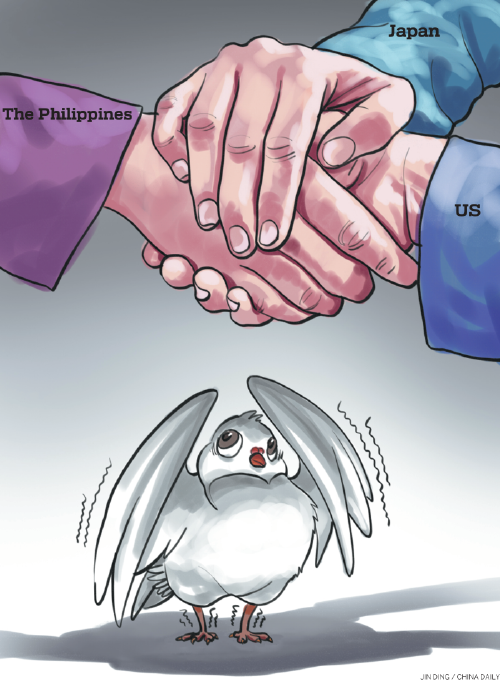
Though hyped as a forum for fostering "peace and security" in the Asia-Pacific region, the just concluded US-Japan-Philippines summit on Thursday actually served as a sharp reminder of Washington's divisive policy of inciting conflict and strife in Asia.
The trilateral summit, the first of its kind, followed a four-way military drill with Australia in the South China Sea. During the summit on Thursday, the three countries also announced joint patrols later this year near the South China Sea.
Washington has a long history of leveraging its military and economic power to sway the policies and decisions of its allies, including the Philippines.
Since Ferdinand Romualdez Marcos Jr. took office as president of the Philippines, Manila, incited by Washington, has adopted an increasingly confrontational stance against China.
Imee Marcos, Marcos' sister and chair of the Philippine Senate Committee on Foreign Relations, recently warned against the government's latest measures to counter China in the South China Sea, saying that such actions are leading the country down a "dangerous path."
Amid flaring tensions in the South China Sea, the White House on Thursday escalated its provocative stance by claiming its "ironclad" defense commitment to the Philippines.
By asserting that "any attack on Philippine aircraft, vessels, or armed forces in the South China Sea would invoke our mutual defense treaty," Washington not only tries to legitimize the Philippines' confrontational approach but also emboldens further provocations by Manila.
Such reckless endorsements only encourage countries like the Philippines to take even more dangerous actions when what is actually needed is diplomacy.
The United States, by forming exclusive cliques with its allies in the region, is also sabotaging the efforts and commitment of China and ASEAN to properly manage and resolve disputes through dialogue and consultation between the states directly involved.
Washington has a long track record of disruptive meddling. Following its blood-soaked interventions in the Middle East, it has been pivoting to Asia.
This pivot is motivated by Washington's relentless pursuit of domination in the Asia-Pacific, the world's most economically dynamic region, and its strategic choice to contain China, which it views as a long-term strategic competitor and "most consequential geopolitical challenge."
For that hegemonic end, Washington has been seeking to sideline established political, economic, and security cooperation mechanisms in the Asia-Pacific. It has effectively undermined the ASEAN-centered regional cooperation framework, a meticulously crafted and time-honored structure developed over past decades.
And in recent years, Washington has been tirelessly spinning a regional security and military web against China. It has reinforced the Five Eyes intelligence-sharing alliance, strengthened the Quadrilateral Security Dialogue, commonly known as the Quad, and bolstered the AUKUS nuclear partnership by trying to strengthen cooperation with Japan.
The overarching goal is clear: By fomenting bloc confrontation and cultivating an atmosphere of insecurity in the Asia-Pacific, Washington aims to consolidate its hegemonic position in the Asia-Pacific, dictating the security agenda and exerting control over its allies and partners.
Many countries in the region have refused to be coerced into taking sides, knowing that such moves risk increasing tensions in the region, undermining the notion of "indivisible security" and fuelling mistrust. Malaysia, Singapore, and other regional states have expressed similar views.
China, a member of the Asia-Pacific family, has always advocated for the building of open, non-exclusive circles of friends with an inclusive mind, while rejecting exclusive small blocs. China and the majority of ASEAN countries have also been committed to properly managing their differences and disputes through peaceful means.
Beijing's aspiration and endeavors have won the hearts of people in the Asia Pacific. According to a recent report titled "The State of Southeast Asia 2024" by the Yusof Ishak Institute, a Singapore-based think tank, more than half of people in Southeast Asia favor China over the United States.
Moreover, the survey showed that over 60 percent of the Southeast Asian population endorses the concept of a community with a shared future for mankind, indicating the resonance of the Chinese vision.
Though facing strong headwinds, the Asia-Pacific remains the world's most dynamic engine for economic growth. Its remarkable development over recent decades has been fueled by the principles of openness, cooperation, and inclusiveness.
Washington's attempts to undermine this progress by imposing a beggar-thy-neighbor policy and inciting bloc confrontation pose a serious threat to the region's cooperative framework. Countries in the region must remain vigilant against following the United States' destructive agenda.