From big to strong
Fostering new quality productive forces will play a key role in modernizing China's agriculture







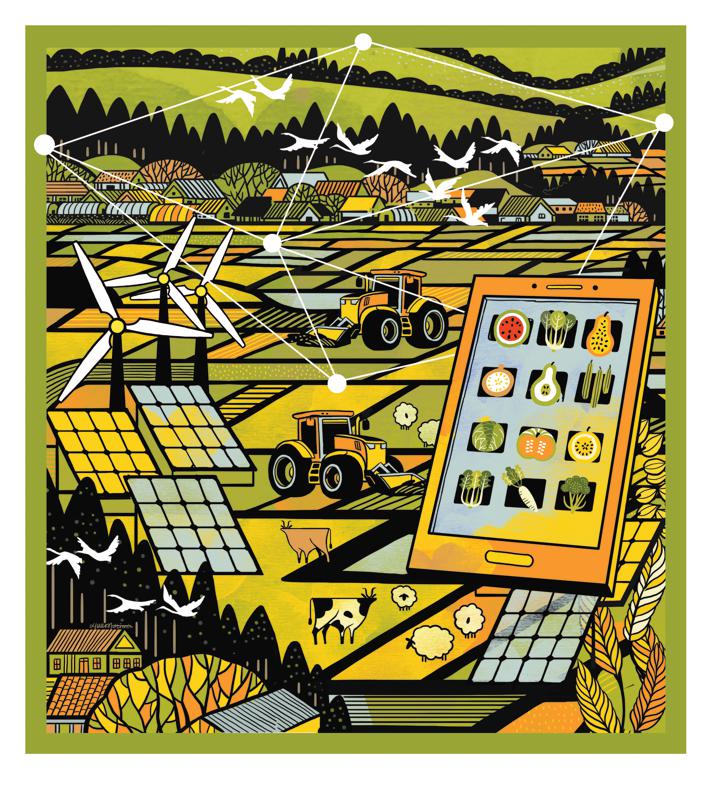
To drive China's agricultural and rural modernization, it is especially urgent to develop new, high-quality productive forces characterized by advanced technology, high efficiency and superior quality.
Following years of development, the efficiency and profitability of China's agricultural production has been increasing, and the overall capacity of its agricultural science and technology has been improving. By the end of 2021, there were over 72,300 employees working for China's agricultural scientific and research institutions, and about 500,000 employees in over 50,000 agricultural technology extension centers nationwide. The independent innovation capability of the seed industry has been greatly improved.
China's strength in agricultural science and technology has entered the first echelon internationally, laying a solid foundation for accelerating the development of new quality productive forces in the sector.
Since the 18th National Congress of the Communist Party of China was convened in 2012, China has been advancing rural revitalization and accelerating agricultural and rural modernization in an all-round way. Specifically in the field of seed breeding, China has scored an array of key breakthroughs and landmark achievements in the conservation of genetic resources and innovation in major varieties.
Furthermore, the construction of high-standard farmland in China has been accelerating. By the end of 2022, the country had 1 billion mu (66.67 million hectares) of high-standard farmland, which significantly improved the total factor productivity of the agricultural sector.
But at the same time, science, technology and innovation have become the main arena for global strategic competition. The development of new quality productivity in the field of agriculture depends increasingly on information, digital, synthetic and other technologies, and is bound to encounter more intense international competition.
Although China has made great progress in seed breeding, there is still a gap in frontier technology compared with major agricultural countries. In the context of intensifying geopolitical competition and in the face of the all-round containment and blockade endeavors of the US, original research results and key core technologies need to be developed and new quality productive forces cultivated in China's agricultural sector.
The problems and challenges confronting China's agricultural sector have further intensified the urgency of developing new quality productive forces in the sector.
According to the Third National Agricultural Census in 2016, smallholder farmers accounted for more than 98 percent of the total agricultural operating entities, and they operated 70 percent of the country's total arable land. The small-scale operation of cash-strapped smallholder farmers has resulted in the slow penetration of sci-tech innovation and difficulty in promoting industrialization and modernization, thus restricting the development of new quality productive forces.
Furthermore, a lack of cutting-edge agricultural technologies, especially major original achievements, insufficient investment, and a serious shortage of high-level agricultural scientists and technicians have made it difficult for China to meet the requirements for developing new quality productive forces in the agricultural sector.
The most arduous task in building a modern socialist country in an all-round way still lies in the countryside. Currently, compared with new industrialization, digitization and urbanization, the modernization of agriculture and rural areas is lagging behind, and the current situation of "big but not strong agriculture" needs to be changed.
First, China should make full use of both international and domestic markets, improve efficiency and build comparative advantages amid the mutual reinforcement between the domestic and international circulations, and achieve high-level sci-tech self-reliance by utilizing the free flow of global production factors and complementary advantages.
To enhance international cooperation in agricultural science and technology, China should strive to bolster exchanges and partnerships with top agricultural research institutions, increase joint and targeted research in advanced agricultural technologies, and facilitate the cross-border flow of innovation resources in this sector.
For example, the Consultative Group on International Agricultural Research has abundant agricultural germplasm resources and cutting-edge technologies, in particular rich management experience and knowledge in addressing agricultural development and poverty in developing countries. Strengthening cooperation with the CGIAR will significantly enhance the effectiveness of bilateral efforts.
Second, focusing on the core technologies of new quality productive forces in the agricultural field, China should launch special scientific programs for the world and build a number of agricultural sci-tech research and development platforms shared by the world.
Efforts should be made to deepen bilateral and multilateral international cooperation mechanisms, such as Belt and Road joint laboratories and various national natural science foundations, in order to facilitate joint research on cutting-edge agricultural science and technology.
Also, it is imperative to focus on joint research in natural sciences. Social science research including the organization and management of global agricultural sci-tech innovation, policy formulation, and regional and national research needs to be strengthened as well.
Third, to cultivate more agricultural sci-tech talents, it is important to continue bringing in scarce high-level agricultural sci-tech professionals and to enhance follow-up supportive programs for them.
Efforts should be also made in developing new agricultural sciences and promoting cutting-edge interdisciplinary research. Increasing the reserve of frontier agricultural sci-tech talents can be achieved through talent cultivation programs, such as strengthening the basic disciplines plan.
Fourth, China should deeply participate in global agricultural governance to enhance its influence on the agenda setting of agricultural science and technology, rules and standards, and development trends.
For example, the World AgriFood Innovation Conference initiated by China Agricultural University has made a good attempt to promote international agricultural sci-tech innovation and participate in global food and agriculture governance by establishing an industry-university-research collaboration mechanism.
Last but not least, it is imperative to deepen reform across the board to create a new-type of relations of production that is compatible with the new quality productive forces. Specifically in the field of agriculture, even traditional productive forces have not been fully released at this stage. It is thus an urgent task to promote the smooth flow of more production factors to agriculture and rural areas, break through the choke points between smallholder farmers and large markets, introduce new types of agricultural producers, operators and managers, and expand new forms of business to promote agricultural and rural development.
Xu Xiuli is dean of the College of International Development and Global Agriculture and professor of Humanities and Development Studies at China Agricultural University. Ma Junle is associate professor of Shandong Academy of Social Sciences. The authors contributed this article to China Watch, a think tank powered by China Daily. The views do not necessarily reflect those of China Daily.
Contact the editor at editor@chinawatch.cn.