A time to rethink
As the supply chain in East Asia gets reconfigured, China needs to seize the opportunity to achieve industrial upgrading and take on the challenges brought by major-country contest







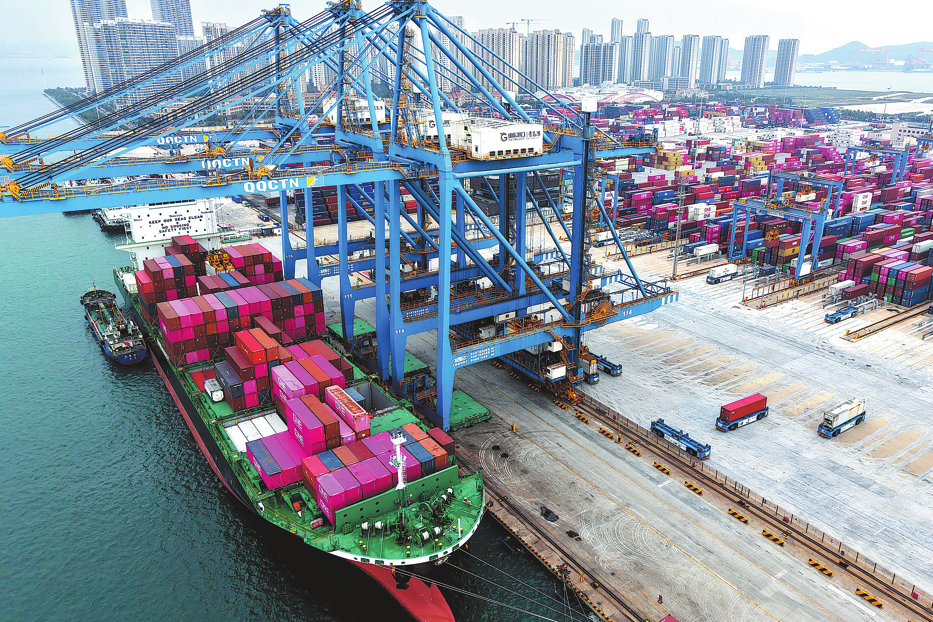
In recent years, the relocation of industrial chains from China has attracted widespread attention. Industry is the foundation of a country's economy, and getting integrated into the global industrial chain is important for a country to participate in the global division of labor. The Chinese economy is an integral part of East Asia's industrial chain, and to a large extent relies on it.
The relocation of industrial chains from China to the Southeast Asian nations will not only expand the scale of East Asia's industrial chains, but also profoundly reshape the region's industrial structure. China needs to pay attention to the emerging trend in East Asia's industrial chain, and adjust its policy accordingly.
Compared with the world's other two major regional industrial chains — North America and Europe — East Asia's unique advantage is its more diverse economic landscape. The development potential of a regional industrial chain lies primarily in its economic structure where different economies occupy different positions, and form an industrial chain with mutually complementary sectors and links. North America and Europe lack countries on the lower end of the industrial chain. By comparison, East Asia comprises economies at all levels of the industrial chain, therefore boasting greater development potential thanks to more complete industrial categories and a deeper division of labor.
In East Asia's regional industrial chain, Southeast Asian countries have many advantages in economic development.
First, the countries have a relatively high quality workforce with lower labor costs compared with countries such as India and Mexico, which makes the region an ideal candidate for the "world's factory". Second, the region has a stable political environment compared with Africa and South America, and is thus more attractive to investors. Third, the region has a solid infrastructure that offers enterprises with convenient production and logistics facilities.
However, the Association of Southeast Asian Nations is not a uniform alliance. While some countries have more developed economies, there are six less developed countries — Laos, Cambodia, Myanmar, Vietnam, Indonesia and the Philippines — that are the most likely candidates to take over industries transferred from China.
ASEAN has close relations with both China and the United States and remains largely neutral in the competition between the two powers, which helps the region benefit from the contest. China and the US jointly shape the economic landscape of Southeast Asia and its direction of future development.
First, China and the US are the two largest trading partners of ASEAN, having a huge impact on the region.
Second, both China and the US want to maintain their good economic and trade ties with ASEAN.China-produced intermediate goods and the US' consumption market jointly fuel the industrial development of ASEAN.
Third, despite their different motivations and goals, both China and the US support industrial relocation to ASEAN. For its part, ASEAN has joined multiple regional and global agreements to facilitate industrial relocation and give play to the region's advantages.
The relocation of the industrial chain from China to Southeast Asia will reshape the overall industrial landscape of East Asia.
First, China will strive to move up the value chain in East Asia by competing with Japan and the Republic of Korea. As ASEAN countries take over low-skill, low-added-value assembly work from China, the latter is turning to providing intermediate products to ASEAN. This not only drives down production costs, but also helps China circumvent sanctions imposed by Western countries on its exports. China's share of foreign added value contained in ASEAN exports rose from 1.6 percent in 2007 to 4.7 percent in 2021, overtaking the US, Japan and the ROK successively. It is foreseeable that as cooperation initiatives such as the China-Indochina Peninsula Economic Corridor and the Lancang-Mekong Cooperation framework deepen and China expands investment in ASEAN, it will surpass Japan and the ROK in terms of investment and vie with them for a higher position in the regional industrial chain.
Second, the US will increase its import of final products from ASEAN.
The US' de-industrialization process, which started in the 1980s, saw the relocation of lower-end manufacturing to regions with lower labor costs, leading to a hollowed-out industrial base in the country. As a result, on the one hand, the US has become more vulnerable to industrial chain disruptions and more dependent on other nations for key strategic products. On the other hand, the rapid technological progress in countries such as China poses a challenge to the US' dominance in high-tech fields.
To preserve its tech dominance, the US tries to rein in ASEAN countries through agreements and frameworks to get rid of its dependence on China's industrial chain and achieve the goal of "de-risking "from China. To this end, the US will reduce its import of finished goods from China and turn to ASEAN for alternatives.
In the face of the reconfiguration of the supply chain in East Asia, China needs to, on the one hand, seize the opportunity to achieve industrial upgrading; and on the other hand, take on the challenges brought by major-country contest.
First, although China is losing its advantage of low labor costs, it still has comprehensive advantages for manufacturing labor-intensive products, including relatively high productivity, a sound infrastructure and a complete industrial chain.
Second, China can position itself as a country in the upper stream of the regional industrial chain and provide intermediate products to the six less developed ASEAN countries. China can invest in the six countries' key sectors, such as infrastructure construction, manufacturing and energy, to fuel their development and share the dividends of their development.
Third, China should expand domestic consumption to reduce its dependence on European and US markets. It can also increase imports from the six ASEAN countries, which will boost the internationalization of the renminbi and expand its use in cross-border payments and transactions.
Su Qingyi is a senior fellow and director of the Department of International Trade at the Institute of World Economics and Politics at the Chinese Academy of Social Sciences. Gui Zihao is a postgraduate student at the University of Chinese Academy of Social Sciences. The authors contributed this article to China Watch, a think tank powered by China Daily. The views do not necessarily reflect those of China Daily.
Contact the editor at editor@chinawatch.cn.