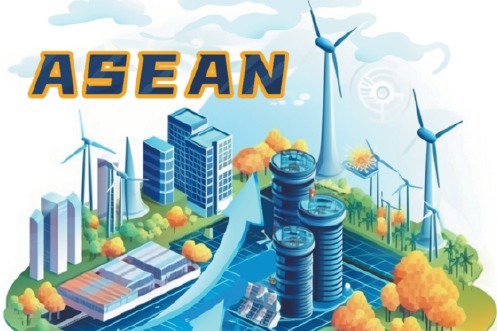
China and ASEAN rising together on the green front








That Asia is rising is evident from the fact the region accounted for 44 percent of the world's GDP in purchasing power parity terms in 2023 — a significant leap from 36 percent in 2010. On the other hand, Europe and North America have seen their shares dip, with Europe's falling from 26 percent to 22 percent and North America's from 21 percent to 18 percent.
This shift in global economic gravity is not driven by China alone. Southeast Asia's rapidly expanding economies — Indonesia, Malaysia, Thailand and Vietnam — are also reshaping the global economic landscape. Since the 2008 global financial crisis, Southeast Asia has achieved sustained growth, with real regional GDP expanding at an average annual rate of more than 5 percent through 2019.
While the COVID-19 pandemic slowed its momentum in 2020 and 2021, Southeast Asia's economic recovery is now well underway. The Asian Development Bank projects regional growth of 4.6 percent in 2024 and 4.7 percent in 2025 — higher than the global averages and outpacing major economies such as the European Union, the US and Japan.
As Southeast Asia strives to become the epicenter of growth, the global transition to clean energy presents an enormous opportunity to the region. With abundant natural resources, a strong industrial base and competitive labor advantages, Southeast Asia is well positioned to capitalize on rising global demand for clean energy technologies, ushering in a new era of green growth.
Partnering with China, the global leader in clean energy, is a promising strategy for the Association of Southeast Asian Nations (ASEAN) member states to navigate their journey toward green prosperity. China currently holds more than 80 percent of the global market share in all stages of the solar photovoltaic supply chain, from polysilicon to cells and modules. In electric vehicles (EVs), China accounts for nearly 90 percent of global cathode manufacturing capacity and almost all of the anode capacity — both essential for making mobility batteries. It also produces more than 80 percent of the world's battery cells and over half of global EV output.
In 2023, China's exports of the "new three" industries — solar cells, EVs and lithium batteries — amounted to 1.06 trillion yuan ($147 billion), a 30 percent increase over the previous year.
China's rise to clean energy dominance didn't happen overnight. It was built over decades of sustained investment, strong research and development support, and the creation of integrated industrial clusters. These efforts have enabled Chinese companies to evolve from relying on cost advantages in labor and materials to leading in advanced manufacturing and innovation, turning cutting-edge concepts into globally competitive products.
By partnering with China, ASEAN members can harness its technological expertise and manufacturing capabilities to fast-track their own development. This collaboration can enable industrial upgrades, spur economic growth and create jobs, while providing substantial business opportunities for Chinese companies and investors, creating a mutually beneficial cycle.
This collaboration is already yielding positive outcomes. Southeast Asia's solar industry, for example, has expanded rapidly, partly due to Chinese investment. Trina Solar, a major Chinese solar power equipment manufacturer, has set up production facilities in Malaysia, Indonesia and Vietnam.
By the end of 2022, Southeast Asia had become the world's second-largest producer of solar modules, trailing only China. The region's total module production capacity reached 70 GW, a striking leap from an almost negligible level just a few years ago.
Moreover, the region has made remarkable progress in ascending the supply chains, particularly in solar cell manufacturing and polysilicon production, partly with the support of Chinese companies.
In the EV sector, too, China's role is growing. BYD, one of the world's largest EV manufacturers, has established manufacturing plants in Thailand, making the country a key hub for EV production in Southeast Asia. The move is helping Thailand to achieve its ambitious EV targets and its aspiration to become a significant player in the global EV market.
For trade-dependent Southeast Asian countries, collaborative strategies — such as trade, technology transfer, jointly research, and investment — have long underpinned socioeconomic progress. Maintaining and deepening these collaborative ties, rather than retreating into economic fragmentation, is essential for realizing the region's full potential for green growth. And both sides, China and ASEAN, have the Belt and Road Initiative to thank for that.
Cooperative efforts, through the Belt and Road Initiative (BRI), to establish an interconnected regional supply chain — characterized by multiple, overlapping dependencies — could also reduce the risk of any single country dominating the entire supply chain and "weaponizing" economic interdependence. In today's complex geopolitical climate, where resilience and economic security are of paramount concern, this collaborative approach is increasingly vital.
Ultimately, a closer partnership between China and Southeast Asia can lead the world on a path to green growth, strengthening economic ties, enhancing regional resilience, and promoting sustainable development. Such a BRI-powered partnership would set a powerful global example of what can be achieved when economies come together for the common good, inspiring broader cooperation to accelerate the transition to a clean, sustainable and prosperous future for all.
Muyi Yang is senior policy analyst, Ember, an energy think tank, secretary, International Society for Energy Transition Studies and non-resident senior policy fellow, Asia Society Australia; and Shiyao Zhang is communication officer, Ember.
The views don't necessarily reflect those of China Daily.
If you have a specific expertise, or would like to share your thought about our stories, then send us your writings at opinion@chinadaily.com.cn, and comment@chinadaily.com.cn.