

US cell phone chipset manufacturer vows to cooperate with investigators
 |
|
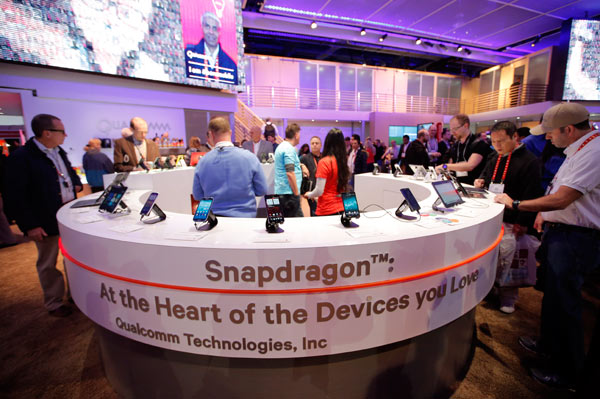
Qualcomm Inc's booth at the International Consumer Electronics Show in Las Vegas. Qualcomm reported $12.3 billion in revenue from China in the year ended Sept 30, which was equal to 49 percent of its total revenue. Provided to China Daily |
The US-based cell phone chipset manufacturer Qualcomm Inc is under an anti-monopoly investigation from China’s National Development and Reform Commission, the country’s top economic planner, casting a shadow on the company’s performance in a country contributing half of its revenue.
Qualcomm said on Monday the commission has commenced an investigation relating to the Anti-Monopoly Law. However, the company did not disclose further details, citing confidential concerns.
"The company is not aware of any charge by the NDRC that Qualcomm has violated the AML," Qualcomm said in an online statement. "We will do our best to cooperate with the NDRC," Qi Fei, a Beijing-based spokeswoman for Qualcomm, said on Tuesday.
The commission did not respond to China Daily's request for an interview on Tuesday.
Qualcomm's business in China falls into two parts — mobile phone chipset production and patent licensing. Most mobile phone companies such as Lenovo Group Co Ltd, as well as telecom equipment manufacturers Huawei Technologies Co Ltd and ZTE Corp, are Qualcomm's major clients in China.
Qualcomm reported $12.3 billion in revenue from China in the 12 months through September, equal to 49 percent of its total revenue.
"Thanks to its strong technology advantage and patent pool, Qualcomm has a dominating and incomparable position in the Chinese telecom and mobile phone industries," Xiang Ligang, a Beijing-based telecom expert, said.
Founded in 1985, Qualcomm was known for inventing a digital wireless technology named Code Division Multiple Access (CDMA). The technology later became the core part of some mainstream third generation (3G) telecommunications standards such as Wideband Code Division Multiple Acces.
About 5 percent of each mobile phone's cost goes to Qualcomm as a licensing fee, Xiang said. That does not include chipset charges if mobile phone companies use Qualcomm's chips.
Chinese mobile phone vendors have long been complaining that Qualcomm takes a tough stance in pricing negotiations. With fierce competition in the domestic market, many Chinese cell phone firms have to constantly push their products' prices down, but because costs change little, they suffer squeezed profits.
"Qualcomm's chipsets are of good quality and reliable, but we just cannot afford them," a high-level official from a Shenzhen-based mobile phone enterprise said, asking not to be named.
It seems that Qualcomm's competitiveness is going to extend to the 4G stage. Roger Sheng, an analyst with research firm Gartner Inc, said he has seen no other rivals to compete with Qualcomm in Long Term Evolution 4G chipsets, at least in the short term.
Paul Jacobs, chairman and chief executive officer of Qualcomm Inc, said in a September interview that China's entry into the 4G era will be a major driver for Qualcomm's sales in the country.
"When it comes to LTE (Long Term Evolution), we are on our third generation of chipsets, and we are really in the lead there," Jacobs said.
Sheng said the Chinese government's move will help protect domestic chipset and mobile phone companies but because the commission did not report details, it is still too early to judge how profound the impact will be.
Xiang said the probe into Qualcomm will force the US chipset giant to lower its position and probably decrease its royalties, especially at a time when local companies negotiate 4G chipsets and licensing fees with Qualcomm.
China enacted the Anti-Monopoly Law in 2008. The country strengthened its punishments over monopoly cases this year.
The commission fined six companies, including Mead Johnson Nutrition Co, Danone SA and New Zealand dairy giant Fonterra Co-operative Group Ltd, a total of $110 million in August following a four-month investigation into price-fixing and anti-competitive practices by foreign makers of baby formula.
Six liquid crystal display panel companies, including Samsung Electronics Co Ltd and LG Corp, were fined 353 million yuan ($57.9 million) for manipulating prices.
|
|
|
|
|
|
|
|

Copyright 1995 - . All rights reserved. The content (including but not limited to text, photo, multimedia information, etc) published in this site belongs to China Daily Information Co (CDIC). Without written authorization from CDIC, such content shall not be republished or used in any form. Note: Browsers with 1024*768 or higher resolution are suggested for this site.
License for publishing multimedia online 0108263 Registration Number: 20100000002731 


















 Op Rana
 Berlin Fang
 Zhu Yuan
 Huang Xiangyang
 Chen Weihua
 Liu Shinan