Comments
  Print
Print  Mail
Mail  Large Medium Small
|
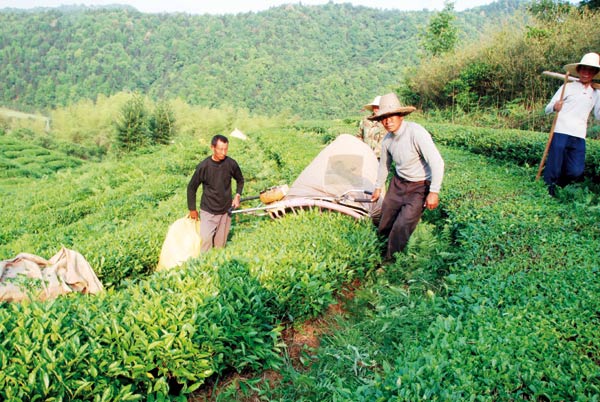 Tea farmers pick tea leaves in Wuyuan, Jiangxi province. More than half of the European market has been accounted for by Wuyuan organic green tea over the past decade. [Photo / Provided to China Daily]
|
Western health sensitivities help transform industry in remote area
After a winding 40-minute drive along a zigzag country road, you climb through a lane lined with osmanthus bushes that give off a sweet scent and finally reach the green-tea plantation of Jin Linsheng, glistening with morning dew and embroidered with thousands of spider webs.
"This is no ordinary green tea; it's organic, with no pesticides or chemicals," Jin says.
"See the spider webs? The more there are, the better the plantation's micro-ecology, the better the tea leaves will be."
Just as Western brands have conquered Chinese palates with coffee, Chinese organic tea growers like Jin in Wuyuan county, Jiangxi province, are now looking to cash in on Western tastes and health sensitivities.
Wuyuan, which is widely regarded as having some of the most beautiful countryside in China, plans to expand planting of organic green tea not only because of growing orders from overseas, but also because of awareness of food safety at home.
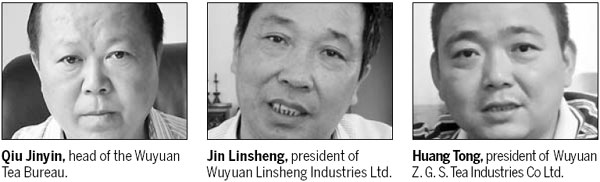
Qiu Jinyin, head of the Wuyuan Tea Bureau, says Wuyuan organic tea planting has been steady and has been unable to meet growing demand, with some companies still working on orders from last spring.
This year the county decided to gradually turn all its tea growing into organic operations and increase the growing area from its present 11,300 hectares to 13,000 hectares within eight years. Qiu says he expects the plantations will then produce 20,000 tons of organic green tea a year with a turnover of 10 billion yuan ($1.65 billion).
"We believe making organic green tea is the way forward for Wuyuan, because people's concerns about their health can only grow, and green consumption will continue to rise," Qiu says.
European market research company Euromonitor International says sales of organic green tea have risen greatly in the continent in recent years.
Last year the market in Europe was worth $31.7 million, it says. Germany ranked the highest at $13.2 million, about 21 percent higher than four years earlier, followed by France at $5.3 million and Britain at $3.4 million, both of whose sales were about a third higher than they had been four years earlier.
Diana Cowland, a health and wellness analyst with Euromonitor International, says more people in Europe are drinking green tea, and the demand for organic products generally is high because people look favorably on the reduced use or non-use of herbicides and pesticides. They like the fact that the tea is approved by recognized bodies.
Wuyuan is located at a latitude favorable to good soil and rain considered ideal for growing green tea. Many plantations can be found in the surrounding mountains, often shrouded in mist. Because of its remoteness, historical lack of transport and tea growers' traditional ways of planting, the leaves are very clean.
The China Tea Marketing Association says that last year Wuyuan county's green tea plantations covered about 11,300 hectares, producing 10,100 tons of tea valued at 1.36 billion yuan. Of that, 4,100 tons were organic, and about 2,400 were exported to Europe, with a value of $15 million.
"Figures are hard to come by, but the Wuyuan organic green tea market undoubtedly accounts for more than half of the EU market," says Yao Jingbo, deputy general-secretary of the association.
Tea used to be a pillar industry for Wuyuan and has a long history there. During the Ming and Qing dynasties (1368-1911), about 2,500 kilograms of Wuyuan green tea is said to have been served to royal families every year. Some was exported to Britain. Tea dances, songs and opera in the area were well-known throughout China, says Yu Xinzu, deputy general-secretary of Wuyuan Tea Association.
However, after the founding of New China in 1949, the planned economy system meant Wuyuan's green tea could not be sold domestically, most of it going to Europe and Africa, but only through an external seller and under the name China Green Tea.
"We weren't allowed to sell the tea ourselves," Qiu says. "Even visitors to Wuyuan who wanted to take tea home as gifts were only allowed to take 1 kilogram," Qiu says.
It was an easy time for Wuyuan because tea growers did not have to worry about marketing. However, after the reform and opening-up began, growers did not know how to deal with the open market, says Hong Peng, president of Jiangxi Wuyuan Dazhangshan Organic Food Co Ltd.
Hong says that lack of a brand weakened Wuyuan green tea's competitiveness as it went up against domestic big names including Longjing in Hangzhou, Zhejiang province, and Tieguanyin in Anxi, Fujian province. Overseas, Wuyuan tea was virtually unknown.
Copyright 1995 - . All rights reserved. The content (including but not limited to text, photo, multimedia information, etc) published in this site belongs to China Daily Information Co (CDIC). Without written authorization from CDIC, such content shall not be republished or used in any form. Note: Browsers with 1024*768 or higher resolution are suggested for this site.
License for publishing multimedia online 0108263 Registration Number: 20100000002731