China in 2017: anchor of stability, engine of world growth


BEIJING - In a world beset by unpredictabilities, China has stood firm in its pledge for stability and progress, and with each year it has continued to solidify its role as a key engine driving global growth.
The first two months of 2017 saw the Chinese economy on a steadier footing than a year earlier, with manufacturing activity picking up, inflation quickening and foreign trade recovering.
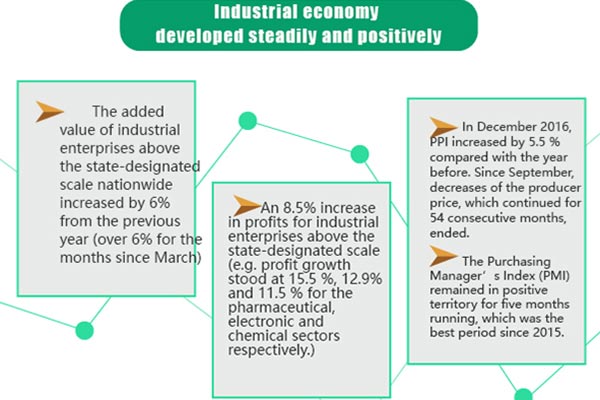
The manufacturing purchasing managers' index (PMI) came in at 51.3 in January, staying in expansionary territory for the sixth month, pointing to a stabilizing economy.
At a time when rising tide of protectionism and institutional changes, such as Brexit, threaten to challenge existing frameworks, attention is now centered on how the world's second largest economy will navigate the troubled waters.
China has set the basic tone of this year's economic work as "seeking progress while maintaining stability," hoping it would buy room to exploit new growth drivers and contribute to global recovery.
The upcoming annual sessions of China's top legislature and top political advisory body in March, the major political events with importance perhaps second only to the Communist Party of China's congress, will offer more details of the country's policy stance for 2017.
For years, China has made "seeking progress while maintaining stability" its main guiding principle, and it has paid off -- growth is expanding steadily, the job market remains resilient, incomes keep rising, and major reforms are injecting new vigor to the economy.
For 2017, the significance of stability could not be more emphasized.
Domestically, policymakers must balance multiple economic goals -- such as keeping growth within a proper range, curbing asset bubbles and containing debt levels -- and those targets would be unachievable without a stable environment.
Meanwhile, 2017 will see the opening of 19th Communist Party of China (CPC) National Congress, when a new central committee will be elected, making stability of great importance.
Outside the country, with the global economy fraught with troubles and uncertainties, China's role as an anchor of stability will at least offer some hope.
The IMF predicted global growth of only 3.1 percent for 2016. China, with an annual growth of 6.7 percent, would account for more than one-third of the growth.
"If China could not maintain stability, there would be little hope for the global economic recovery," noted Zhang Yunling, an international studies specialist who is also a member of the National Committee of Chinese People's Political Consultative Conference.
Despite China's commitment to stability, it is not trumpeting stability for stability's sake. Rather, policymakers are carefully choosing when is best to act.
Since China proposed supply-side structural reform at the end of 2015, steady progress has been made in five major areas: cutting industrial capacity, reducing housing inventory, lowering leverage, cutting corporate costs and improving weak economic links.
These efforts will be emphasized at the two sessions to facilitate China's economic restructuring, spreading optimism among global investors and economists on future prospects, which will also be a boon to the world.
Apart from advancing reform to address its own structural imbalances, China is committed to wider opening-up and greater engagement with the world to weather the testing time together.
Despite a growth slowdown, US investment bank Morgan Stanley this month estimated that China's private consumer market will expand to $9.6 trillion by 2030 and account for 47 percent of GDP.
While stronger consumption power means huge market potential for goods and service traders across the globe, a more open and advanced Chinese economy would bring investment and jobs overseas.
In the United States alone, robust bilateral trade ties with China have supported some 2.6 million jobs, according to a report from the US-China Business Council in January.
Despite emerging doubts over the benefits of globalization, China remains a firm advocate of free trade and believes that problems such as job losses will never be solved by running counter to the trend of history.
In an article published on Bloomberg Businessweek last month, Premier Li Keqiang made clear of China's prescription for the global economic ills -- "In a world with a plethora of uncertainties, China offers an anchor of stability and growth with its consistent message of support for reform, openness, and free trade."