Keeping the brand full of beans


|
 A Starbucks cafe in Beijing. The US-based coffee chain now has 700-plus outlets in more than 50 cities in the Chinese mainland. [Photo / China Daily] |
Global coffee chain looks for further expansion in China as it seeks to fend off rival outlets
Coffee industry veteran John Culver said he is very proud to be a pioneer in bringing the drinking culture of the beverage to this vast country with its 1.3 billion population and many thousands of years of history of drinking tea.
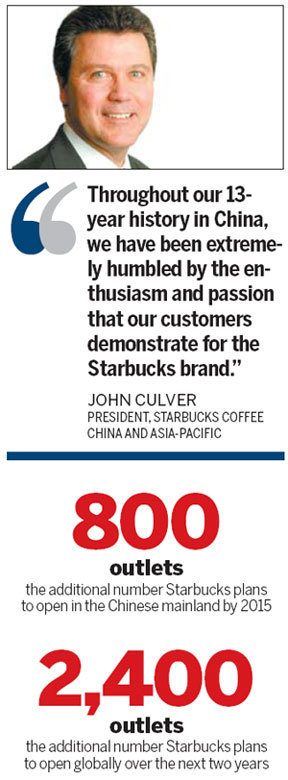
"Thirteen years ago, when we first entered this market, a coffee house culture did not exist in China. The Chinese had no idea what high quality Arabica coffee was and they really had no place to go to take their friends and family to try it," said Culver, president of Starbucks Coffee China and Asia-Pacific.
After opening its first outlet in the Chinese mainland in 1999, Starbucks has swept the market with its US-style coffee culture. Its image of a mermaid is now an icon of a chic Western lifestyle among Chinese people. Today, the chain consists of 700 cafes in more than 50 cities on the Chinese mainland, a firm foothold by any standard in this land of tea drinkers.
Undoubtedly many stick to their tea drinking habit. But coffee has a fast-growing appeal among younger people in big cities. To them, it's not just the coffee. It's the entire experience created by the meticulously planned and designed environment of the cafes that serve the drink.
|
 |
According to the latest Euromonitor report, Starbucks has a 61 to 62 percent market share in China's coffee house sector, way above its closest competitor.
The company recently announced an ambitious plan to open 2,400 new outlets across the world over the next two years.
It has set a target of opening 800 new cafes by 2015 in the Chinese mainland alone, where it will have 1,500 outlets.
"When we look back at the last 13 years since we entered the market, we see the Chinese found ways to embrace the Starbucks experience. They have made Starbucks part of their daily ritual, appreciating high-quality espresso (for example) and also coming to appreciate a third-place environment," Culver said.
The "third-place environment", one that is neither work nor home, is new to Chinese people - traditionally, treating guests to tea in one's home is the most common and safe means of social interaction.
Nowadays more people like to meet their friends or business partners in a coffee house, which provides a cozy setting with soft couches and warm light, and also doesn't have the noise associated with Chinese teahouses.
Culver joined Starbucks in August 2002 as vice-president and general manager of food services, responsible for leading sales, marketing and operations.
His focus on building brand awareness in traditional food service venues included positioning the Starbucks brand with slogans such as "We proudly brew Seattle's best coffee".
Culver and his team worked to increase the presence of the Starbucks brand with key US customers and to ensure that Starbucks' quality standards were maintained in more than 15,000 outlets. He was later promoted to president of global consumer products and food services, leading the strategy to support Starbucks growth and expansion of product offerings worldwide, including packaged coffee, ready-to-drink coffee, ice cream and teas and drinks.
In late 2011, when Culver was about to take the position as president of Starbucks Coffee China and Asia-Pacific, he was expecting "China to become Starbucks' second home market outside the United States".
These days, as Starbucks holds the leading position in China's fast-growing coffee outlet market, his ambition looks like it will soon be realized.
Starbucks China operating margin decreases
Waft of Yunnan coffee draws Starbucks, Nestle
Starbucks opens farmer support center in China