 |
|
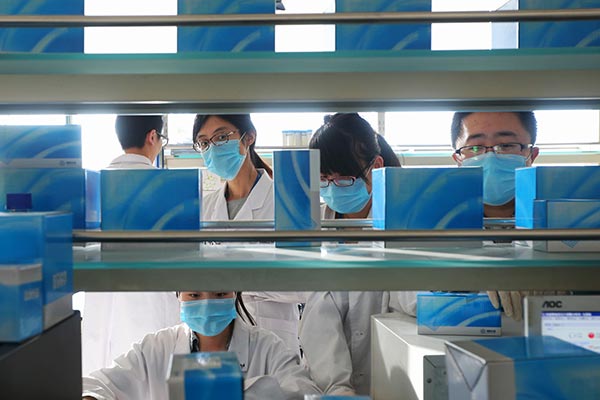
CapitalBio Corp's technicians at work in a laboratory in Beijing. DAI BIN / FOR CHINA DAILY |
CapitalBio Corp, a leading Chinese life sciences company that makes biochips, has been exploring markets in more than 30 countries as its technologies mature.
Its chips detect, and thus help prevent, hereditary disabilities and infectious diseases.
The company also develops and commercializes healthcare solutions, including innovative biochip-related products for genomic, proteomic and cellomic research, bio-safety testing, clinical applications and to address wider human health needs.
For 16 years, the company has been using its biochip technology to detect potential diseases that could cause irreversible damage such as deafness.
Overseas markets in Southeast Asia, Europe and the United States have supported its business for more than a decade.
China's biochip research and development were initiated in 1997. A decade later, the country's market size for biochips reached $100 million. The figure is expected to grow to $900 million by 2020.
CapitalBio was one of the first companies to invest in the promising sector. The company was founded in 2000 by Cheng Jing, who is now a professor of biomedical engineering at Tsinghua University and an academic at the Chinese Academy of Engineering. Back then, he had returned to China from the US.
The Biochip Beijing National Engineering Research Center was established to promote the new technology with a handful of professors from universities and research institutes such as Tsinghua University and the Huazhong University of Science and Technology in Wuhan, capital of Hubei province. Cheng was appointed the center's director.
As more than 100 companies entered the field over the past 19 years, Beijing and Shanghai rose to be the two major hubs for biochip R&D and production.
CapitalBio started to eye international markets amid fierce competition among domestic biochip producers. Europe and the US are the most important destinations for exports by CapitalBio.
During the past eight years, one of its five subsidiaries, CapitalBio Technology Co Ltd, exported 380 sets of biochip equipment worth $8 million to Swedish company Phadia, which was merged with the US company Thermo Fisher in 2011.
CapitalBio Technology also manufactured and exported biochip equipment worth $4 million to Nasdaq-listed US life sciences company Affymetrix Inc.
 |
|
Representatives of Vietnam-based Bimedtech company and CapitalBio Corp attend a groundbreaking ceremony for a biochip joint venture factory in Ho Chi Minh City, Vietnam.[Provided to China Daily] |
The two companies aimed to pursue a number of complementary products for research and molecular diagnostics for worldwide markets, which may include additional instrumentation, reagents and services.
The overseas expansion is deeply related to domestic operations. China has more than 24 million mute-deafs, and each mute-deaf entails at least 700,000 yuan ($107,000) in costs towards rehabilitation and assistive devices, according to Cheng.
"The born deaf are prone to be mute because they cannot hear anything. Our chip can detect the problem and let doctors implant equipment to correct their hearing and help develop language skills," he said.
Cheng said the company's biochips have been used to examine hereditary deafness in more than 1.32 million kids across the nation. As long as the syndrome is found, cochlear hearing implants can be used to rectify the problem and prevent such kids from becoming deaf-mutes, he said.
Southeast Asian countries such as Vietnam, Thailand and Indonesia are another key region for CapitalBio. Subsidiary CapitalBio Technology has been promoting biochips for detection of deafness and Mediterranean anemia at hospitals in Vietnam.
The company recruited Do Xuan Thang, a Vietnamese who studied in China, as a business manager to explore the market in the neighboring country.
"I often fly from China to Vietnam, and work as a business manager and an interpreter when my Chinese colleagues go to Vietnam," said Do Xuan Thang.
CapitalBio Technology aims to identify Vietnamese people suffering from Mediterranean anemia to prevent the disorder's spread. A child born to parents suffering from anemia needs blood transfusion at birth. Detection of anemia is crucial so that such couple could be advised against having children. Such an effort could also help manage population from the medical and demographic point of view.
CapitalBio Technology has established a joint lab with a Singaporean company to further promote biochips in the region, said Xu Junquan, its president.
Since each country has its own legal system to govern medicine and medical equipment, CapitalBio has to adapt and find a local partner to promote its products, said Ren Chen, manager of international business development at CapitalBio Technology.


Copyright 1995 - . All rights reserved. The content (including but not limited to text, photo, multimedia information, etc) published in this site belongs to China Daily Information Co (CDIC). Without written authorization from CDIC, such content shall not be republished or used in any form. Note: Browsers with 1024*768 or higher resolution are suggested for this site.
License for publishing multimedia online 0108263 Registration Number: 130349