 |
|
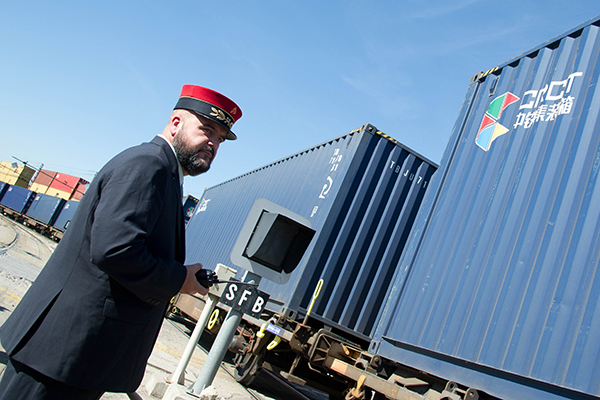
A Madrid-Yiwu train leaves for Yiwu, Zhejiang province, a city well-known as the largest small commodity wholesale market in the world. [Photo/Xinhua] |
Almost 150 years ago, Leland Stanford, a railroad magnate now better known for founding Stanford University, swung a sledgehammer to drive in a golden spike in Promontory, Utah, completing the last link in the first transcontinental railroad across the United States.
China's huge infrastructure investments over the past 15 years and President Xi Jinping's Belt and Road Initiative for spreading modern infrastructure links across Eurasia, remind me of the golden ages of building rail, road and canal links across North America. China will gain similarly vast benefits-in many ways we can't know in advance.
My wife tells me that, in her youth in the 1980s, it took 57 hours on uncomfortable trains to go from her hometown in Yunnan to Beijing. Now, it takes 13 hours and 40 minutes on luxurious high-speed rail, or about three-and-a-half hours on a not-too-uncomfortable plane. But, is this increased convenience worth the massive costs of infrastructure projects?
I was struck by a recent China Daily article discussing the establishment in Chongqing of the world's third-largest coffee futures exchange, made possible by a new rail link from there to Duisberg, Germany. Who could have predicted the creation of this business?
Similarly, my own hometown of Nashville, Tennessee, was a sleepy, fairly poor, southern town best known for country music and publishing religious literature. In the 1970s, a major airport was built and three new interstate highways connected there, making it a key node for traffic going north-south or east-west. It has since, maybe predictably, become a major logistics and automobile manufacturing center. Much less predictably, it is now the biggest US headquarters for healthcare companies and medical research and is a "hot" city for young professionals.
Pioneers going to Oregon or California in the 1840s spent at least four months in horsedrawn wagons. Many died along the way. The transcontinental railroad cut the travel time from the east coast to the west to 10 days. It stimulated the growth of trade between the coasts and made farming, mining and industry possible in the territories in-between. Earlier, the Erie Canal in New York State between the Hudson River and the Great Lakes cut the cost of freight transport by 99 percent. The US interstate highway system, started by president Dwight Eisenhower in the 1950s, spread prosperity from the northeast into the rest of the country.
China's new infrastructure will also be a game changer, promoting businesses and ideas in ways that are impossible to predict. China's new rail and road systems are at least equal to high-income countries, and its ports are better. This is a key differentiator that puts China far ahead of its economic competitors.
I once spent a month consulting for Indian Rail. I loved riding in the engine or the caboose of those scenic trains on routes built by the British, but they are slow and inefficient and hold back economic growth. Chinese ports can reportedly unload containers at a rate of one every 23 seconds. On a visit to the port of Mumbai, I was told that a ship has to wait six days on average before unloading even begins.
It is hard to estimate the cost-benefit ratio for infrastructure. And, it certainly is possible to plan badly. We have "bridge to nowhere" boondoggles in the US, Japan notoriously poured concrete everywhere in the 1990s in an attempt to stimulate its stagnant economy. Obviously, parts of China's infrastructure might not pay off. I once drove a beautiful, very expensive highway in the mountains with many tunnels in western Hebei province, which didn't seem to be carrying much traffic.
But, on net, China's infrastructure has fundamentally transformed the country. It promises to open up opportunities that only tomorrow's innovators and entrepreneurs can imagine. The Belt and Road Initiative spreads those opportunities to Earth's biggest continent.
I have a selfish interest in China's rail-my grandfather was a railroad man and passed along his love of trains. I've been trying to convince my beautiful wife that we should ride our bicycle-built-for-two from Beijing to Europe. But, it looks like that's not happening. So, I've added journeys on the new rail lines from Sichuan to Germany, and, eventually, Kunming to Singapore to my bucket list.


Copyright 1995 - . All rights reserved. The content (including but not limited to text, photo, multimedia information, etc) published in this site belongs to China Daily Information Co (CDIC). Without written authorization from CDIC, such content shall not be republished or used in any form. Note: Browsers with 1024*768 or higher resolution are suggested for this site.
License for publishing multimedia online 0108263 Registration Number: 130349