CHINA> Focus

|
CHINA> Focus
|
|
A pioneer in land-use rights reform
By Wang Zhuoqiong (China Daily)
Updated: 2008-11-21 08:40 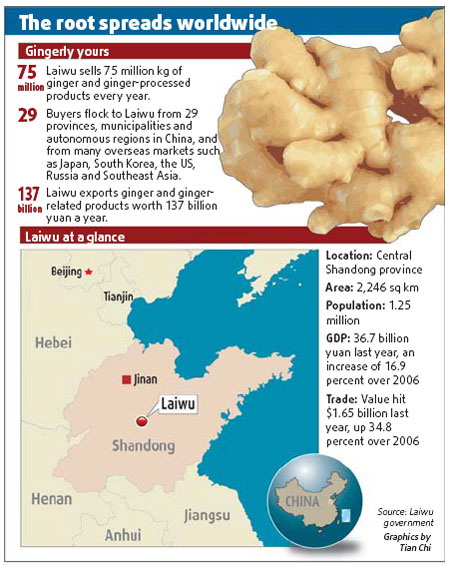 The result: by 2008, about 80 percent of villagers had transferred their land-use rights. "Some of those who have not done so are now eager to join," Liu says. So much has changed that Li is now the leader of a team of 40 farmers growing ginger. The 600,000 yuan ($87,841) the company paid to the village committee as management fee for the transfer "has solved many problems", says 45-year-old Jia. The village committee used the money to pay for road construction, tree-planting and other projects. There are two marked changes in the village, Jia says. With a rise in farmers' income, disputes among villagers, all too common earlier, have become fewer. And vendors' business is booming. "When people have extra money, they buy things So snack vendors and fruit-sellers see their products being sold in no time."
The Laiwu company has acquired about 180 hectares of land in Gongjiazhuang and three other villages. Last year, it produced about 30,000 tons of ginger and 50,000 tons of garlic. But raising output is not its only goal, for it pays equal attention to food safety and product quality. "If chemical fertilizer is sprayed on a plot, not only the ginger, but also the soil will be ruined," Liu says. The 44-year-old started a pilot food safety project with the Laiwu municipal government after he was laid off from a local government-affiliated foreign trade company. "If you want to get into the foreign market, there is only one thing to do - meet their quality standards," he says. The company has set up a lab at the cost of 20 million yuan, and built a duck-breeding farm to make its own non-chemical fertilizer. Growing ginger may not be a difficult exercise, but the method followed, fertilizer and seeds are vital in large-scale farming to guarantee food safety, Liu says. That's precisely why he has hired about 20 technical personnel to train the farmers in the art of growing more and healthy ginger. Since the company is also cost-conscious, it pays the village committee to find capable persons to lead the farmers' teams. "That saves us from hiring extra hands also, the leaders know the capabilities of the team members because they are from the village, too," Liu says. "But the committee has a say in employment and appraisal." The success of Gongjiazhuang will take time to be spread across the country. Han, of the State Council DRC's rural economy department, says it could take decades given the size of the country and the population in rural areas. The key to the reform is strengthening farmers' rights - the guarantee of voluntary transfer and ownership of profit. Plus, the government has to ensure that after the right to use a farmland is transferred, the person or company acquiring it uses it strictly for farming. Since land-use rights transfer is market-oriented, the role of the government should be as a rule maker, a watchdog and service provider, instead of a participator, Han says. If the country wants to ensure the food security then it is very important that a fixed area for grain farming is mapped out and non-farming industries are prevented from setting up plants in that area. Back in Gongjiazhuang, where a successful beginning has been made, farmers are becoming restless. They are now free because they don't have to till their farmland and are looking for work to earn some extra money. Forty-five-year old Liu Zhengcui juggles between home and the forage processor factory the family runs. She is raising some rabbits at home, too. Earlier, Liu's husband used to move to the city to work as a construction worker. But now, she says, he may not have to do so. Why? Is the family making that much extra money after transferring its land-use rights? Liu, a tall and slender woman, doesn't answer. But her smile says it all. |
||||
主站蜘蛛池模板: 常山县| 延川县| 五常市| 沾益县| 阿合奇县| 台东县| 新田县| 盱眙县| 收藏| 周宁县| 都兰县| 龙里县| 于田县| 卢湾区| 天长市| 漳平市| 赞皇县| 景泰县| 高阳县| 宁南县| 舞阳县| 松阳县| 台中市| 政和县| 抚顺县| 渝中区| 舟曲县| 武安市| 辉南县| 滨州市| 仁寿县| 富民县| 永善县| 南丹县| 廉江市| 六盘水市| 惠来县| 青冈县| 高尔夫| 华容县| 黑河市| 吴江市| 崇文区| 伊川县| 若尔盖县| 武穴市| 平顺县| 吉林省| 浙江省| 康平县| 城固县| 鹤壁市| 安岳县| 洛阳市| 无极县| 宜宾市| 焉耆| 苗栗市| 驻马店市| 汤原县| 云和县| 阿拉善盟| 南投市| 克什克腾旗| 嘉鱼县| 哈巴河县| 太原市| 闵行区| 息烽县| 中宁县| 北京市| 临澧县| 昌图县| 余庆县| 正定县| 余干县| 苍溪县| 且末县| 焉耆| 彭阳县| 开原市| 静海县|



