School is where the home is
Updated: 2011-09-28 08:02
By Zhu Zhaoxu (China Daily)
|
|||||||||||


|
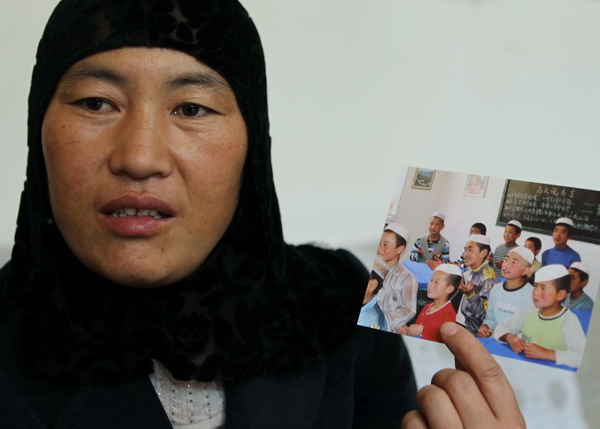 Ma Lan, who teaches at a community school in Gantugou, Dongxiang, shows a photo of her students when she started a school in her home village in 2003. [Photo by Xu Jingxing/China Daily]
|
It took her one-and-half hours to traverse a 7-kilometer dirt road from Gantugou, where she works at a community school for 82 children from the village and its vicinity.
"You can imagine how much longer it would have taken for a child to come to attend the Zhaojia school, the only learning facility for children at Gantugou and three other villages before 2003," the 38-year-old teacher said.
Zhaojia is one of the 24 townships in Dongxiang county on the Loess Plateau where residents, scattered among mountain ravines or ridges, used to cite lack of easy access to school as an excuse for keeping their kids at home doing chores or herding sheep.
The Dongxiang people, an ethnic group that has lived for eight centuries in the dry, forbidding mountains in Gansu province in Northwest China, are the least educated among the country's 56 ethnic groups, and have only less than four years of education on average even now.
Ma, a senior high school graduate, wanted to make a difference.
She asked the local government to post her to a "teaching spot" at her home village Gantugou in 2003, when education authorities planned to set up at least 50 such places to cut short the grinding distance for children to go to school.
By then Ma was already a teacher of stature, having taught at the Zhaojia school for a decade. At Gantugou, she had to start from scratch.
"There were only 30 desks for 65 school-aged children, and nothing else no walls, no roof; the Gantugou 'teaching spot' was all but a threshing ground," she said.
The wheat threshing floor was part of her family's property, but the Mas donated it to the "school", according to Zhaojia township chief Tang Shilin.
Ma fixed the blackboard on an earthen fence, and at night she would take it home, lest someone take it away for firewood.
Even after working for two semesters in the open air, Ma and her colleague did not see any signs that building for classrooms would start soon.
With revenues hovering around a meager 10 million yuan ($1.2 million) in 2003, Dongxiang county was in dire straits and unable to allocate further resources to help community schools in addition to conventional ones, according to Ma.
Ma and her family decided to build classrooms themselves, on another patch of land that was previously allocated to her household.
The pupils were at last able to study, sheltered from rain and snow, in 2004.
But getting children to school was another matter.
As most farmers survived on an average annual income of around 1,000 yuan in 2004, many had difficulty paying for their children to go to school.
"My salary was 164 yuan a month, much better off than farmers, so I would foot the bill for some from the extremely poor, and buy schoolbags and pencils for others, so that their parents would agree to send them to school," Ma said.
But even after the policy of exempting textbook and tuition fees for students in poverty-stricken areas was implemented in Dongxiang in 2006, some students dropped out.
Ma understood that to teach their children well, she had to teach their parents first.
"Your son may not end up entering a college after all, but finishing at least junior high school education means he can find a higher-paid job," she recalled telling the farmers.
While boys in Dongxiang were usually luckier, girls were victims of poverty and prejudice, the teacher said.
Statistics from the Dongxiang Education Bureau indicated that 10 years ago, one in four school-aged girls had no access to school.
"I would ask their parents what if the girls couldn't read road signs and get lost, or when you are ill, your daughter can't help with taking the prescription from the doctor," Ma said.
Ma promised to give extra lessons to girls, teaching them how to cook and do the laundry so that they could be of help back home.
Support eventually came. In an effort to meet the national criteria for eliminating illiteracy, Dongxiang has stepped up enforcing the compulsory education law. Some stubborn parents were even summoned to court for refusing to send their kids to school.
In 2007, Gantugou received generous aid from the government 100,000 yuan to revamp the classrooms.
Ma is now headmistress of the Gantugou "teaching spot", teaching math and Chinese language to two classes, each with about 20 students.
"We have 82 students in six grades but only five teachers and four classrooms, meaning we have to put two or three classes on 'self-study' while the rest are taught in the same classrooms," she said.
Things are getting better, as virtually no student has quit school over the past few years, she said.
It is only a matter of time, perhaps, that more and larger classrooms are built and the Internet, English lessons and a piano trickle in, she said with a hint of a smile.
- 271 injured in Shanghai's subway crash

- Sino-DPRK trade zone 'going well'
- Probe to look into fatal train attack
- Asian powers start key dialogue
- Spacecraft ready to go on mission
- Guard kills US citizen at CIA base
- Shanghai subway trains rear-end, 270 injured
- Last-minute preparations for spacecraft launch







Hot Topics
Libya conflict, Gaddafi, Oil spill, Palace Museum scandal, Inflation, Japan's new PM, Trapped miners, Mooncake tax, Weekly photos, Hurricane Irene
Editor's Picks

|

|

|

|

|

|