China's first space lab module ready for launch
Updated: 2011-09-29 06:35
(Xinhua)
|
|||||||||||


|
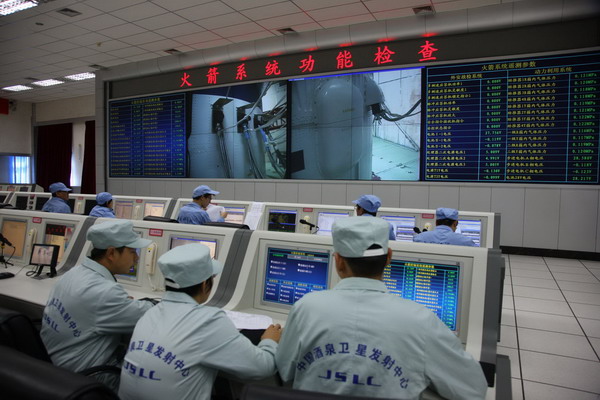 Workers check the Long March-2FT1 carrier rocket in Jiuquan, Northwest China's Gansu province, Sept 21, 2011. [Photo/Xinhua]
|
Fuel has been injected into the Long March-2FT1 carrier rocket, which the Tiangong-1 is mounted to and scheduled to be launched from Thursday evening at the Jiuquan Satellite Launch Center in northwest China.
The Long March-2FT1 is the latest modified model of the Long March-2 rocket series and features a more powerful thrust force, said spokeswoman Wu Ping at a press conference at the launch center.
The Long march-2FT1, which has been given more than 170 modifications, is 52-meters long with a payload to low Earth orbit of 8.6 tonnes, according to Wu.
The modifications to the rocket came after an unsuccessful launch in August when a Long March-2C rocket malfunctioned and failed to send an experimental satellite into orbit.
Engineers conducted comprehensive technical evaluations and made modifications to improve the reliability of the Tiangong-1's Long March-2F carrier rocket, which shares most of its components with the failed Long March-2C.
Wu said China is confident about the upcoming launch of its first space lab module, despite the highly risky nature of space explorations.
Despite August's failed launch, China's Long March rocket series has a success rate of 94.4 percent for its nearly 130 space launches since 1990 - a ratio higher than that of the world's total space launches.
Rocket modification
To contain the Tiangong-1 module, which is larger than China's Shenzhou manned spacecraft, the Long March-2FT1 has a larger nose fairing, according to Jing Muchun, chief designer of the Tiangong mission's carrier rocket system.
The shape of the rocket's boosters has also been modified to allow for greater fuel volume than the Long March-2F model, resulting in an increase in its thrust power, the chief designer said.
Compared with carrier rockets that the United States and Russia have used to launch moon-landing vehicles and space station components, China's Long March rocket series is much less powerful.
For example, a carrier rocket must have a payload capacity of at least 20 tonnes to send one single part of the International Space Station into low Earth orbit.
"China's manned space program aims at building up a space station, so we need a more powerful carrier rocket," Jing told Xinhua at the launch center.
"Research and development on a new, bigger carrier rocket that burns more environmentally-friendly liquid-oxygen-kerosene fuels is in progress," he said.
Docking tests for space station
If the Tiangong-1 successfully enters its low Earth orbit, it will await space dockings with the Shenzhou-8 spacecraft, to be launched one month later, and the Shenzhou-9 and -10 spacecraft, to be launched successively for more docking tests in the next two years.
After two docking tests with the Tiangong-1, the Shenzhou-8 will return to Earth and the Tiangong-1 will wait for the next docking test, Wu said.
According to the plan for China's manned space program, the Shenzhou-10 will be a manned spacecraft, possibly carrying a female Chinese astronaut who will test manual space rendezvous and docking with the Tiangong-1.
The 8.5-tonne Tiangong-1, with a length of 10.4 meters and maximum diameter of 3.35 meters, is scheduled to blast off between 13:16 and 13:31 GMT on Thursday.
The space docking tests and experiments conducted through the Tiangong-1 module will provide experience for China's construction of a permanent manned space station around 2020, Wu said.
Once it has mastered the space docking technology, China plans to develop and launch multiple space modules to assemble a 60-tonne manned space station around 2020 in which Chinese astronauts will start more research projects in space.
According to Wu, Chinese scientists have begun research on a manned moon-landing, but the government has no plan or timetable for such a mission.
Tiangong-1 leaves no junk
Upon completion of all space docking tests on the Tiangong-1, the module will conduct a controlled descent to re-enter the atmosphere and drop into a designated maritime area, according to the spokeswoman.
"We will enhance our monitoring and early-warning measures for space debris during the Tiangong-1 mission to prevent collision in space," the spokeswoman said.
"China is always willing to participate in international dialogue and cooperation to jointly handle space debris, and China will also bolster its exchanges and cooperation with other countries to contribute to the exploration and peaceful use of space," she said.
"We believe that international exchanges and cooperation in the field of aerospace engineering should be intensified on the basis of mutual benefit, peaceful use and common development."
China has carried out comprehensive cooperation and exchanges with countries such as Russia and Germany, as well as with the International Astronautical Federation (IAF), since it started its manned space program in 1992.
Wu said the Tiangong-1 will carry 300 IAF flags into outer space.
According to Wu, scientists from China and Germany will jointly carry out experiments on space life science at the Shenzhou-8 spacecraft.
One Chinese scientist and five international peers have also participated in Russia's Mars-500 Program, a ground-based experiment simulating a manned expedition to Mars.
Zhou Jianping, chief designer of China's manned space program, told Xinhua that China will turn its future space station into an international platform for space research and application.
"China's ultimate intention for developing space technologies is to explore space resources and make use of them for mankind's well-being," Zhou said.
Research on geography, astronomy and bio-technology in a low-gravity environment, such as that of a space station, will bring unimaginably greater achievements than those conducted on Earth's surface, he said.
Related Stories
Long March rocket fueled for Tiangong-1 launch 2011-09-28 20:31
China confident in launch of Tiangong-1 2011-09-28 19:30
Launch delays 'will not affect Shenzhou blast off' 2011-09-28 08:03
Last-minute preparations for spacecraft launch 2011-09-26 13:29
Forecasts signal late-week launch 2011-09-26 07:53
China to launch 8 Antarctic, Arctic expeditions 2011-09-25 20:22








Hot Topics
Libya conflict, Gaddafi, Oil spill, Palace Museum scandal, Inflation, Japan's new PM, Trapped miners, Mooncake tax, Weekly photos, Hurricane Irene
Editor's Picks

|
|

|

|

|

|