|
|||||||||||


Although the local farmers initially found it hard to understand the bohemian attitude of the "invaders", they became quickly integrated after several months.
Apart from getting regular income by renting out property to the artists, they also found work as cooks, housekeepers, security guards and gardeners.
|
 |
|
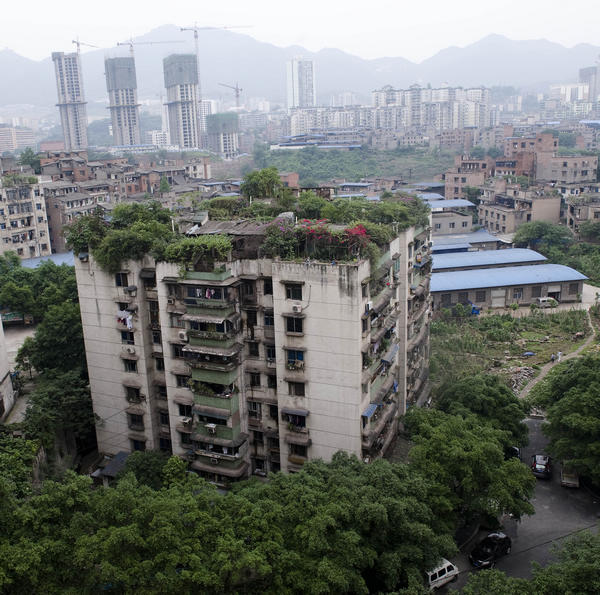
Some cities have already started greenings campaign, like this apartment in Chongqing. Planting food takes it a step further. Photo by Xinhua |
"A local farmer told me he used to know nothing about art, but now he can tell visitors who is who and how the artistic works are created," Liu says, chuckling.
He has confidence that in the future, not only artists but also those in related industries of film, animation, advertising, architecture, and industrial design will gather in this artistic village.
The growing community will attract more visitors, making it better known as an educational and art exhibition venue.
This looks like an ideal blueprint - indeed, a blueprint that has worked in many Western countries. In China, the creative industry is a cornerstone of the economy, and is developing 10 times faster than the traditional industries.
But most of all, this blueprint will signal the start of a new approach to the rural-urban relationship in terms of land use and human interaction.
It is this kind of approach that is surfacing and making urban planners sit up, take notice and take action at the recent 2011 Chengdu Biennale and the 2nd EU-China High Level Cultural Forum in Beijing.
In Chengdu, the delegates deliberated the concept of "garden cities" while in Beijing the debate revolved around "inventing cities", or "re-inventing" in this particular context.
Gilbert Hottois, a Belgium philosopher, said at the forum in Beijing that like many scholars he tended to attribute the fault of putting city and country, modern and traditional at opposing, conflicting sides to "modernism", which in its turn stemmed from the Industrial Revolution in the 18th century that gave birth to mass urbanization and an estrangement with the land.
However, with a rapidly increasing global population and worsening pollution, cities have reached the bottleneck of development and can no longer accommodate exploding numbers of people on their own.
Simply put, the next global vision will mean inventing "garden cities" that involve active collaboration between cities and rural areas, so both urbanites and country folks can optimize and enjoy conveniences such as global information, international networking, cutting-edge technology and design, without sacrificing pastoral and cultural heritage.
Wu Zhiqiang, director of the college of architecture and urban planning at Tongji University, also the chief planner of the 2010 Shanghai World Expo, leaves us this vision: "The international garden city conglomerate will be a Yangtze River delta composed of a mega city, several medium cities and rural hinterland nearby, instead of just Shanghai alone."
It is a vision with promise, and worth working towards.
You may contact the writer at sundayed@chinadaily.com.cn.





Hot Topics
HIV/AIDS, Egypt protest, Thanksgiving, climate change, global economic recovery, home prices, high-speed railways, school bus safety, Libya situation, Weekly photos
Editor's Picks

|

|
|
|

|

|