Labor backflow unleashes potential
Updated: 2012-02-25 22:38
(Xinhua)
|
|||||||||


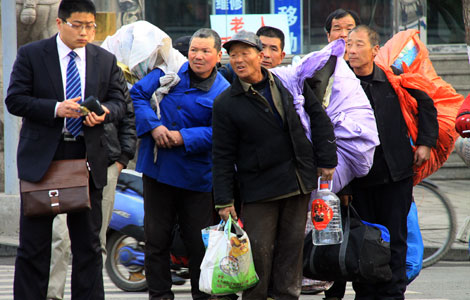
CHENGDU - Homesickness, arduous journeys and hurried farewells are common ills for China's vast population of migrant workers. But these hardships may disappear in the wake of industrial relocation initiatives designed to bring work closer to home.
Liu Zhao, a farmer from Ziyang county in southwest China's Sichuan province, took a job offer at a career fair held by the local government right after the Spring Festival holiday.
The fair was aimed at helping local firms recruit from their community after local migrants returned home for the holiday.
"You can earn about 2,000 yuan (317 U.S. dollars) a month with a job in a faraway eastern city. But now, I can make the same money at my doorstep," Liu said.
As Sichuan's biggest source of labor, Ziyang county sends about 60 percent of its population of laborers to work in economically developed eastern regions every year. But the number has dropped since 2009, with more laborers choosing to work closer to their hometowns.
A tug-of-war over labor, fought between the developed eastern cities and undeveloped central and western regions, has triggered heated discussion ahead of the government's primary legislative sessions.
The two sessions, which will map out a blueprint for the next year of development in China, are the fifth session of the 11th National People's Congress, China's top legislature, and the fifth session of the 11th National Committee of the Chinese People's Political Consultative Conference, the country's top political advisory body.
Although a labor backflow has served development in central and western China, the phenomenon risks slowing growth in eastern cities, which have relied on labor-intensive industries for decades.
"Why go back?" said Kang Houming, a laborer from Yongchuan county in southwest China's Chongqing municipality.
"I would've chosen to work in a coastal city ten years ago. But now, I would rather work at a local plant, as incomes are the same and the workplaces are closer to home," argued Kang, who earns 2,500 yuan a month at a local firm.
As controversial as the backflow is, observers said it reflects China's changing regional economic layout -- labor-intensive industries are relocating to inland regions, which has in turn pushed eastern regions to hasten industrial upgrading.
The labor backflow is also good news for global economic recovery, as it shows that China still has the potential to sustain its rapid growth.
The global financial crisis is itself another reason for the labor backflow, as more companies have moved their plants to inland provinces to find cheaper labor and offset the impact of the crisis.
Information technology giants such as Taiwan's Foxconn Technology Group and U.S. based PC-maker Hewlett-Packard, as well as large logistics, electronic and financial companies, have all shifted their production bases to west China since 2010.
Enterprises are often more than willing to recruit local employees, as their stability helps cut operational costs, said Liu Mingbin, director of the general manager's office of Chongqing Huanghe Motorcycle Co., Ltd.
The backflow is also related to the country's efforts to boost economic development in western regions and industrial restructuring in eastern regions. Regional development programs have been launched to help cope with the shrinking external market, and the government hopes to ensure an orderly and smooth relocation of industry to west China.
A guideline issued by the State Council, or China's cabinet, asked local governments to focus on industrial relocation and give full play to advantages in labor and resource.
The government has called for obtaining a 45-percent urbanization rate in western regions for the 12th Five-Year Plan (2011-2015) period, as well as boosting the regional GDP and residential incomes during the period.
Local governments have made preparations to undertake industrial transfers, establishing economic development zones and creating favorable policies for the new arrivals.
"We used to make calls to foreign companies to ask them to take on more local employees. But now they call us for more workers. We have to apologize and turn them down," said Wu Lixin, head of Ziyang's employment service administration bureau.
As China's economy slows, large investments will drive development in the west, making it a new source of growth, said Guo Xiaoming, deputy head of the Sichuan Provincial Academy of Social Sciences.
"The fight for labor appears to have had an adverse effect on eastern regions. But it will actually force these regions to push for restructuring and industrial upgrading, which will have a far-reaching influence on China's future development," said Lu Xueyi, a researcher with the Chinese Academy of Social Sciences.
Related Stories
China scene: West 2011-03-04 07:43
'China offers vital alternative to West' 2011-10-12 08:10
China's east, west enjoy economic 'honeymoon' 2002-04-11 10:50








Hot Topics
Wu Ying, iPad, Jeremy Lin, Valentine's Day, Real Name, Whitney Houston, Syria,Iranian issue, Sanyan tourism, Giving birth in Hong Kong, Cadmium spill, housing policy
Editor's Picks
|
|

|

|
|

|