Chinese society is aging much faster than expected and with the working-age population declining, children have become a pressing issue for the country, Li Yang reports.
 |
|
SONG CHEN / CHINADAILY |
The British economist Thomas Robert Malthus could not have expected his book An Essay on the Principle of Population published in 1798 would become a Bible for the family planning authority in China more than 200 years later.
Malthus argued a fast increase in population causes famine, a specter that has haunted China since warlords controlled swathes of the country in the early 1900s.
In an open letter to young people in the late 1970s, China's then Ministry of Health earnestly tried to persuade each couple to have only one child, and have it late, to save food and resources. The logic was quite convincing for people living a hand-to-mouth life in a planned economy.
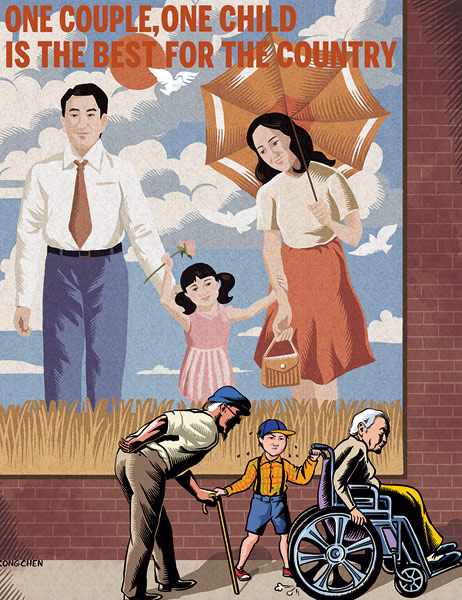
The benign persuasion finally evolved into the compulsory family planning policy that was implemented for more than 30 years, allowing most couples to have just one child. It has been claimed the measure succeeded in reducing China's potential population by 300 million over roughly three decades, and saved food and resources accordingly, for not just China but the whole world.
In fact, from 1980 to 2010, China's annual consumption of resources and energy increased fourfold, while its population increased by 30 percent, official data show.
Today, the family planning strategy has gone far beyond the realm of public administration, as it has reshaped at least three generations' concept of the family. "One couple, one child" has become the standard of modernity and normality, and the more children a couple have the more abnormal and backward the family seems to be.
Yet, the fertility rate, the average number of children a woman bears, in China today is far below the basic replacement fertility rate of 2.1. The family planning commission said its most recent survey in 2006 shows the rate was 1.87. The World Bank said China's fertility rate after 2010 has remained at 1.7.
Many experts suggest the actual rate is lower than 1.4, arguing it is in the interests of the government to exaggerate the figure to counter voices calling for an end to family planning, as it is a lucrative source of revenue that can bring in hundreds of billions of yuan each year in the form of the social compensation fees, which are de facto fines, paid by couples who contravene the family planning policy.
In 2013, under mounting pressure from the public and the media, two-thirds of the provincial regions disclosed the scale of the fees that had been collected, allocated and used in an opaque way for years, releasing the figures for the fees they had collected the preceding year. The 19 regions collected 16.6 billion yuan ($2.77 billion) in 2012.


Copyright 1995 - . All rights reserved. The content (including but not limited to text, photo, multimedia information, etc) published in this site belongs to China Daily Information Co (CDIC). Without written authorization from CDIC, such content shall not be republished or used in any form. Note: Browsers with 1024*768 or higher resolution are suggested for this site.
License for publishing multimedia online 0108263 Registration Number: 130349