Overdue reform
China merged the former National Family Planning Commission, a ministry-level department, with the former Ministry of Health to form a new National Health and Family Planning Commission in 2013.
Last year, the family planning policy was reformed to address the fast aging of the population, allowing couples, in which either party is a single child, to have a second child.
But only 920,000 couples applied to have a second child in the first year of its implementation, a small number compared with the 16 million births each year in China. In Shanghai, less than 5 percent of qualified couples applied. The Shanghai government said that the city's fertility rate is just 0.7, the lowest among major cities in the world.
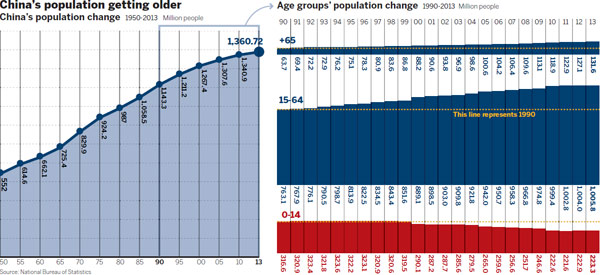
Chinese society is aging much faster than expected. China's census in 2010 put the overall population at 1.34 billion. In the past 10 years, researchers have altered their prediction of the population peak, with forecasts ranging from 1.4 billion in 2030 to 1.6 billion in 2050.
The latest UN prediction is that China will see its peak population of 1.39 billion in 2026, when the number of senior citizens above 60 years old will hit 411 million, up from 171 million in 2010, and the working-age population will fall to 696 million from 817 million in 2010.
Privilege of the rich
The relaxing of the family planning policy may have come too late, and the government must improve its public services to encourage eligible couples to have another child.
"China will almost certainly have low fertility rate in 20 years, even if the government abolishes all birth controls," said Cai Yong, a sociologist at the University of North Carolina.
Work and life pressures are important reasons why many women do not want more children. Li Ming, the mother of a daughter and a middle school teacher in Shanghai, said: "The high living costs make having the second child a privilege of rich people. The government does not help couples to raise more kids."
China piloted a two-child policy in Jiuquan of Gansu province, Yicheng of Shanxi province, Chengde of Hebei province, and Enshi of Hubei province from 1980, involving about 8 million people. Statistics show the fertility rate in the four cities has remained under 2 for the past 35 years because of the poor public services in these inland areas.
Population and the economy
The aging population is taking its toll on the economy. According to the National Bureau of Statistics, the working-age population, people aged between 15 and 59 years old, was 937.27 million in 2012, 3.45 million lower than the previous year. This is the first time China has seen the decline of the absolute number of its working-age population since the early 1960s, when a great famine swept the country.
Wages started rising fast from two years ago, and more and more factories are being relocated to the central and the western regions of China, Southeast Asia and Africa as companies seek cheaper labor and resources.
"Population policy is not a spring, when the policy is loosened the fertility rate will not necessarily rebound. But the low fertility rate is an inevitable result of the tight birth control," said Guo Zhigang, professor of sociology at Peking University, adding that China must use foresight in making its population policy, or a fast aging population will sap the country's innovation and production capacity.
Malthus could not have predicted the world population would rise 25 percent from 750 million to 900 million in the second half of the 18th century, and explode 2.5 times from 2.4 billion to 6.1 billion in the second half of the 20th century, two periods that also witnessed the fastest improvements in productivity and people's livelihoods.
Most of the great famines in history are caused by low production, rather than population explosion. According to David Lam, professor of demography at US Population Studies Center, from 1960 to 2010, the grain output rose more than threefold, the average per capita grain output increased nearly one and a half times, and the comparable prices of several important non-renewable resources almost remained unchanged.
The World Bank's data show the poverty-stricken population's proportion in the population of the middle and low income countries dropped from 52 percent to 25 percent from 1981 to 2005.
The correlation also exists between China's fast population rise from 1950 to 1980 and its economic rise after the 1980s. UBS Securities estimates the population dividend has contributed to about 0.8 percentage points of growth for the Chinese economy each year over the past 30 years on average.
In the future, the dividend for China will come more from the innovation of its young and middle-aged population.


Copyright 1995 - . All rights reserved. The content (including but not limited to text, photo, multimedia information, etc) published in this site belongs to China Daily Information Co (CDIC). Without written authorization from CDIC, such content shall not be republished or used in any form. Note: Browsers with 1024*768 or higher resolution are suggested for this site.
License for publishing multimedia online 0108263 Registration Number: 130349