Comments()
  Print
Print  Mail
Mail  Large Medium Small
The exchange between the Chinese mainland and Hong Kong is getting increasingly frequent and convenient since the Chinese government resumed the exercise of sovereignty over Hong Kong in 1997. In recent years, mutual understandings have increased and bilateral ties have been strengthened, while along with all the progress, clashes are inevitable as the two different systems are getting closer.
Growing influx
Expectant mothers from the Chinese mainland rushing to Hong Kong to give birth has been pushed to the front line of the clash between the people of Chinese mainland and Hong Kong. The growing influx of mainland women creates pressures on the city's obstetrics service and has affected Hong Kong local expectant mothers' access to maternity care, causing worries among some Hong Kong people.
The trend has continued to grow over the last decade. The total number of babies born to mainland mothers surged from 620 in 2001 to nearly 44,000 in 2011. Government statistics show the number of newborns of mainland women not married to Hong Kong permanent residents, or "non-local women", skyrocketed from fewer than 1,000 in 2000 to more than 35,000 in 2011.
Impulse to give birth in HK
It is commonly believed that such a trend is almost certainly connected to a ruling by the Court of Final Appeal in 2001 that any child born in Hong Kong automatically attains the right of permanent residency, regardless of the status of their parents.
The policy is driving thousands of well-off expectant mothers from Chinese mainland to seek ways to give birth in Hong Kong, where the permanent residents, it is believed, enjoy a better social welfare system and education. It is a fact that Hong Kong does better in bilingual education and has world-renowned institutions. Meanwhile, Hong Kong passport holders are granted visa-free entry by more countries.
Lin Xiaoshan, mother of a 4-year-old boy, said she decided to give birth in Hong Kong because "I want my boy to study abroad and a Hong Kong identity card will help a lot."
Besides Hong Kong permanent residency, which is granted to every child born in the city, many women also opt for overseas birth to circumvent the family planning policy, which limits most families to one child.
Zhang Lixuan, a 37-year-old mother from Wenzhou in Zhejiang province, went to Hong Kong to give birth to her second baby in 2009. "Due to the family planning policy, I had no choice but to go to Hong Kong to give birth," she said. "Or I would have to pay a heavy fine."
According to Beijing government policy, parents who have a second child must pay a penalty of up to 240,000 yuan. But babies born in Hong Kong become permanent residents of the special administrative region and do not have to pay the penalty.
Business opportunity
A market for "birth agents" has emerged with the increasing demand for delivering babies in Hong Kong.
According to some agencies, giving birth in Hong Kong costs more than HK$100,000 ($12,900), which is 20 times the average cost of giving birth on the mainland.
"Expectant mothers should expect to pay about HK$20,000 to get a bed in Hong Kong's hospitals. They have to pay about HK$100,000 to cover other costs, including time in hospital, delivery of their baby and babysitting service," said a staff member of an agency in Shanghai. He said the price varies with the level of service.
Agencies and care centers that help mainland women give birth in Hong Kong have raised their fees to about 250,000 yuan ($39,500), roughly 150,000 yuan more than in April, after York Chow Yat-ngok, secretary of the Food and Health Bureau of Hong Kong, announced on April 25 that maternity clinics in the special administrative region will be banned from accepting nonresidents by 2013, a move aimed at freeing up services for Hong Kong residents.
Local residents affected
The influx of mainland women has affected Hong Kong in recent years. Tam Yiu-chung, a Hong Kong member of the CPPCC and chairman of DAB, Hong Kong's strongest political party, said in an opinion piece in China Daily that he believes local residents have been inconvenienced personally by the crush of cross-border mothers, and their effect on maternity wards.
Undeniable facts in recent years have proved the "birth rush" by "non-local women" affects Hong Kong so much it is beyond local society's ability to handle it, said Tam.
"Hong Kong has limited resources, not only in providing beds for pregnant women but in education and healthcare. If there are more women from the mainland giving birth in Hong Kong, we will face a big shortage of social resources in the near future," said Chan Yuen-han, another CPPCC member from Hong Kong
Some local Hong Kong residents resorted to extreme ways to voice their concern and discontent.
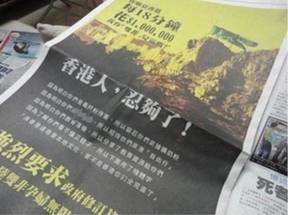
A full-page ad opposing pregnant women from the Chinese mainland giving birth in Hong Kong was published by a local newspaper on Feb 1, triggering a hot debate online.
 |
|
A newspaper in Hong Kong ran a full-page ad on Feb 1 opposing pregnant women from the Chinese mainland giving birth in Hong Kong. [Photo/Sino Weibo] |
The ad was co-funded by Internet users in Hong Kong, who have set up a group on Facebook to oppose pregnant women from the Chinese mainland going to Hong Kong to give birth.
The ad shows a picture of a locust crawling on top of Hong Kong's Lion Mountain with the headline: Are you willing to see Hong Kong spending HK$1 million every 18 minutes to bring up children whose parents are not from Hong Kong?
Although the non-local birth issue has cast a shadow on the ties between Chinese mainland and Hong Kong, the children born to mainland mothers also might help ease the burdens of the city's aging population.
Hong Kong has witnessed a continuing decline in the birth rate since 2003. The newborn population dropped from 86,751 in 1981 to 46,000 in 2003.
Chief Secretary for Administration of HK Stephen Lam responded that babies born of parents who are both non-Hong Kong permanent residents should be viewed positively, as they may become the new lifeblood of Hong Kong's aging population.
Measures to address this issue
Faced with the challenges posed by the "birth rush" by "non-local women" from the mainland, the Hong Kong SAR government began a series of administrative measures in 2007 and has been tightening rules to prevent the problem from getting worse.
At present, charges for public healthcare services in Hong Kong are divided into two categories based on Eligible Persons and Non-eligible Persons (NEPs).
As the local public healthcare system mainly serves Hong Kong residents, it is currently stipulated that only holders of Hong Kong Identity Cards or children under 11 years old who are Hong Kong residents are entitled to use healthcare services at government-subsidized rates.
Copyright 1995 - 2010 . All rights reserved. The content (including but not limited to text, photo, multimedia information, etc) published in this site belongs to China Daily Information Co (CDIC). Without written authorization from CDIC, such content shall not be republished or used in any form. Note: Browsers with 1024*768 or higher resolution are suggested for this site.
License for publishing multimedia online 0108263 Registration Number: 20100000002731