Ken Liu's science fiction awards bring global attention to Chinese authors of the genre. Kelly Chung Dawson reports in New York.
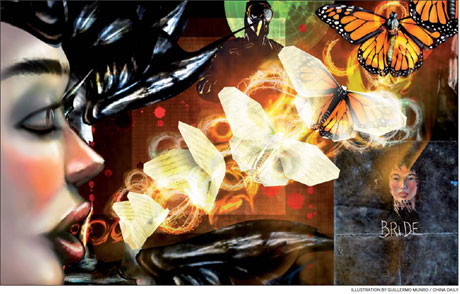
In Ken Liu's Hugo Award-winning short story The Paper Menagerie, a Chinese mail-order bride literally blows life into tiny paper animals folded for her American son. The story, which also won a Nebula Award in 2011, puts Liu in exclusive company with Harlan Ellison and only a few other prestigious science fiction authors who have won both awards.
In 2011 and 2012, his story about the rocky history of Chinese-Japanese relations, The Man Who Ended History: A Documentary, also received nominations for the Nebula and Hugo awards for Best Novella.
Although Liu was born in Lanzhou, capital of Gansu province, and lived there until he was 11, he now views himself as an American writer working in the Western literary tradition, he tells China Daily.
But his "Chineseness" is still an important influence, as evidenced by his choice of topics, he says.
"I also think of myself as Chinese," he says.
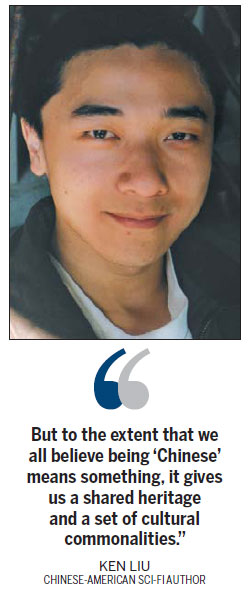
"Of course, a Chinese like me is not going to share all the same assumptions and beliefs as a Chinese born and raised in the PRC or a Chinese from Malaysia, or a Chinese from Canada. But to the extent that we all believe being 'Chinese' means something, it gives us a shared heritage and a set of cultural commonalities.
"I also think writers put bits of themselves into their work, and it is not surprising that parts of my life show up in my fiction."
Jamie Todd Rubin, author of In the Cloud, If by Reason of Strength and other science fiction works, describes Liu's work as wide-ranging and unique.
"I primarily think of Ken as one of the best writers of short science fiction out there today," Rubin says.
"But many of his stories do explore and involve Chinese heritage and the intersection of Chinese culture and American culture. Exposure to these cultural intersections makes the stories more interesting. And I suspect it is a breath of fresh air for a genre that has historically been dominated by American culture.
"Ken's work stands apart because he is both prolific and very, very good. We have prolific writers in science fiction and very good writers, but the intersection is pretty rare."
Liu's previous work as both a programmer and a lawyer combine to produce a self-professed blend of "technical rigor and emotional reach" that draws on published scientific research, he says.
With The Man Who Ended History, Liu turns his focus to Unit 731, a Japanese-run biological and chemical warfare research facility in Pingfang district of Heilongjiang's provincial capital Harbin, where war crimes were carried out against Chinese citizens during the War of Resistance against Japanese Aggression (1937-45).
Liu's story imagines a world in which a Chinese-American scientist and his Japanese wife (also a scientist) have devised a time machine, allowing the family members of Unit 731 victims to witness the crimes in person. The catch is that the trip can only be made once for any time period in question.
"The story is inspired by the experiences of Iris Chang, who, as a result of her efforts to bring attention to the Rape of Nanking, roused fierce opposition from denialists," Liu says.
"More than just discussing the atrocities, the story is also about memory, the limits of historiography, our collective responsibility to history, the hold of the past on the present, the ways that contemporary politics affect historical interpretation and the duty owed by all of us to the victims of past atrocities and their descendants."
The story patches together the imaginary accounts of those who have made the trip with the responses of academics, average citizens and critics on both sides of the issue in Japan and China.
Although the piece comes down heavily on the side of the Chinese, those medical personnel who participated in the experiments are also given an opportunity to justify their behavior in the name of science.
In one passage, a character writes: "Every time we tell a story about a great atrocity, like the Holocaust or Pingfang, the forces of denial are always ready to pounce, to erase, to silence, to forget. One has to be careful, whenever one tells a story about a great injustice. We are a species that loves narrative, but we also have been taught not to trust an individual speaker.
"Yes, it is true that no nation, and no historian, can tell a story that completely encompasses every aspect of the truth. But it is not true that just because all narratives are constructed, that they are equally far from the truth There are some narratives that are closer to the truth than others."
Liu also notes that Japan has actually publicly apologized on several occasions for war crimes committed against the Chinese, if only in vague terms.
The subject matter can be challenging for readers, Rubin says.
"Ken's stories often take readers out of their comfort zone and make them feel real emotion," he says. "The Man Who Ended History: A Documentary is a perfect example of this. I imagine many readers found the violence and atrocities in the story disturbing, but the story is really about facing the past, owning up to the past - good and bad - and not burying or denying the past."
It wasn't easy, Liu says.
"Research for this story was very difficult," he says.
"Beyond the issues faced by the typical historian of this era - destruction of evidence and suppression of records - there was also the issue of the denialists themselves. The hatred that they exuded was so extreme that I found myself losing faith in humanity at times.
"The generally positive reception the story has received, however, restores my faith. No matter how dark the world appears, there always seems to be a sliver of light."
Initiated in 1955, the Hugo Awards are presented annually by the World Science Fiction Society, which also sponsors the annual World Science Fiction Convention.
WSFS representative Kevin Standlee says: "Over their nearly 60-year history, the Hugo Awards, voted upon by the members of the annual World Science Fiction Convention, have been considered a good reflection of quality writing that appeals to informed and interested science fiction and fantasy readers."
The Nebula Award is voted upon by his peers at the Science Fiction & Fantasy Writers of America. Liu has also been nominated for the juried World Fantasy Award.
"His exceptional talent is widely appreciated. More generally, interest in Chinese science fiction appears to be on the rise," Standlee says.
He pointed to the Science Fiction & Fantasy Translation Awards, presented every year to work translated into English.
Both awards (for long and short form) were given to Chinese writers and translators this year: Liu received the short-form award for translating Chen Qiufan's The Fish of Lijiang; John Balcom of Columbia University Press received the long-form award for Huang Fan's Zero.
Liu's work is available online.
Contact the writer at kdawson@chinadailyusa.com.

|
|
|
|
|
|
|
|

Copyright 1995 - . All rights reserved. The content (including but not limited to text, photo, multimedia information, etc) published in this site belongs to China Daily Information Co (CDIC). Without written authorization from CDIC, such content shall not be republished or used in any form. Note: Browsers with 1024*768 or higher resolution are suggested for this site.
License for publishing multimedia online 0108263 Registration Number: 130349 













 Raymond Zhou:
 Pauline D Loh:
 Hot Pot
 Eco China
 China Dream
 China Face