 |
|
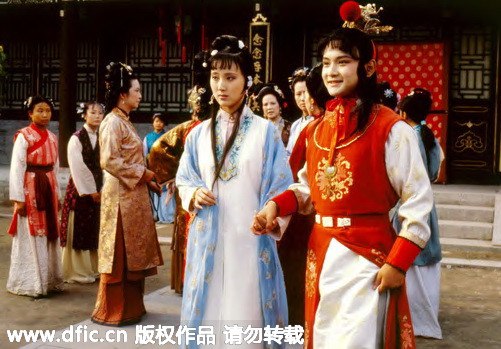
Still shot from TV series The Story of the Stone. [Photo/IC] |
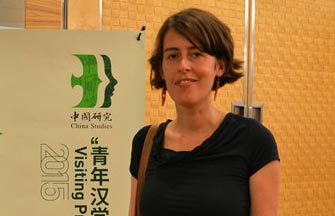
Annelous Stiggelbout is a Dutch translator and a sinologist. She participated in the 2015 Visiting Program for Young Sinologists hosted by China's Ministry of Culture and the Chinese Academy of Social Sciences.
Q: Why did you become interested in Chinese literature? What are the literary works that introduced you to the world of Chinese literature?
A: I have always loved to read and when I started studying Chinese, one of my long-term goals was to come to enjoy Chinese novels in Chinese. I started out reading Chinese works in translation, from works of contemporary authors including Zhang Jie, Zhang Xianliang to classics like The Story of the Stone.
Q: What is the first book that you read in Chinese? How come you chose this book as your first work of Chinese literature? How do you like this book?
A: Tackling a complete novel seemed rather daunting, so as my first book I picked King of Chess by Zhang Xiguo. I had read the first few chapters in class, and its use as a textbook made me want to try this novel, so I felt this was a book I could handle and it seemed interesting. It's about two men who discover a boy who can see into the future. The boy uses this knowledge mainly to get really good at Wuziqi, or gobang, and the men try to get him to cooperate to win fame and fortune for them. I quite liked the book.
Q: When did you start to have the idea of translating Chinese literature, and when you actually get started?
A: Translation is something I had been interested in ever since I knew more than one language and after studying Chinese for some years I started to translate for Het Trage Vuur, a periodical for Chinese literature in Dutch translation. My first translation was an excerpt of Mian Mian's Panda Sex, published in 2006.
Q: What is the biggest problem in translating Chinese literature? Can you give us an example?
A: There are many translation problems big and small: how to handle Chinese ways of addressing people (translating 小王(xiaowang) to 'little Wang' is rarely the best idea, and forms of address like 老板(laoban,or boss) or 師傅(shifu, or master) don't really exist in Dutch); how to handle cultural differences where something is completely obvious for a Chinese person but completely foreign for a Dutch reader; and others. But the problem that I encounter the most – and that is actually the core of my work – is that Chinese sentences often just don't work in Dutch. If I translate literally, it's correct but looks awful, so I have to find some way of saying the same thing but in a way that still looks good in Dutch. The story Ququ Ququ (Criket Criket) by Bi Feiyu for example contained the sentence "活人與亡靈之間依舊存在一種捕捉與防范的關(guān)系" (there exists a relationship of capture and precaution between living people and the souls ). Not difficult to understand, but it took me many tries to shape this into a Dutch sentence that was both beautiful and correct.
|
|
|
|
|
|
|
|

Copyright 1995 - . All rights reserved. The content (including but not limited to text, photo, multimedia information, etc) published in this site belongs to China Daily Information Co (CDIC). Without written authorization from CDIC, such content shall not be republished or used in any form. Note: Browsers with 1024*768 or higher resolution are suggested for this site.
License for publishing multimedia online 0108263 Registration Number: 130349 














 Raymond Zhou:
 Pauline D Loh:
 Hot Pot
 Eco China
 China Dream
 China Face