 |
|
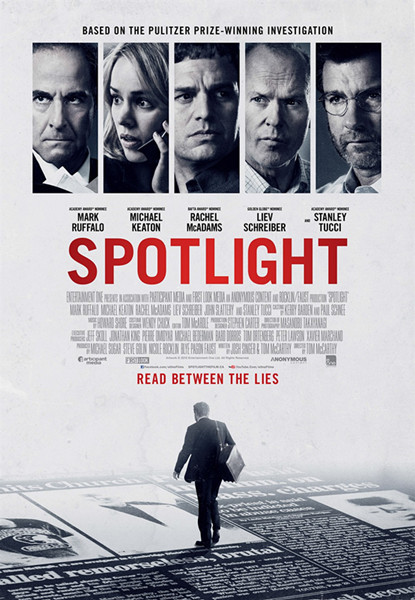
Poster of the 2015 film Spotlight [Photo/ Mtime] |
Robby Robinson was, as his character said in the film "Boston born and bred" and raised a Catholic. He attended the Jesuit-run Boston College High School, whose building is visible across Morrissey Boulevard from the Globe. He first came to the Globe in 1972 as a Northeastern University work-study program coop student. We worked together for several years and in 1981, when we left for Beijing to help found an English language paper for China named China Daily, Robby Robinson stayed at the Boston Globe and worked his way up the ranks.
In the afterglow of a successful movie, we sat down last month with Robby Robinson, now Editor-at-Large at the Globe, to talk about the future of print and investigative journalism in the Internet age, and the eternal pull of journalism.
Does the so-called "old fashioned" investigative journalism still exist?
Yes, it does, though not nearly as much as it should. The most important part of any investigative reporting remains the face-to-face interaction reporters have with people, both victims and victimizers. Getting people to open up on any subject is difficult to do by text, email or even telephone. Unfortunately, there is less and less of this kind of reporting, as editors in many hollowed-out newsrooms have decided that investigative reporting is a luxury they can no longer afford. They are wrong. It is a necessity we can not afford to do without.
Where is the present state of investigative journalism in this virtual age?
Newsrooms have far fewer resources - thanks to the Internet and its negative impact on revenues. But because of the Internet, reporters have many more resources at their keyboards. Thus, it is now possible to do online in a day or two the kind of reporting that once took weeks or months to do, if it could be done at all.
If so, how does it work now? And on what platform? What have we gained and what have we lost?
Two decades ago, for example, researching one person's property holdings could take weeks of going through musty old volumes in the courthouse. Now the same research can be done online in minutes. This is true in many areas of reporting.
And the platform: Once, one needed to work for a major news organization for his or her investigative work to be recognized and have impact. That is no longer true. Even bloggers, and smaller news sites, can do investigative reporting that will go viral if it is well done. Unfortunately, we have lost more than we have gained, simply because newspapers nationally have barely half the reporters they had two decades ago.
We come from a print journalism tradition. How do you apply professional ethics in this Internet age?
The temptations to cut corners are greater. To make money, many news organizations now feature so-called sponsored content - ads that are often hard to differentiate from news. Many radio stations now sell ads to companies with get-rich-quick schemes, ads they would have refused even a decade ago. Reporters are under so much pressure to produce stories in a hurry that some smaller papers now reproduce press releases as if they were news stories. These sorts of ethical lapses would have raised an outcry until recently.
Just as Watergate served to inspire our generation of journalists, do you think "Spotlight" will inspire a new generation?
It is our hope that the film will help prospective journalists understand that, despite the economic challenges to the news business, it is a noble profession, with an opportunity to effect change. I've spoken on several college campuses recently, and journalism students are inspired by the film.
When you talk to students about journalism, what do you hope to be the take-away for them?
I hope they understand that we all need to find a career that is rewarding; that very often journalists can shine a bright light into life's darkest corners; that journalists can give a voice to the voiceless; that journalists can help provide justice for life's victims; that journalism is a life worth living; and that the rewards for doing good journalism are greater than making it into the top one percent.

|
|
|
|
|
|
|
|

Copyright 1995 - . All rights reserved. The content (including but not limited to text, photo, multimedia information, etc) published in this site belongs to China Daily Information Co (CDIC). Without written authorization from CDIC, such content shall not be republished or used in any form. Note: Browsers with 1024*768 or higher resolution are suggested for this site.
License for publishing multimedia online 0108263 Registration Number: 130349 






















 Raymond Zhou:
 Pauline D Loh:
 Hot Pot
 Eco China
 China Dream
 China Face