Comments()
  Print
Print  Mail
Mail  Large Medium Small
 |
|
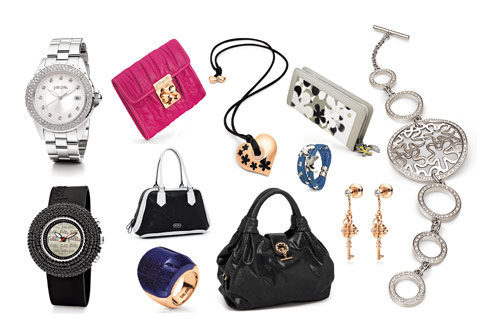
Folli Follie 2012 collection of watches, jewelry and bags. Mid-level luxury brands offer an attractive option for young people. Provided to China Daily |
China's growing middle class is going for "mass luxury" - brand names that promise quality but do not burn a hole in the pocket. Tiffany Tan scouts the market.
Wang Qian adores jewelry, and Folli Follie is her brand. Every few months, the 27-year-old heads to a Folli Follie store to pick up another ring, necklace, watch or pair of earrings. Why the fascination with the Greek fashion label with the flower motif?
"The price is just right, the designs are trendy and the quality is good," Wang, a resident of Panjin, Liaoning province, says after buying a new Folli Follie watch at a Beijing mall with her husband.
Another reason she regularly goes jewelry shopping may offend her favorite brand - but it hasn't diminished her loyalty.
"The jewelry fades pretty fast, so I need to find a replacement every so often," she says. "But anyway, the prices suit me."
Wang, a fresh graduate who is now doing an internship, is part of China's expanding middle class, which is fueling the domestic growth of mid-level luxury brands, such as Folli Follie, Coach, Longchamp, Agnes B and Marc by Marc Jacobs.
Referred to as "affordable", "mass" or "accessible" luxury, these labels occupy the space between inexpensive generic brands and high-end luxury like Louis Vuitton, Chanel and Gucci.
They offer an attractive option to consumers climbing the economic ladder: a brand name, better product quality and better design, but one that won't burn a hole in their pockets.
"This does not necessarily mean having products that use cheaper materials," says Angelito Tan, founding partner of Robert, Tan & Gao, a luxury consultancy with offices in Shanghai and Beijing.
"More often than not, it's simply having more products that are less expensive to make (such as accessories), providing consumers with a 'glimpse' of the luxury lifestyle experience at a price point that is not necessarily prohibitive," he says in an e-mail interview.
Prices vary depending on the brand and the product category. But generally, jewelry pieces cost 800-8,000 yuan ($127-1,270), while bags are 1,500-8,000 yuan.
Coach, an American brand best known for its handbags, is considered one of the leaders in accessible luxury on the Chinese mainland. This, say analysts, is due to the brand's "first-mover advantage" (it entered the market in 1988), extensive presence (at least 73 stores) and regularly updated merchandise.
It has also faithfully stuck to its niche. "Another thing Coach has done very well is avoiding competing head-to-head with true luxury brands," Leo Wang, an analyst at China Market Research Group in Shanghai, says.
"They don't set up stores near LV or Gucci. Coach stores are located in less upscale shopping centers, but the key is that they are usually the most visible tenant in those malls, so they get a lot more attention than they would if they were near a higher-end brand," Wang, who specializes in fashion retail strategy, says in an e-mail interview.
But China's accessible luxury market is still in its infancy, and brands know the battle for customer hearts and credit cards is just starting.
Studies put the Chinese middle-class population anywhere from 200 million to 300 million, and the figure is expected to grow exponentially within the next decade.
Athens-based Folli Follie, for one, has redirected its efforts toward China.
Last year, it signed Hong Kong model and actress Gaile Lai to be its global brand ambassador to show "how important this part of the world is for us", says CEO George Koutsolioutsos.
In June, the brand unveiled its largest flagship store in the world at Beijing's Oriental Plaza Mall. And within the next two years, it's planning to open 120 new stores on the mainland to bring the figure up to 250.
"We do believe, overall, that sooner or later, China will become the biggest market in the world, overcoming the US," Koutsolioutsos, whose parents founded Folli Follie in 1982, says in an interview in Beijing.
"We want to be part of this growth, for sure. We believe that this affordable luxury will have a bigger audience in the future," he says. "We are the perfect offering to feel luxurious and trendy for the season without, of course, spending a fortune."
But the brand, which entered the Chinese market in 2002, has to fight hard to keep customers like Wang Qian.
"Multiple competitors are at risk of stealing its share of a market that is only beginning to grow," says Leo Wang of China Market Research. "Most lifestyle brands face this threat as they have not been able to build a loyal consumer group yet."
But in a few years, the winds of change in the Chinese marketplace might just take Wang Qian to the doorstep of another brand. When she makes more money, Wang says, she wants to get something from the high-end French jeweler Cartier.
Contact the writer at tiffany@chinadaily.com.cn.

Copyright 1995 - 2010 . All rights reserved. The content (including but not limited to text, photo, multimedia information, etc) published in this site belongs to China Daily Information Co (CDIC). Without written authorization from CDIC, such content shall not be republished or used in any form. Note: Browsers with 1024*768 or higher resolution are suggested for this site.
License for publishing multimedia online 0108263 Registration Number: 20100000002731