Morsels of culture


 |
|
Hou Shuming runs a booth at Wan Feng Snacks. Photos by Wang Jing / China Daily |
 |
|
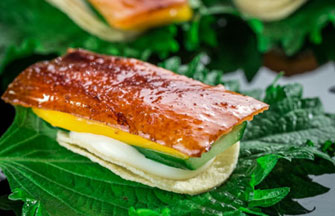
Clockwise from top: Beijing Traditional Snack Food Association head Hou Jia at Wan Feng Snacks; A traditional Beijing dessert found at Wan Feng Snacks; A craftsman makes candy figurines at Wang Feng Snacks; Pineapple fried rice sold at Wan Feng Snacks. |
The myriad snacks available in the capital are not only delicious delights but also offer a taste of history. Eric Jou reports in Beijing.
Beijing is known for a cornucopia of foods, from Peking Duck to the snacks along Wangfujing snack street, where one can munch such mouthfuls as fried scorpions on a stick.
But Beijing is now taking a leading role in bringing all of China's snacks and good eats to the table.
Enter Wan Feng Snacks (WFS).
The eatery in the capital's Fengtai district offers 52 delicacies from around the country in one three-story, traditional-style building.
It offers everything from dim sum to Taiwan omelets.
Chinese snacks are often enjoyed for their health benefits and readily available ingredients.
Many Chinese snacks are made with innards and other ingredients often discarded in the West.
To ensure the snacks are authentic, chefs and cooks from around the country have been recruited to man WFS' booths.
Beijinger Hou Shuming, who runs a traditional Beijing snacks booth in WFS, says: "WFS helps keep tradition alive."
Hou has been at WFS since its founding and looks forward to its expansion. While her booth is supposed to provide traditional Beijing fare, she also sells southern Chinese wonton and soup dumplings.
"Our booth, Wonton Hou, was created because of our love of old Beijing snacks," Hou says.
"While we make and sell other snacks such as wonton and soup dumplings, we're making the versions that have become part of Beijing."
Opposite Hou's booth is another stand offering specialties that are decidedly not Beijing-style.
Yang Zijie came to Beijing to open a shop selling Cantonese dim sum. The 28-year-old says he was attracted by the opportunity to promote traditional Chinese eats, but he came to Beijing to test the dim sum market.
"Business has been sporadic because people from the North and South have different tastes," Yang says.
He has sampled the competition, trying local dim sum institutions such as Jindingxuan.
Yang says Jindingxuan is good but has localized to accommodate northern taste buds - a move he laments he may have to take, too.
"Northern customers seek out traditional and authentic foods," he says.
"But they prefer foods that contain something they recognize."
While well-known, WFS isn't the city's only acclaimed purveyor of Chinese snacks.
The famous - or, rather, infamous - Wangfujing street market proffers some of the city's oddest eats.
Tourists try snacks such as fried scorpion skewers and starfish.
Another celebrated snack street is Nine Gate, which is located near Houhai and is puritanical in keeping its food traditional Beijing-style.
Nine Gates is WFS' spiritual predecessor. Both are owned and operated by the Beijing Traditional Snack Food Association.
Hou Jia, head of the association, started Nine Gates in 2006 to protect and publicize Beijing eats.
The 46-year-old says he "felt compelled to spread the history and wealth of all of China's eats to the world."
He puts it like this: "Snacks aren't just snacks. They are a part of culture and history. Every dish is riddled with history from the reasons its ingredients were chosen to how it has been consumed over time."
And such snack history can be devoured by development if not preserved, Hou Jia believes.
"Because life is changing so fast, many snacks are only found in certain places and could be forgotten," he says.
"So, we started WFS to promote China's snacks to the world."
Hou Jia believes Chinese snack food makers should study US fast food outlets, despite the distinctions in healthiness.
US fast food's strength, Hou Jia believes, is that it can be exported around the world while retaining its original - ultimately standardized - taste.
So, WFS strives to standardize regional eats, he says.
Hou Jia points out that many foreigners - and especially Westerners - can't accept that many Chinese snacks are made of innards.
He recalls that when German visitors weren't told they were eating intestines but, rather, something "traditionally good for them", while they heard the histories of the snacks, they were able to accept eating innards.
"If you travel from China to the US, it would be a waste to eat Chinese food," Hou says.
"Eating helps you understand a culture. You can see why the people have their eating habits and how the environment shapes their lives."