Comments()
  Print
Print  Mail
Mail  Large Medium Small
 |
|
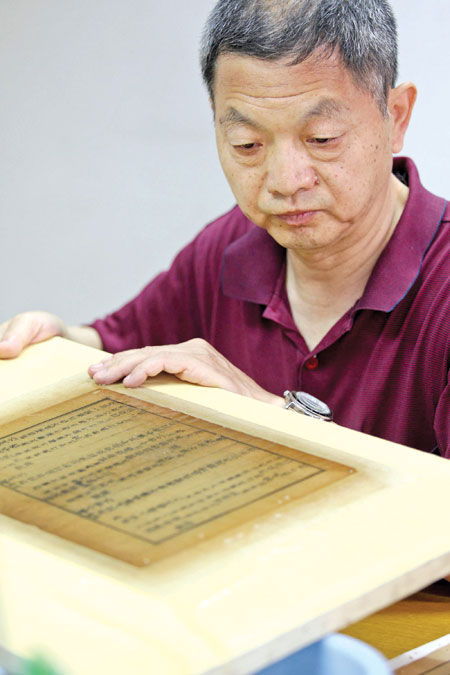
Du Weisheng, 60, has spent the past 38 years restoring ancient books at the National Library of China. Jiang Dong / China Daily |
In the country that invented paper, there are about 50 million old books waiting to be restored. Wang Kaihao finds out more about how, in Beijing, some dedicated craftsmen are working at the task.
The bustling crowds passing the southern gate of Beihai Park in Beijing every day probably do not give the building nearby a second glance. The unobtrusive block, built in 1909, houses a branch of the National Library of China, the country's first national-level modern library.
In the building, too, are about 1.6 million volumes of ancient Chinese books. According to the library's definition, any book published before 1912 falls into this "ancient" category.
Du Weisheng, a 60-year-old Beijinger, sits among the musty volumes.
He is a librarian and he has been tasked with restoring the ancient books since 1974. He had just retired from the army then, and was more than willing to exchange his weaponry for a writing brush, thread, paste and pieces of paper - his daily tools.
"I didn't want to do heavy labor, so I was quite happy to get the job," he recalls. At first, he knew little about ancient books and he was seconded to Peking University to learn how to catalogue books for a year before starting at the library.
"In the old days, the technicians didn't spend much time learning and many of them were illiterate," Du says. "This ignorance may have led to irreparable damage to the fragile volumes."
For example, books from the Song (960-1279) and Yuan (1271-1368) dynasties were generally bound by a butterfly fold, but restorers in later dynasties often used thread bindings and some even stitched loose-leaf books together and left folds on the pages.
"Book restoration is not just done once and for all. There is a saying: 'Old thread is like straw', and so we have to restore a book again and again," Du explains.
"However, the ancients were a lot wiser than us. They used huangbo to soak the Dunhuang manuscripts (Dunhuang is known for the Mogao Grottoes, which houses some of the finest examples of Buddhist art in Gansu province), which efficiently protected them from insects and mold for 1,600 years."
Huangbo, or Phellodendron amurense, is one of the 50 fundamental herbs in traditional Chinese medicine.
Du says book restorers mainly learned by experience. "This is crucial in our field," he adds. "For example, the pages of ancient books often stick to one another. Paper made from bamboo is easily torn and bark paper will become warped when stretched. I have to use just enough effort to separate them, something you get to know only through practice."
Du also has access to the country's first library test laboratory set up in 2007. Here, checks can be made on the type of paper, its thickness, tensile strength and other important data.
Although Du admits technology makes the work easier, he still considers machines to be only auxiliary. He says he can estimate the thickness of the paper manually just by feel, and only uses the machines for confirmation.
"Imagine if I had to test the thickness of every page by machine? That is why I think our job will probably never be replaced by machines."
Ancient Chinese scripts are easier to restore than Western books sometimes. Chinese volumes are usually printed on one side of the paper only, and the torn pages can be mended with a patch of paper on the back using homemade starch.
But their restoration can also be more complicated. The effect of acid on paper is a universal problem, but most mainstream solutions now available still focus on Western books, and are not suited to old Chinese books, which are generally thinner and more fragile.
Du says limewater is still used in China, although they are always looking for better methods since the limewater does not always work well.
According to Zhou Chongrun, the librarian in charge of the ancient collections, most of the volumes have to be kept in temperature-controlled rooms at about 16 C to 22 C. Humidity is kept at between 40 to 60 percent. But the collections are too large to be stored in such ideal conditions, because of the cost and space.
"We keep away the insects through the old-fashioned way of using camphor," Zhou says. "And thanks to the dry weather in Beijing, we are not much bothered by mold, although we still need to avoid direct sunlight."
But there are new problems. The library is now equipped with photo-catalyst air cleaners to pre-empt air pollution, which is a major cause for accelerating the acidification of paper.
There is also the perpetual worry of too many books waiting to be restored and not enough qualified restorers. According to Zhang Zhiqing, deputy curator of the library and deputy director of National Center for Preservation and Conservation of Ancient Books, there are only about 20 book restorers in the library.
"The ancient books are no longer closely related to daily life, but they form an emotional link to history and the past," Zhang says. He remembers a time when there were only about 100 qualified book restorers in the whole of China, but since a nation-wide ancient books protection project was launched in 2007, the numbers have expanded to more than 4,000. But it's still not enough, given that China has about 50 million volumes of ancient text waiting to be repaired.
Zhang thinks it is imperative that more attention be paid to the problem, and he thinks it's all about the attitude. Some local libraries do not place a lot of emphasis on the restoration, whereas some poorer, smaller libraries have done excellent work in protecting and restoring the books under their care.
"It's more about notions than money," Zhang concludes. There is also the dilemma of public opinion, which may be silent as long as nothing happens.
"Should some collection become damaged, the public will be very upset with us. So we must be very cautious."
Contact the writer at wangkaihao@chinadaily.com.cn.



Copyright 1995 - 2010 . All rights reserved. The content (including but not limited to text, photo, multimedia information, etc) published in this site belongs to China Daily Information Co (CDIC). Without written authorization from CDIC, such content shall not be republished or used in any form. Note: Browsers with 1024*768 or higher resolution are suggested for this site.
License for publishing multimedia online 0108263 Registration Number: 20100000002731