Comments()
  Print
Print  Mail
Mail  Large Medium Small
He admits he came to know the Western instrument by chance.
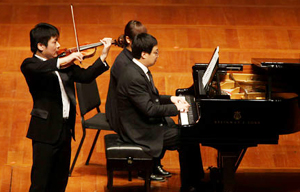
His parents, both influential chemical engineers in Shanghai in the early 1950s, determined that their only child should be musically literate. So, they enrolled him in piano lessons at 3 and two years later, opted for the easier-to-carry violin. "It was a fad during that time for parents to have their children take music lessons," Zheng recalls.
When the "cultural revolution" (1966-76) erupted, Zheng was banished in 1968, when he was 18, to a village in southern Anhui Province, as the son of "wealthy capitalists in Old China". He went alone, without even his violin, which was taken away by Red Guards.
He lived and worked with peasants for seven years. It was until 1973, when a friend lent him a violin, that he began to play again, with a renewed passion. Perfecting his technique, he started to perform in public and won acclaim.
"I always thought I would end up being a chemical engineer, but it was in the countryside that I decided to become a violinist," he recalls.
In 1975, when the fervor of the "cultural revolution" started to subside, and universities and colleges reopened, many aspiring violinists went back to school. Fearing that he was too old to take the university entrance exams, the 25-year-old chose to join the string section of a song and dance ensemble in a small city in the province, where he stayed for five years.
Deft with his hands, Zheng also served as the orchestral repairman.
That skill led to a measure of fame and two years later, he was invited to join the Beijing Music Research Institute, under the tutelage of violin maker Dai Hongxiang, who urged him to "make violins rather than play them".
In 1983, Zheng was sent to study at a prestigious violin-making school in Cremona, Italy.
Graduating three years later, he spent an additional year at Parma's Conservatory of Music, where he studied how to repair the instrument.
Armed with new skills, Zheng decided to run a violin-making research institute back in China. He was offered $50,000 by the Chinese government to buy books, equipment and 10 cases of wood, which became the foundation for the research institute under the Central Conservatory of Music.
Upon his return to China in 1988, Zheng searched the primeval forests in Sichuan, Yunnan and Jilin provinces for wood.
A section of imported maple could cost as much as $1,000. He figured he could find it cheaper in China. After discovering Chinese maple had what he needed, Zheng realized his aim: to create a credible violin with local material that could win international competitions.
He succeeded in 1991 when his violin won first prize for sound at the Stradivarius competition in Cremona.
However, Zheng is not satisfied with winning international awards alone.
"I hope to cultivate a violin culture in my country but it is not enough to have only a few people doing this," Zheng says.
Related: Lensman's badges of honor
Zheng serves as a National People's Congress Standing Committee member, specializing in art education.
Besides publishing numerous essays about violin making and its culture, Zheng also assumes the role of artistic and technical consultant for some violin-making studios.
In May 2010, he initiated and organized the first China International Violin Making Competition, in the hope of "lifting China's violin-making sector to a higher level".
Now, he is busy preparing for the 2nd China International Violin Making Competition, scheduled to run May 2013 in Beijing.
The first competition encountered many obstacles, "especially the difficulty of finding adequate funds and sponsorship for the event", Zheng says. "Officials, entrepreneurs and the general public did not see its significance."
China churns out at least 1 million violins, accounting for 70 percent of global production, for European and North American markets, including Italy, the home of the modern violin. Violin making has boomed in such places as Donggaocun village, in Pinggu, suburban Beijing, a major production base for export violins.
But "for the majority of the public, violin culture, violin making, playing, collecting and appreciation, still remains a new, exotic and even mysterious thing," Zheng points out.
The past decade has witnessed a surge in household purchases of Western instruments, including violins, in China.
However, "it is a shame that most Chinese parents ask their children to learn these instruments not for music's sake but for utilitarian purposes", Zheng says.
The motivation is primarily to equip their kids with another "weapon" to gain an advantage in the education system.
And average buyers and purchasing managers for State-run orchestras and opera houses don't really know a good violin from a bad one.
"People often pay too much for a poorly made violin," Zheng says.
Since 1989, his research institute has trained more than 100 professional makers in the Cremona tradition of violin making.
Many of them have gone on to win recognition at major international violin-making competitions. "Nurturing a younger generation of violin makers for China is an equally important task to my violin-making career," Zheng says with a smile.
Contact the writer at zhulinyong@chinadaily.com.cn.



Copyright 1995 - 2010 . All rights reserved. The content (including but not limited to text, photo, multimedia information, etc) published in this site belongs to China Daily Information Co (CDIC). Without written authorization from CDIC, such content shall not be republished or used in any form. Note: Browsers with 1024*768 or higher resolution are suggested for this site.
License for publishing multimedia online 0108263 Registration Number: 20100000002731