Comments
  Print
Print  Mail
Mail  Large Medium Small
 |
|
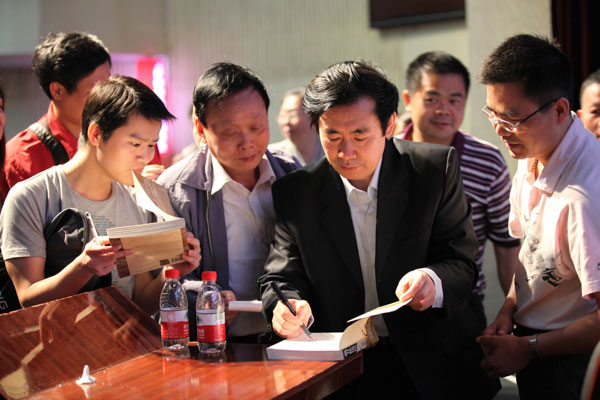
Author Zhang Wei draws a crowd of fans after his public speech about writing and cultural development in Guilin, Guangxi Zhuang autonomous region. Photos Provided to China Daily |
Novelist Zhang Wei has become a literary icon in China thanks to his prolific but diligent work, and his writing is now reaching more foreign readers as well, Mei Jia and Sun Ye report.
Shandong-based writer Zhang Wei says he seldom has felt writing is a pain while producing the biggest body of works in contemporary Chinese literature for more than 30 years.
"Writing is one form of labor. Nothing brings more happiness than doing work, since labor keeps people healthy in mind and body," Zhang says, speaking in a slow and confident tone as he chooses his words carefully.
"But if one writes with utility, he won't deliver the message," says the author of 10-volume prize-winning novel You're On the Highland.
He is convincing, because he has survived the loneliness of a long individual quest in writing and has remained calm like "a big animal" in the process of creating 14 million quality words.
During the 2013 Beijing International Book Fair earlier this month, Writers Publishing House released 19 volumes of Zhang Wei's Chronicle of Novels, while Hunan Literature and Arts Press launched Zhang Wei's Chronicle of Prose and Essays in 20 volumes in Chinese.
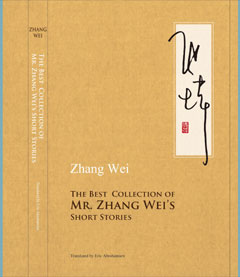
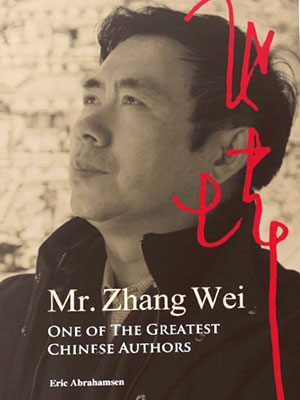
Meantime, Canada-based Royal Collins Publishing Group presented two new titles in English on Zhang Wei. The first is an interesting and useful introduction, Mr. Zhang Wei: One of The Greatest Chinese Authors. The second is an eight-story anthology, The Best Collection of Mr. Zhang Wei's Short Stories, which aims to let foreign readers know the writer better.
Eric Abrahamsen, co-founder of Beijing-based translators organization Paper Republic, writes the former and translates the latter book.
"His (Zhang's) exquisite descriptive power and the fairy-tale quality of his writing has led to a reputation as one of the most powerfully creative writers in China," Abrahamsen comments.
Zhang, born in 1956, started his writing career with poetry in 1975, before attempting his first novel.
"I was an eager reader and had read almost all of the translated foreign works at the time," Zhang says. "But the writers who influenced me deeply are ancient literati Qu Yuan, Li Bai, Du Fu and Su Shi."
Having won 60 literary prizes and published 300 titles in multiple languages, Zhang established his name with the novel The Ancient Ship, published in 1986.
The novel caused a stir because Zhang captured and previewed moments of turmoil in Chinese social transformation, as well as so-called sensitive topics then. The book's translator, Howard Goldblatt, called him a mystery among Chinese writers.
The next bomb he threw to his readers was September's Fable, published in 1992. It's a novel about the natural order being distorted by modernization.
Wang Yiren, one of Zhang's faithful readers born in 1974 and editor of the Jilin-based newspaper New Culture View, says these two works by Zhang influenced Wang and even reshaped his values and personal character to be an individual thinker and to contain loneliness and others' judgments.
|
 |
 |
|
Two new books, published in English by Royal Collins Publishing Group, may help more readers get to know author Zhang Wei. |
In 1988, Zhang began writing his magnum opus, You're On the Highland, about the vicissitudes experienced by four generations of two families over 100 years of social changes. Even his minor characters that are bad guys are vivid and have merits readers would love.
The result is a 10-volume novel with 4.5 million words, which also won him the prestigious Mao Dun Literature Prize in 2011.
"It's not a literary trial or a smart design that I wrote so long a novel. But it's a free expression, that I've longed for, of the ideas I got during my numerous visits to the countryside," Zhang says.
Zhang is not one of those writers who stay secluded in their study. Over the years, he has traveled many miles to experience reality in vast rural areas and talk with as many people as possible to gather literary sources.
"It's a habit I've been keeping for decades. Once I even stayed and lived at a burial ground for a month," he says.
"However developed and urbanized China becomes, rural China will be the most widely read subject because we have such a big population in the countryside," he says.
The first five volumes of the magnum opus are being translated into English, but that painstaking work will take a little time.
"Readers outside of China rarely get to appreciate the poetry and beauty of our composition. In the same way that a weak nation has no real diplomacy, a weak country gets no real appreciation of its works.
"So far as I know, many are reading to peep into an alien country to fill up their curiosity, not for literature. So a country has to be strong, and we should work for equal treatments in appreciating our literature," he says.
Chen Xiaoming, literary critic with Peking University, says Zhang is a highly creative and romantic writer.
"He is capable of showing the best of Chinese language. So in context of international literary exchanges, I believe his works show the charm and shared values of Chinese culture," Chen says.
Zhang believes a core value that will take a writer far is "how he can battle against the smallest thought of opportunism to gain profit out of writing".
Two of Zhang Wei's latest collections of prose and essays are from his lectures at the Wansongpu School. An estate Zhang started building in 2003 at the northern part of Jiao-dong Peninsula, it hosts lectures and academic exchanges for talented students.
"To me, a good novelist is the one who takes responsibility in practice," he says. "I saw problems in education then I set out to solve the problems as much as I can," he says.
"I love to lend a hand to writers-to-be because I remember how hard it was for me to start from scratch."
|
|
|




Copyright 1995 - . All rights reserved. The content (including but not limited to text, photo, multimedia information, etc) published in this site belongs to China Daily Information Co (CDIC). Without written authorization from CDIC, such content shall not be republished or used in any form. Note: Browsers with 1024*768 or higher resolution are suggested for this site.
License for publishing multimedia online 0108263 Registration Number: 20100000002731