 |
|
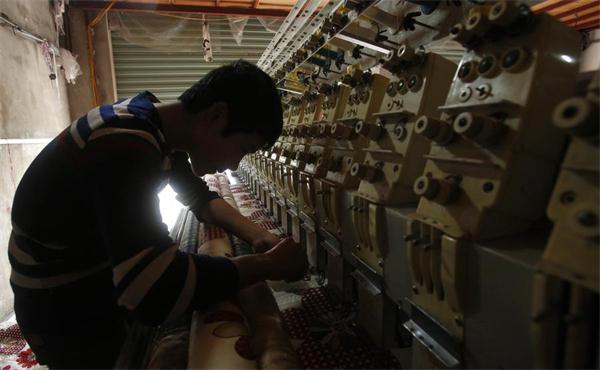
Phan Dinh Dai works with a made in China quilting embroidery machine at a factory producing blankets, sheets, pillows and cushions at a village outside Hanoi January 27, 2015. [Photo/Agencies] |
The development of manufacturing industry has been a key contributor to China's economic transformation. This will be so in China's next stages of development too.
According to World Bank data, China's manufacturing industry now accounts for almost 20 percent of global manufacturing output. This production quantity is impressive, if not staggering, but the macroeconomic factors that led to China's comparative advantage are now rapidly eroding and giving way to a "new normal", which is characterized by rising labor and operating costs, persistent periods of sluggish international demand, and an increasingly sophisticated domestic consumer with rising quality standards and rapidly changing tastes. As a result, domestic manufacturing growth has been slowing at a more rapid rate than the broader economy.
If China's massive manufacturing base - deliberately developed over many years - to remain a major source of domestic employment and economic activity, it must rapidly transform and upgrade. To engineer this redirection in the industry, Premier Li Keqiang has put forward a concept dubbed "Made in China 2025", and the State Council, China's Cabinet, has set up a leading group for the ambitious plan. Led by vice-premier Ma Kai, the group will coordinate, deliberate and implement plans for becoming a world manufacturing power. This means the government is actively seeking to translate the qualities associated with "Made in China" from a past era of scale and replication to those that are identified with the creation of high value-added products.
To achieve this, China needs to encourage entrepreneurship, expand government incentives that target and enable small and medium-sized enterprises to develop, and support the further expansion of overseas mergers and acquisitions. Improved vocational training will also be critical to success.
China is actively supporting the development of a new wave of manufacturers that it hopes will transition the country away from lower-value production to a focus on higher-value, advanced-technological and specialized manufacturing. To do so, the government seeks to develop domestic innovative brands, products and intellectual property through a process it refers to as "mass entrepreneurship and innovation".
This commitment to innovation is evident today in the growth of research and development expenditures. In KPMG recent report on global manufacturing outlook, we identified shifting perspectives on research and innovation among China-based manufacturing executives. We asked executives about their manufacturing plans for China, and 93 percent of the respondents said they would spend at least 4 percent of their revenues on R&D for the next 24 months. Two years ago, only 65 percent of the executives asked the same question had said so. Globally, 74 percent of the executives, responding to the same question, said they planned to spend more than 4 percent of their revenues on R&D. This indicates a significant rise in the emphasis on R&D in China.
As global enterprises seek to innovate in China in order to strengthen and defend their relevance to the country's emerging middle class, Chinese companies are increasingly looking overseas to acquire the skills and technology to leapfrog competitors in their domestic development. This growing wave of outbound mergers and acquisitions are fueled, in our view, less by the desire to establish overseas representation and capture foreign market share than by the need to acquire the tools necessary to effectively compete in an increasingly innovation-driven domestic manufacturing industry.
China must transition from its role as an imitator and outsourcer for the developed world to become an innovator and creator of solutions that incorporate and advance best-in-class technologies. This will be the new brand of "Made in China".
David Frey is partner and head of Asia Pacific industrial manufacturing, KPMG China, and Luke Treloar is senior manager, markets strategy, KPMG China.


I’ve lived in China for quite a considerable time including my graduate school years, travelled and worked in a few cities and still choose my destination taking into consideration the density of smog or PM2.5 particulate matter in the region.
Copyright 1995 - . All rights reserved. The content (including but not limited to text, photo, multimedia information, etc) published in this site belongs to China Daily Information Co (CDIC). Without written authorization from CDIC, such content shall not be republished or used in any form. Note: Browsers with 1024*768 or higher resolution are suggested for this site.
License for publishing multimedia online 0108263 Registration Number: 130349