 |
|
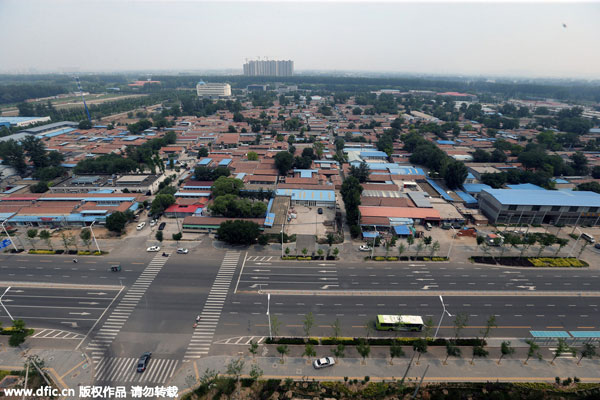
Lucheng town in Tongzhou where Beijing will relocate municipal administrative bodies. [Photo/IC] |
To focus on its role as China's capital and shift some non-capital functions from the city center, Beijing has decided to make its Tongzhou district a "subsidiary administrative center". Tongzhou, which has reportedly earmarked about 55 square kilometers to accommodate nearly 15 percent of Beijing's urban population by 2020, is also part of the national strategy of integrating the capital with neighboring Tianjin municipality and Hebei province.
But it is doubtful whether Tongzhou can prove to be a permanent cure for Beijing's "urban diseases", especially its dense population that is testing its urban infrastructure. Densely populated urban areas often signify inclusiveness and prosperity, while decreasing resident numbers presages recession.
What is really wrong with Beijing's urban planning is the lack of infrastructure, especially transport. Although it is home to at least 20 million people, Beijing has only about 527 kilometers of subways - way less than Tokyo's more than 2,500 km and New York's 3,342 km. As a constantly expanding metropolis, Beijing needs more than 2,000 km of subway lines and rapid bus transit lanes.
Unfortunately, Beijing's focus has been on road transport to facilitate real estate development. A metropolis like Beijing should develop its real estate sector on the basis of its subway links. The lack of such a development plan forces residents to commute by car, worsening the traffic jams and air pollution.
Moreover, Beijing's urban planning, especially administrative divisions, is not suited to developing suburban districts, which now play a key role in urbanization across the world.
In 2010, the US' top 100 metropolitan areas were home to almost 65 percent of its total population, and accounted for 75 percent of its GDP and 92 percent of patents. To some extent, the US economy is not state-based but metropolis-based. But the top 100 cities of China are home to less than 20 percent of its population and only half of its GDP.
The difference in the demographic structures of the two countries has a lot to do with their tertiary industries and innovative capabilities. Tertiary industries account for about 80 percent of the US' GDP but barely 50 percent of China's.
The concentration of people in bigger cities is the result of market-based resource allocation. Being the country's center for technological innovation, Beijing needs more talents and enterprises to live up to its assigned role despite lacking water sources, which can be resolved by increasing water prices, reducing its use in agriculture and industry, and desalinating sea water.
On one hand, sky-high property prices in Beijing in recent years have curbed the increase in its population. On the other, the uneven distribution of local inhabitants has dealt a blow to Beijing's healthy development. The population density in four of Beijing's six districts (with a total area of 92 sq km) with core capital functions is 23,758 people per sq km, while in the other two districts, Haidian and Chaoyang, (1,276 sq km) it is just over 7,900.
Given these facts, a subsidiary administrative center has to be an integral part of Beijing's comprehensive urban planning, not a temporary plan to accommodate some of its residents. Given the distance of more than 20 km between Tongzhou and Beijing's central business district, the suburban district may not be suited to be a subsidiary administrative center.
Considering that Guomao in Chaoyang district and Zhongguancun in Haidian district are business centers, multiple subsidiary centers should be built near other pivotal stations on Subway Line 10 that circles the city. And more subway lines connecting neighboring Hebei province can start from these new urban centers, which are expected to house Beijing's municipal administrative organs.
If more parallel subways are built to convey passengers to the circular Subway Line 10, Beijing can offer better transport facilities. And districts with core capital functions can serve as the national political center, while the expanded urban centers can focus on technological innovation.
The author is a professor of economics at Beijing Jiaotong University.


I’ve lived in China for quite a considerable time including my graduate school years, travelled and worked in a few cities and still choose my destination taking into consideration the density of smog or PM2.5 particulate matter in the region.
Copyright 1995 - . All rights reserved. The content (including but not limited to text, photo, multimedia information, etc) published in this site belongs to China Daily Information Co (CDIC). Without written authorization from CDIC, such content shall not be republished or used in any form. Note: Browsers with 1024*768 or higher resolution are suggested for this site.
License for publishing multimedia online 0108263 Registration Number: 130349