Global Biz
US stocks tumble on worries about jobs, European debt
(Agencies)
Updated: 2010-02-05 11:31
 |
Large Medium Small |
NEW YORK: Stocks buckled Thursday under the growing belief that the global economy is weaker than many investors expected and likely to stop companies from hiring. The Dow Jones industrials briefly traded below 10,000 for the first time in three months.
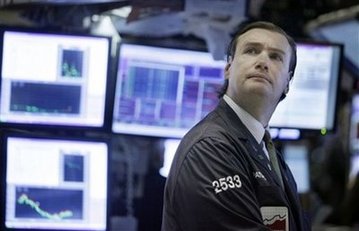 Specialist Patrick King works on the floor of the New York Stock Exchange Thursday, Feb. 4, 2010. [Agencies] |
Demand for safer investments sent the dollar and Treasurys higher and the euro falling. Major indexes skidded as much as 3.1 percent to their lowest levels in three months. The Dow fell 268 points and briefly traded below 10,000 for the first time since Nov. 6. The Dow's 2.6 percent drop was its biggest in seven months. And it was the ninth time in 14 days that the Dow has moved by more than 100 points.
Just 273 stocks rose on the New York Stock Exchange, while more than 2,800 fell. One of the weak performers was metals producer Freeport-McMoRan Copper & Gold Inc., which tumbled 5.3 percent. The few winners included Cisco Systems Inc. following a big increase in its earnings. Consolidated trading volume at the NYSE rose to 5.9 billion shares from 4.3 billion Wednesday.
The day's news reminded investors that the global economic recovery remains tenuous. It also raised questions about whether the market can resume its rebound from 12-year lows it hit last March.
The slide began in Europe on concerns about onerous debt levels in Greece, Portugal and Spain. Worries about those countries set off broader concerns that governments will have difficulty containing rising debts and borrowing more money to help revive their economies.
"The market is becoming aware that the wall of cash that lifted it last year is coming to an end," said Jon Merriman, chief executive of Merriman Curhan Ford in San Francisco.
|
||||


The drop in stocks was the latest leg of a stumble that began in mid-January. Stocks fell then in response to China's attempts to curb its overheated growth. Those moves raised fears that the other world economies could suffer as a result. The pullback in stocks worsened as leaders in Washington said they would impose tighter regulations on US banks.
Investors also worry that a slowdown in foreign countries would spill over to the US and make it harder for the economy to overcome its biggest problem: unemployment.
The Labor Department said Thursday that claims for unemployment benefits rose by 8,000 to 480,000 last week. The news disappointed investors who had hoped for a drop. It was the fourth increase in the past five weeks.
The jobless claims numbers chilled expectations that the government's January jobs report would show that employers added workers in the first month of the year. Analysts expect Friday's report to show that employers added 5,000 jobs in January. The government is also expected to report that the unemployment rate ticked up to 10.1 percent from 10 percent.
"You've got the recipe for a market in which my screen is entirely red," said Bernie McSherry, senior vice president of strategic initiatives at Cuttone & Co. in New York.
The Dow fell 268.37, or 2.6 percent, to 10,002.18. The Dow has fallen 723 points, or 6.7 percent, since closing at a 15-month high of 10,725.43 on Jan. 19.
The broader Standard & Poor's 500 index fell 34.17, or 3.1 percent, to 1,063.11, its steepest drop since April 20, 2009.
The Nasdaq composite index slid 65.48, or 3 percent, to 2,125.43.
In other trading, bond prices rose sharply, pushing yields lower. The yield on the benchmark 10-year Treasury note fell to 3.61 percent from 3.71 percent late Wednesday.
The Chicago Board Options Exchange's Volatility Index jumped 20.7 percent. An increase in the VIX, which is known as the market's fear gauge, is a sign that investors predict more big moves in stocks.
Demand for safety jumped as traders remained skeptical about Greece's plan to slash its budget deficit from 12.7 percent of the nation's gross domestic product in 2009 to less than 3 percent in 2012. Meanwhile, Portugal on Wednesday cut a planned treasury bill issue. And Spain said its deficits will be more than anticipated in the coming three years.
Charles Norton, portfolio manager of the ALPS/GNI Long-Short Fund, said the renewed questions about foreign governments' ability to finance their deficits are a sign that investors have been too optimistic in predicting a recovery in the world's economies.
Norton said signs of improvement in the US economy are less impressive than they first appear. The government said last week that the economy grew at an annual rate of 5.7 percent during the fourth quarter. A big part of that gain came from companies rebuilding inventories.
"They are the only sources of economic activity that we've seen so far," Norton said. "They're both likely to wane over the course of this year. Then what's left?"
The bad news on employment and European government debt overshadowed pockets of better-than-expected sales reports from some US retailers. Macy's Inc. raised its profit forecast after sales rose.
The rise in the dollar hit commodity prices and stocks of companies that produce them. Crude oil fell $3.84 to settle at $73.14 per barrel on the New York Mercantile Exchange. It was the biggest one-day drop in four months.
Aluminum producer Alcoa Inc. fell 58 cents, or 4.3 percent, to $12.91, while Freeport-McMoRan fell $3.72, or 5.3 percent, to $66.74.
Cisco rose 9 cents, or 0.4 percent, to $23.16. Macy's rose 43 cents, or 2.7 percent, to $16.67.
Energy stocks fell as oil slid. Exxon Mobil Corp. fell $1.88, or 2.8 percent, to $64.72, while Chevron Corp. fell $1.84, or 2.5 percent, to $71.37.
The Russell 2000 index of smaller companies fell 20.98, or 3.4 percent, to 589.68.
Britain's FTSE 100 dropped 2.2 percent, Germany's DAX index slid 2.5 percent, and France's CAC-40 lost 2.8 percent. Japan's Nikkei stock average fell 0.5 percent.