In mid-1945, a team of US soldiers liberated a Japanese internment camp in East China, freeing more than 2,000 foreign civilians. A young Chinese scholar was also a member of the rescue party, and 70 years later, he's still feted by those he helped to save. He Na reports.
Editor's Note: This is the sixth in a series of special reports about the experiences and influence of foreigners who either lived or served in China between 1937 and 1945.
 |
|
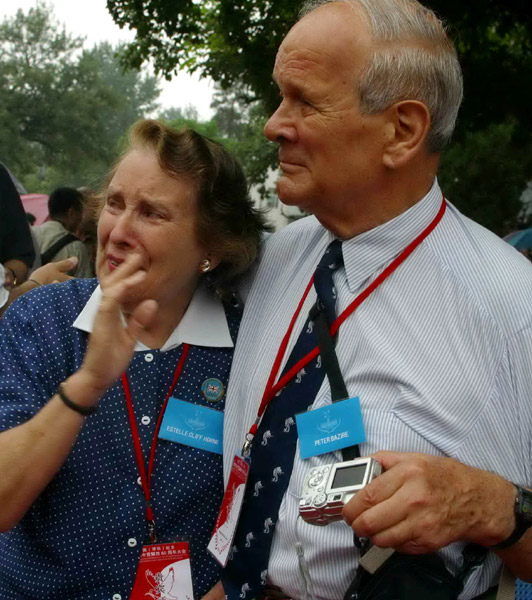
Estelle Cliff Horne and another former internee are unable to hold back tears when recalling the years they spent at the Weihsien camp in Shandong province. The pair are pictured during a visit in 2005. JU CHUANJIANG/CHINA DAILY |
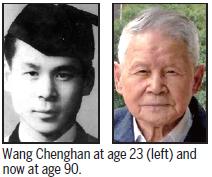
Wang Chenghan, also known as Eddie Wang, is not man who stands out in a crowd. Short of stature, gray-haired and with wrinkles on his face, the 90-year-old is virtually indistinguishable from the elderly people who can be seen dancing in squares across China as they take their daily exercise.
Appearances can be deceptive, though. In conversation, the retired engineer is an impressive person; he has excellent command of English and is deeply knowledgeable about engineering, but his charisma derives in part from an extraordinary experience he had 70 years ago.
In 1945, at the tender age of 20, Wang was the Chinese interpreter for a group of US soldiers who risked their lives by parachuting from a B-24 bomber to liberate Weihsien civilian internment camp in what is now the city of Weifang in Shandong province.
Change of status
The Japanese attack on Pearl Harbor in December 1941 immediately changed the status of Westerners in China's coastal regions, and in a matter of days they were transformed from untouchable neutrals into enemy aliens.
"The Japanese invaders established many camps worldwide and also in China to intern Allied Westerners, and Weihsien was the largest," wrote Mary Previte, an 82-year-old US national who was interned at age 9, in a recent e-mail exchange with China Daily.
In addition to Previte, who later served in the New Jersey General Assembly, about 2,000 people from 30 countries were interned by the Japanese Imperial Army for more than three years.
The detainees included past and future politicians, artists and scientists, such as R. Jaegher, a foreign-born adviser to Chiang Kai-shek, the Reverend W.M. Hayes, president of the former Huabei Theological Seminary, Olympic gold medalist Eric Liddell and Arthur W. Hummel Jr., who later became US ambassador to China.
According to Xia Baoshu, 83, a Weihsien camp researcher and former president of the Weifang People's Hospital, the camp was once the American Presbyterian Compound, but when the Japanese arrived, they placed electrified barbed wire on top of the walls, dug a moat outside the walls, and erected gun towers that were manned around the clock.
Former internees remembered the place with horror.
"Can you imagine it? I remember being trucked into Weihsien like an animal. My memories of the camp are awash with every kind of misery-plagues of rats, flies, bed bugs," Previte said.
The late Norman Cliff, a Chinese-born British missionary and writer, was 18 when he entered the camp. In his memoir, he wrote that every ounce of energy was spent acquiring fuel, food and clothing.
Angela Louise Cox, a Canadian internee, remembers the terrible conditions in the camp: "Sanitary conditions were very poor. The winters were cruel and there was a lack of medical care. But the overwhelming memory for the detainees was the lack of food." According to Cox, the internees were given three poor-quality meals a day, including thin millet porridge for breakfast every morning, but "it was ever enough".
Canadian Edmund Pearson, 79, a retired engineer and businessman who was 6 when he was interned, said that after being ravenously hungry for more than three years, he would eat almost anything.
"It took a long time before I could deal with the Japanese, even though as an adult I went to live in Hong Kong with my family and had to do business with the Japanese. The people are fine, but the government has never acknowledged what they did to us," he wrote in a 2014 e-mail to China Daily. "My personal encounters with Japanese businessmen happened when I was sent to live in Hong Kong in 1973 to 1975. They all denied being in the war, except for one person," he added.

Copyright 1995 - . All rights reserved. The content (including but not limited to text, photo, multimedia information, etc) published in this site belongs to China Daily Information Co (CDIC). Without written authorization from CDIC, such content shall not be republished or used in any form. Note: Browsers with 1024*768 or higher resolution are suggested for this site.
License for publishing multimedia online 0108263 Registration Number: 130349