Lack of experience
 |
|
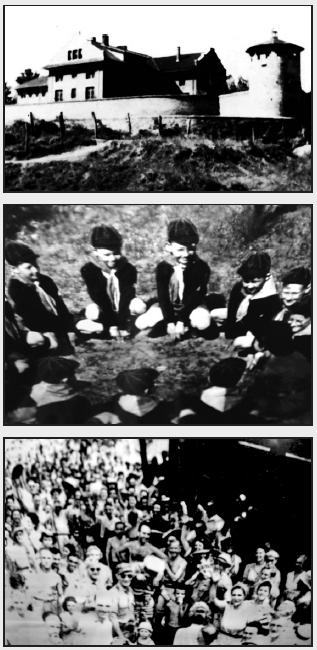
Scenes from Weihsien: From top: An exterior view of the Weihsien camp. A scout troop at the camp. Internees wave joyfully as the camp is liberated and they are set free. XINHUA AND PROVIDED TO CHINA DAILY |
Once the decision had been made to liberate the Japanese camps in China, the US military quickly organized nine missions, all of them named after birds. The mission to liberate the Weishen camp, codenamed "Operation Duck", was led by Major Stanley Staiger.
"Eddie Wang accompanied the team as the Chinese interpreter. The team bound for Weihsien flew from Kunming, Yunnan province, in a B-24 plane," Previte said.
Wang started learning English at high school in Chengdu, Sichuan province, and was a sophomore at Sichuan University when he joined the military in December 1944, although he had already undergone training in small arms, light machine guns, and the use of the high explosive, TNT.
Wang was recruited into a telecommunications group in Chongqing where he learned Morse code, and was then sent to interpreter training classes, and completed a 25-day course before being assigned to Operation Duck. His job in Weihsien was to translate anything to do with China for the benefit of the US soldiers.
Seven decades have passed, but Wang still has clear memories of almost everything that happened during the mission. The only thing he cannot recall fully is the parachute jump. He had only received basic training on fixed simulation equipment, and had never actually jumped from an airplane until that day in 1945.
"I always worried making about a real jump. Fortunately, the parachutes used on the mission deployed automatically, which saved my life. When I jumped from the plane, the sudden strong flow of air made me dizzy, almost unconscious," he recalled. Despite his lack of experience, Wang landed safely.
An ecstatic welcome
By early 1945, the Japanese were losing ground in most of China and their defeat was almost assured. The news was withheld from the internees, though, and it wasn't until the arrival of the B-24 on Aug 17, 1945, that they knew their long days in hell were over.
"We wept, hugged, danced, and waved at the plane circling overhead. People poured to the gate to welcome the heroes. All the internees were celebrating liberation, and they even cut off pieces of parachutes, and got rescuers' signatures and buttons to cherish," Previte said.
Wang remembers the warmth of the welcome he and the other members of the group received. "We landed almost a mile away from the camp in the fields of Gaoliang, and were welcomed by the internees. We took over and stayed in what had been the small Japanese headquarters building, not far from the entrance of the camp," he said.
He said two teenage girls taught him to dance after the camp was liberated. "A Greek girl also gave me a piece of parachute silk embroidered with the rescue scene and autographed by all seven liberators, including myself," he said.
Despite the welcoming scenes and the smooth takeover of the camp, the soldiers were fully aware that their mission was a dangerous one.
"Japan had surrendered, but it wasn't known whether all the troops had received the order to surrender, especially those in remote places. For the rescuers it was a life threatening task," said Wang Hao, director of the Weifang Foreign and Overseas Chinese Affairs Office.
Previte recalled that Ensign James W. Moore, one of the US party, told her of the men's concerns at the time. "Would the Japanese in these outposts know that Japan had surrendered? Would it be peace, or would it be guns bristling like needles, pointing at the sky?" she said, paraphrasing the young soldier's words.
Moore also told Previte that the officer commanding the team, Major Staiger, decided that the plane would approach at low altitude, reasoning that they would lose fewer men and less equipment if the Japanese had less time and space to shoot at them and their parachutes.
Endgame
Although Wang finds it difficult to recall the parachute jump, many former internees, including Previte, witnessed the scene. None of them ever forgot the excitement they felt when they saw the emblem of the US Air Force emblazoned on the giant plane.
"It was a Friday. In a scorching heat wave, I was withering with diarrhea, confined to a mattress atop three side-by-side steamer trunks in the second-floor hospital dormitory. Inside the barrier walls of the concentration camp, I heard the drone of an airplane far above the camp," Previte recalled.
Sweating and barefoot, she raced to the dormitory window and watched a plane slowly sweep lower and lower, and then circle again.
"It was instant cure for my diarrhea. I raced for the entry gates and was swept off my feet by the pandemonium. Prisoners ran in circles and pounded the air with their fists," she recalled.
"I watched in disbelief. A giant plane emblazoned with the American star was circling the camp. Americans were waving from the bomber. Leaflets drifted down from the sky," she said.
Weihsien went mad.
After the war, Wang graduated from Sichuan University and became an engineer. He retired in 1990, and has only revisited the camp once, during a business trip to a nearby city. Almost every memento of the raid has either been lost or misplaced over the years, and the only things he has left are a battered duffel bag and his memories. "Objects aren't important," he said. "It's enough to know I helped to make a difference."
Contact the writer at hena@chinadaily.com.cn
Ju Chuanjiang contributed to this story.

Copyright 1995 - . All rights reserved. The content (including but not limited to text, photo, multimedia information, etc) published in this site belongs to China Daily Information Co (CDIC). Without written authorization from CDIC, such content shall not be republished or used in any form. Note: Browsers with 1024*768 or higher resolution are suggested for this site.
License for publishing multimedia online 0108263 Registration Number: 130349