Supervisory commission key to effective governance







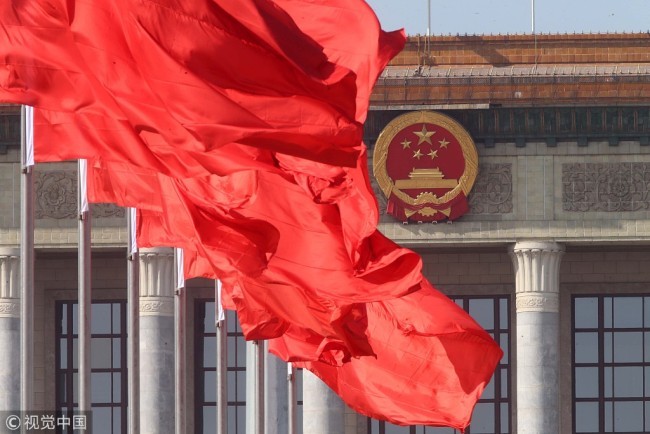
China's Constitution is the general statute for governance. The Communist Party of China Central Committee has suggested a section on supervisory commission be added to the Constitution to establish the commission's legal status.
The Party's decision is of strategic importance, as it will lay a solid constitutional foundation to strengthen the Party's leadership in the anti-corruption campaign, and establish a unified authoritative, efficient supervision system to bring all staff who exercise public power under its coverage.
Coordinating efforts to deepen reforms
Adding the section on supervisory commission to the Constitution is a big adjustment of the political institutions, power and relations. It represents an important top-level design of the planned national supervisory commission, which will help strengthen the Party's leadership in the anti-corruption campaign. The move will also provide the constitutional basis for making the supervision law and establishing supervisory commissions at various levels.
Deepening the State supervisory system reform is an important and strategic decision to strengthen the self-supervision of the Party and the State, and to strengthen the Party's leadership. The biggest advantage of socialism with Chinese characteristics is the Party's leadership. Whether the Party can ensure effective supervision in exercising power, and explore an effective path of "self-purification" will decide the future of the causes of the Party and the State.
There should be an effective mechanism to integrate inner-Party supervision, State organ supervision, democratic supervision, judicial supervision, people's supervision and public opinion supervision to ensure the problems are timely solved.
Inner-Party supervision has been strictly reinforced since late 2012. But it still does not cover all civil servants, as some of them are not Party members. The establishment of the supervisory commission system, which in itself is a kind of self-supervision of the Party and the State, will ensure that officials exercising power are brought under the purview of the supervisory commissions.
Writing the supervisory commission into the Constitution reflects the Party's supervisory role and the people's will, providing legal guarantee for the deepening of supervisory institutional reforms. The proposed section on the supervisory commission has specific rules in terms of the commission's nature, status, name, personnel and tenure, and leadership and work systems, providing the basis for the commission to fulfill its duties.
Endowing the supervisory commission with constitutional status will strengthen the fight against corruption, which, despite its achievements, remains complicated. An important purpose of the supervision system reform is to strengthen the Party's centralized leadership in the anti-graft drive.
The establishment of the supervision system, which will coordinate the functions of the personnel in charge of investigating duty-related crimes and corruption in the Party, the government and the judicial system, is an important anti-graft institutional reform. And the supervision law will accord further legal status to the supervisory commission to conduct investigations and define its duties and authority, and thus bring the anti-graft work under greater legal regulation.
Understanding the rules of supervisory commission
The proposed constitutional amendment dedicates a whole section to the supervisory commission, which reflects the commission's importance in the State governance system and provides a basic guarantee for the supervisory commission to fulfill its duties, as well as for deepening the supervision system reforms.
As the proposed constitutional amendment indicates, the supervisory commissions at various levels are the State's supervisory authorities. It is an innovation, based on the practical national conditions, to strengthen the supervision over all staff who exercise public power.
The supervisory commission will work with the Party's discipline inspection committee. But it will not be an administrative or judicial organ. Directly under the Party's leadership, it, on behalf of the Party and the State, will supervise all public power holders, and target all duty-related unlawful and criminal activities.
Besides, the supervisory commission will also be in charge of carrying out ideological and political work.
The proposed constitutional amendment stipulates that the supervisory commissions' chairpersons will be elected by the people's congress at the same level, and can work for not more than two consecutive terms, making clear the responsibilities of the supervisory commissions.
When a supervisory commission exercises its powers in important matters, it should first obtain the approval of the Party committee at the corresponding level, and the supervisory commission will be answerable to the corresponding people's congress.
The cooperative and restrictive relations between the supervisory commissions and the other organs must be properly understood. The proposed constitutional amendment says the supervisory commission will exercise supervisory rights independently, and will be immune to interferences from administrative departments, social organizations and individuals.
When the supervisory commission will process duty-related unlawful and criminal cases, it will cooperate with and restrain the procuratorates and law-enforcement departments, and individuals and the related departments should cooperate with the supervision commission to help it exercise its supervision rights.
In practice, the Party watchdogs and the supervision organs already have mutual cooperation and established checks and balances with judicial organs and some law-enforcement departments.
Improving the supervisory system of Party and State
The proposed constitutional amendment represents the correct political direction, signifies the organic unity of the Party leadership, the people running the country and law-based governance. It is necessary to implement the proposed amendment, in order to lay a solid foundation for its adoption at the first plenary session of the 13th National People's Congress, China's top legislature.
The proposed amendment also highlights the CPC Central Committee's strategic planning, and will raise the people's awareness of the Constitution.
The supervisory institutional reforms must be deepened, and expanded to other areas, following the pilot projects in Beijing, and Shanxi and Zhejiang provinces, in order to ensure law-based governance.
It is crucial to adhere to and strengthen the Party's leadership, bring the entire supervision system under the Party's unified command, integrate inner-Party supervision, State supervision, judicial supervision, people's supervision and public opinion supervision for effective overall supervision.
Also, the supervisory commissions should be subject to inner-Party and public supervision, so as to ensure supervisory officials do not abuse power.