Trade war: Whoever 'wins', we lose







Well, here we are, standing at the brink of a trade conflict no one wanted —with the possible exception of United States President Donald Trump.
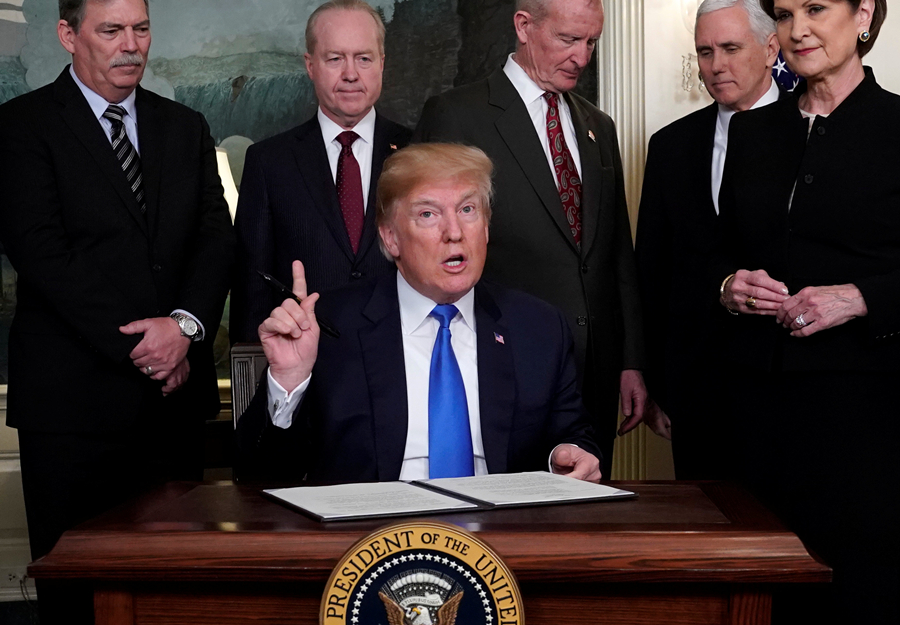
After endless bluster, it appears he is finally putting action to his words when it comes to trade with China. On Thursday, Trump signed a memorandum instructing the US Trade Representative to levy tariffs on an estimated $50 billion in Chinese imports, with a list of products likely to be affected within 15 days. The move comes in response to perceived "discriminatory practices" regarding intellectual property.
Naturally, the Chinese government has proposed its own set of tariffs, expected to affect 128 different US goods with a total import value of $3 billion. Though it is a fairly reserved countermeasure —one taken in response to steel and aluminum tariffs levied against China earlier this month — it has prompted fears of a trade war between the two countries, panicking investors and sending stocks reeling on both sides of the Pacific.
Trump is demanding China reduce the supposed $375 billion trade deficit between the two countries on the order of $100 billion to ease the tension. That deficit estimate, however, is based on outdated economic models which don't take the bigger picture into account. In the modern, globalized era, imports have components from all over the world. Take the iPhone as example — an American-branded smartphone responsible for a large portion of the deficit. The Trump administration's reckoning of the imbalance gives full value for the finished product which is assembled in China, even though the phone itself carries parts from Japan, Korea and other countries. NDTV pegs the actual trade deficit, using more accurate value-added terms, at around $236 billion. Trump could comply with his own ridiculous demands by using a fairer methodology. "Problem" solved.
That would be an easy, painless solution, but not the kind that grabs headlines. As we’ve seen, demonizing China is a quick, simple way to get attention. Doing so while calling them "friend" is typical of Trump's near-incoherent positions on the issues. This move, like so many others since his inauguration, feels like a desperate attempt to stay relevant on the world stage.
China's policies have allowed its domestic high-tech industries to flourish, and the country is well on its way to wresting the title of top innovator from the US. Rather than accept this change in the economic order gracefully, the US is instead choosing to have a tantrum, and punishing its own people in the process.
Though China is moving toward a high-quality growth model and building up its advanced industries, it continues to hold advantages in agriculture and manufacturing the US can't hope to match. The tariffs are expected to primarily hit emerging Chinese sectors like new-energy vehicles and technology, but there are markets elsewhere for most of these products. If Trump pushes for higher taxes on essential consumer goods, however, buyers used to low prices will begin to wonder just who is responsible for the extra strain on their wallets.
And that doesn't even begin to describe potential downsides to the president’s rash actions. Many of the high cost, non-staple products Trump's tariffs will hit are owned by US companies — remember the iPhone? — and rely on Chinese labor to lower expenditures. Those businesses will be none too happy to see their sales drop due to irate customers finding other uses for their disposable income.
Meanwhile, China's import taxes will target industries with a strong presence in states that went Trump’s way in the 2016 election — creating political consequences as well as economic ones for his administration. As for the US products listed by the Ministry of Commerce, Chinese consumers have plenty of alternatives to choose from. The migration of China's massive customer base to European or domestic fruit, nuts and pork will do severe harm to an already struggling US agricultural sector. There's little to gain and everything to lose in a trade war, and this is but a skirmish.
It's sad Trump has chosen this path, but it isn't shocking. After all, he spent half the campaign going on about how the countries' trade deficit was "the greatest theft in the history of the world". He never really offered specifics on this, of course — Trump was never one for details or facts when it came to the US-China relationship. It was more important to rile up his xenophobic base with long-debunked myths and falsehoods about a country few Americans have seen for themselves. And, to his credit, it worked.
Yet these moves by the US are more than idle rhetoric on the campaign trail. They're real policies, with real-world consequences. It should surprise no one when China chooses to respond.
The overwhelmingly negative reaction from US businesses and lawmakers to this abrupt policy shift tells the real story — a trade war with China will hit the US where it hurts, and will do far more harm than good to consumers. Either Trump knows this and does not care, or is just plain ignorant. Given how the country handles other matters under his leadership, it’s not too tough a guess.
The author is a copy editor with chinadaily.com.cn.
The opinions expressed here are those of the writer and do not represent the views of China Daily and China Daily website.